Week 2 Questions – Tintin
What issues do his albums raise in terms of representation of ‘race’, and particularly ethnic and cultural stereotyping?

The legal dispute began in 2007 when Congolese Belgian citizen Bienvenu Mbutu Mondondo filed a lawsuit against the release of the comic book, claiming that the comic book is full of racial demeanor. Mbutu argues that “it makes people think that ‘black people are savage’.”
However, the law ruled, “It is clear that this cartoon came out in 1946, when colonial thinking prevailed, and it was not intended to create a threatening, hostile or contemptuous atmosphere in the plot.”
Mbutu’s lawyer said, “Mbutu will hold on to this case as far as possible,” and said he will appeal.
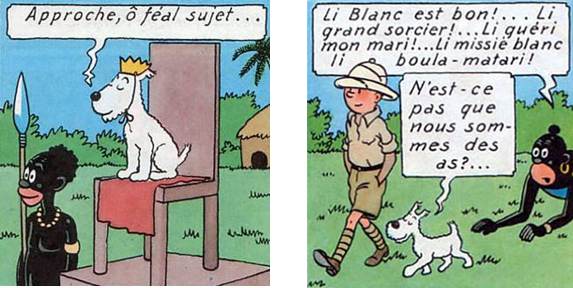
The first edition of the controversial book, <Tintin in the Congo> was published in 1946 when Congo was under Belgian colonial rule. Cartoons have explicit white supremacist views everywhere, with black natives lying flat behind Tintin and puppies, saying, “White people are very great and spiritual,” or riding on a palanquin. Tintin series portrays not only blacks but also Asian and Native Americans as a silly and barbaric image.

Hergé said in a media interview during his lifetime, “When I drew <Tintin in the Land of the Soviets> and the <Tintin in the Congo>. I was fed the prejudices of the bourgeois society that surrounded me, Africans were great big children andI drew cartoons based on that standard,” he once confessed.
Historical background
After the success of <Tintin in the Land of the Soviets>, Hergé wanted to send Tintin to the United States, but Norbert Wallez, the editor of the far right, instructed Hergé to draw a story that took place in Belgium’s ruled Congo. Wallez believed that Belgium’s colonial rule of the Congo at that time needed to be promoted, as Tintinist Michael Farr Pa pointed out. It was in 1928 when the memory of Belgian King Albert and Queen Elizabeth’s visit to the colony was still vivid. During Leopold’s reign, about 10 million Congolese died in brutal rule, such as cutting off their hands if they failed to meet their quotas. Hergé later sarcastically referred to the Congolese as “our beautiful colony that needs us very much.”

On a comparative note, a parody comic book with such racist characteristics has also been created. South African cartoonist Anton Kannemeyer (1967–) tackled the issue of racial relations and imperialism by using the style of <Tintin in the Congo>. He parodies this with Pappa in Afrika (2010), where Tintin is depicted as a white African resident, white liberal or racist, white imperialist. It satirizes the stereotype that whites are superior, knowledgeable and civilized, while whites are barbaric and stupid.
Reference
Independent Digital News and Media. Herge’s ‘racist’ adventures of Tintin? Not so, court decides. The Independent. https://www.independent.co.uk/news/world/africa/herges-racist-adventures-of-tintin-not-so-court-decides-6894770.html.
Vrielink, J. (2012, May 14). Effort to ban Tintin comic book fails in Belgium | Jogchum Vrielink. The Guardian. https://www.theguardian.com/law/2012/may/14/effort-ban-tintin-congo-fails.
Wikimedia Foundation. Norbert Wallez. Wikipedia. https://en.wikipedia.org/wiki/Norbert_Wallez.
유럽 만화의 아버지 에르제. gabiadesign. (2019, June 3). http://design.gabia.com/wordpress/?p=33469.
화상. 에르제 [Hergé] – 벨기에 만화가. 필라테리아. http://m.blog.daum.net/philook/11247978?np_nil_b=1.
 Pop Genres 2020