What is the philosophy of cosmicism and how is it used to convey a sense of dread in both The Shadow Over Innsmouth and The Colour out of Space?
Cosmicism is a philosophical view symbolizing cosmic fear, which refers to the overwhelming despair and fear of space, disaster, and transcendental God, which appear in places like the unknown, deep-sea, and cosmic world that we have not yet recognized. Even in Lovecraft’s novel, the theme is the fear of extraterrestrial species with secrets that give us the mystery of the universe that humans cannot know or fear, which can be seen as Cosmicism. Cosmic horror is a sub-genre of horror that utilizes Cosmism. Cosmicism is based on fear, which is told with important feelings in myths and religions. These Cosmic horror are written on the subject of human fear and end nihilism in a dystopian atmosphere. Especially easily seen around us, “Alien” and “Budbox” and “The Mist” are well-known cosmic-themed films in which humans are brutally attacked and killed by unknown alien species and supernatural beings.
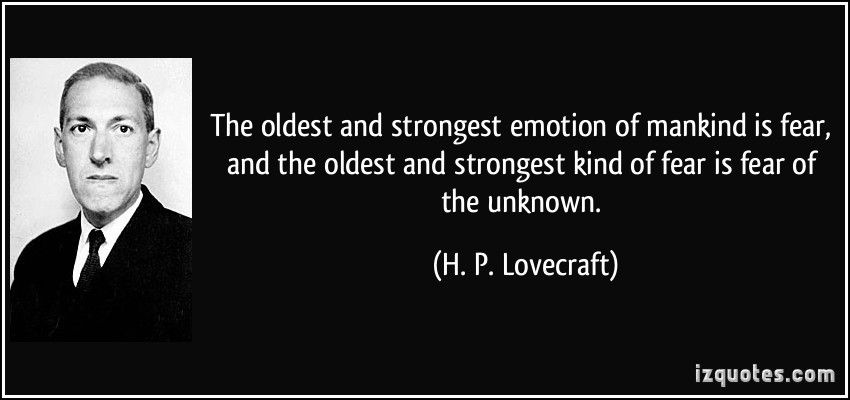
Lovecraft said this in his essay book. It is a sentence that reflects Lovecraft’s opinion of fear. To describe Lovecraft’s philosophy of work in one word, it is Cosmicism. The fear expressed in his novel has a distinct element from the visual and auditory fear revealed in the general work. The fear of unknowns, vast universes, or beings that cannot be seen, heard, or felt, is revealed in the work. The images and moods of these horror descriptions serve as a tool to express his unique sense of subject matter very well. Cosmicism is a philosophical view of fear.
Lovecraft’s creation, Cthulhu, also sleeps deep in the sea, and Dagon s also a monster living in the sea and his subordinate species, respectively. In the West, people are disgusted by marine animals, and in the case of deep-sea creatures, they are more disparate in appearance.

The outward grandeur or creepy external portrayal of the extraterrestrial life, Old One, and Shogos or architecture can be frightening.
There could be a violent situation and a primal fear of death being slaughtered by them. However, the theme of “human beings are very insignificant” in the absolute ancient alien civilization is a typical characteristic of Lovecraft’s Cosmic Horror. This is quite out of the ordinary plot.
The horror monster shown in the general myth is the object of Oedipus overcoming. However, the monster in Cosmic Horror is like unknown mother nature that humans cannot resist.

The distinction between traditional cosmic horror is that the genre deals with cosmicism, or unknown fear, and cosmic fear. This sense of subject sets the plot apart. Thus, in general, works of the Cosmic Horror genre are tragic. In particular, Lovecraft’s unique horror philosophy is contained in “Shadow over Innsmouth”. Human beings are weak and cannot solve cases in the climax. Experience the greatest fear in the climax and fall into despair. As a result, many works face tragedy at the end of the play or merge with fear, as Nietzsche said.
Reference
Stableford, B. (2006). The cosmic horror. Icons of Horror and the Supernatural: An Encyclopedia of Our Worst Nightmares
Cosmicism. (n.d.). Retrieved September 06, 2020, from https://en.wiktionary.org/wiki/cosmicism
The H.P. Lovecraft Archive. https://www.hplovecraft.com/.
 Pop Genres 2020