What gaps are there in Hergé’s representations of women?
In the story of the adventure of Tintin, women have always been disadvantaged. The image of women portrayed by Herge is basically neglected or rarely appears, even if they appeared, they are only referred as second-class characters as clumsy, foolish and suppressed by men. Just ike racial discriminations by Herge with intense meaning of stereotype.
Herge utilized the way that men are superior to women. As according to Mountfort (2020),’ Women have nothing to do in a world like Tintin’s’ shows the neglect of women, and the ability of women is worse than men, even if women are given some of the most important roles but merely to help men with chores as a secondary unit to men in order to reveal that men are superior to women. Nevertheless, the way Herge narrated women in his book has never drawn much criticisms, because, in the traditional era men supremacy was very common in every field of society at that time, this can be said as attributed by the patriarchal system at the time. As according to (Santos, 2019), patriarchy refers to the division of power based on gender, emphasizing the power operation mode of advocating masculinity and despising femininity, which means that women are always been devalued object, and compliance to men is the only option for women.
Many feminists advocate challenging patriarchy, they believe that patriarchy is the oppression of women and the main factor leading to gender inequality. However, as womens’ employment and education levels increase with times, the conditions and values of women have much improved, but the influence of the traditional patriarchal structure on many levels such as social habits and systems is still huge (Santos, 2019). At least, film and television work with sex discrimination rarely appear on the market. And the adventure of Tintin film directed by Steven Spielberg also used a rational way to eliminate stereotyped images of women, at least without any discrimination or harm (FEM, 2012).
What issues do his albums raise in terms of representation of ‘race’, and particularly ethnic and cultural stereotyping?
The stereotype is a fixed term of the impression, it is a kind of fixed impression instilled in the minds of people to derive a solid view towards particular people and things. The scope of the stereotype usually including race, gender, culture, country and politic. In society today, these opinions or views mainly come from the multimedia transmission, including news, film and television and entertainment works, which involve an ironic impression of others. For example, Asians know martial arts, French and Italians are very lively and romantic, Black Africans are very athletic, and women are the worst drivers (Quinn & Neil, 2007, P.2-3). Whether it is a positive or negative stereotype, it is always disgust people.
The adventure of Tintin’s comics created by a Belgian cartoonist Hergé, which involves many controversial racial ironies. From the perspective of dialogues and narratives of Tintin, Herge utilized various stereotypes to depict other races to highlight his own racial superiority. For example, in “Tintin in the Congo” refects the colonial attitudes over African ethnic groups, in which Black Africans are portrayed as lazy, slaves and unintelligent like childish people who speak in pidgin French (Mountfort, 2020). Tintin even refers to Belgium as the fatherland of African, meaning European people are superior over Black African (Mountfort, 2020).
In the Blue Lotus where the plot set in China, there are still many discrimination or contempt meanings towards the Chinese nation, which characterized the view of the world towards the Chinese, like how Herge narrated in Congo. For example, the Chinese were depicted as pigtailed torturers, also implies the Chinese government as brutal (Mountfort, 2011, P.30-35), just as most of the Western media criticizing the government of China today, as “commie” as a “tyranny regime” and without fairness judgement of good side of the Chinese government(Wu, 2010, P.1 & 5). In the story, there are also abusive dialogues towards Chinese people as dirty little yellow Chinese. When Herge describing the invasion of the Japanese in China, Herge did not consider views and feelings of the Chinese ethnic group (Mountfort, 2011, P.38-42). Besides, the adventure of Tintin also involves racial discriminations on Muslims, Indigenous peoples of the Americas and people of the Soviet Union. It despises the patriotism of the Soviet Union people is because of brainwashed by propaganda (Ha, 2015), which indirectly implies that the patriotism of Westerners is because of cleverness. Herge uses stereotypes throughout “Tintin”, and negatively described different races.
As for the reason why Herge had a discriminatory description, it can be said that the main reason was due to the environment in which he lived in Europe at the time, so the information he received was all positive news about the Western or negative news about other countries. As according to Mountfort (2020), Herge was subjected to the prejudices of the bourgeois society and under the purely paternalistic indoctrination during 1930, so he narrated those other non-Western ethnic groups based on the standards Herge received or heard. Furthermore, Herge was within in a European environment at the time, so he did not have a broader international outlook regarding the cultures and situations of other countries. As according to (Ha, 2015), Herge was only 22 years old who had never left Europe when he started drawing “Tintin” comic book, besides, it was a period of prosperity for Western civilization and modernization.
Mountfort, P. (2011). ‘Yellow skin, Black hair … careful, Tintin’: Hergé and orientalism. Australasian Journal of Popular Culture, 1(1), 33-49. https://doi.org/10.1386/ajpc.1.1.33_1
What are some of the problematics around cosphotography in terms various (potentially unwelcome) gazes?
Unwelcome gaze in cosplay mainly comes from the crowd of photograph shootings, and most of these crowds are known as male gaze, and these male gazes will be specifically towards on female cosplayers and making female cosplayers feel distressed. Several factors can be discussed for this type of problematic gaze.
First of all, there are a large number of females participating in the cosplay community. The main reason is that females tend to prefer to express themselves on the platform stage. As according to (Leng, 2014, P. 97-99), it is the nature of women to dress up beautifully, and they prefer to show their own characteristics. As a result, cosplay platform has become a performing stage for females to express their beauty and self-confidence. Just as Mountfort (2018, P.48-53) said, cosplay has become the yearning performance of many females as a culture of “Do It Yourself”, that is to say by playing their favourite fictional characters to benefit the audience or spectators, and then through the responsive feedbacks of audiences to satisfy their desire for beauty. However, this phenomenon could attract many unwelcome gazes from male spectators inevitably.
Second, high population of male audiences. If women are performers, then men are the admirers or enjoyers who are here to appreciate the elegance of female actors, Just like the 5th element of cosplay described by Lamerich, the male audiences are also part of cosplay process in guaranteeing the so-called authenticity” (Mountfort, 2018 P. 58), by taking photos and requiring particular poses of cosplayer, as long as not to breach the limit of the personal boundary, cosplayers are willing to accept or cooperate. However, some photograph audiences might overexcited and likely to request excessive requirements. For example, too much demand for sexual demands(poses) will also cause distress to female cosplayers. Furthermore, the main reason for the high population of male audiences in cosplay exhibition show is that males tend to focus on their favourite hobbies; such as appreciating or enjoying anime, video games, collecting items, etc., so they are particularly sensitive and even excited about females cosplayers to play their favourite visual female characters, this is also one of the phenomena of so-called otaku culture like in Japan (Ikeguchi, 2018, P.251-253).
Thirdly, the scope of female cosplay, specifically on female cosplayers in which if the female character that female cosplayer play is too sexy, such as the character like “Chun-Li” in Street Fight or “Mai Shiranui” in King of Fighter, it is easily to attract a lot of unnecessary or unwanted attentions including sexual harassment and stalker (Leng, 2014, P. 107). However, if the characters they played are categories like ugly, funny, horror, or a female playing a male role, there will be no harassment of being physically assaulted, because usually male is stimulated by the female due to the way of dressing.
Finally, the gaze of laymen or an outsider of cosplay community is another unwelcome gaze, these people are also one of the audiences, but their purpose is not to appreciate the efforts of cosplayers, instead, to offset their performances by some kind of abnormal behaviours. For example, some audiences will use sharpness eyes to make performances decline or to make cosplayers scared and nervous. Another is the unwelcome gaze is much more like discriminative gaze, where these outsider audiences will laugh and joke cosplayers by photo-taking their imperfect or flaw of the cosplayers. For example, these outsider audiences are likely to upload the imperfections of cosplayers, to ridicule in a stereotypical way including their looks, body shape, and even ethnic race which is equivalent to a personal assault that declines their confidence and dedication (Mountfort, 2018, P. 62-65).
Mountfort, P. (2018). Cosphotography and Fan Capital. In P. Mountfort, Peirson-Smitth, Anne, & A. Gaczy, Planet Cosplay (pp. 45-74). Bristol: Intellect Books.
What genre or genres is Princess Mononoke? How does it relate to its ‘prequel,’ Nausicaā ?
Princess Mononoke is a fictional genre or a subgenre of fiction which related to the adventure fantasy and natural ecological enlightenment. “Princess Mononoke” is always referred to as a prequel to “Nausicaa of the Valley of the Wind”, so here are three perspectives including; historical settings, genre setting and the compensation of the Author to rationalize the prequel statement.
On the historical setting, “Princess Mononoke” is set in the background of the Muromachi period in Japan around the year from 1392 to 1572. It is an era for the flourishing of art and literature such as Noh theatre, Zen garden and tea ceremony, and prosperity of commercial, agricultural and architectural (Mounfort, 2020). The author Hayao Miyazaki utilized visual effects to depict the features of the Muromachi era such as the Shinto Shrine and other Japanese-style buildings to represent the symbol of the establishment of Japanese culture and relics (Cavallaro, 2006). While the setting Nausicaa is set in the postmodern or near-future collapsed world, because of the Apocalyptic war, civilization declined, created the vast toxic jungle, and giant mutant insects that can be seen everywhere (Miyazaki & Takahata, 1984). The two have one thing in common which is the militarism, in both stories, there is this kind of military group, behind the group there is always a warlord leader with arrogant ambitious like Lady Eboshi, Kushana and Kurotowa, they will trample innocent lives without hesitation as well as environmental destruction for the sake for the power and interests (Miyazaki & Takahata, 1984). As according to Mountfort (2020), most of Miyazaki’s films portray the dangers of militarism, problems include nationalism and the spectre of the arms race, and meaningless implicit criticism of the war.
In terms of genre setting, both “Princess Mononoke” and “Nausicaa” are eco-fable, as both stories are adventures for the purpose to prevent humans from destroying the natural ecology. The only difference is that “Princess Mononoke” has inserted many myths, spirits and gods into the story. For example, other than the protagonist “San” has psychic abilities to communicate with animals and gods, animals, the animal characters who pose with god’s spirit like Kodama (the souls of the forest), Nago (boar-God) and Okkoto (Old boar-God) represent the anger towards the destruction of nature by humans, and further expanded the “fantasy” element of “Princess Mononoke” and created essentially a personal myth (Cavallaro, 2006). The most prominent is that Hayao Miyazaki utilised the Shishigami character (forest spirit and Night Walker) as the nature itself to convey the message of nature, and implies that the development and destruction of greed will eventually lead to the destruction of mankind. Nausicaa, on the other hand, is a pure fantasy type anime without mythological elements, the author only used the role of Nausicca as the mediator for between mankind and nature through communication with animal and ecology, just like the character Nausicaa from Homer’s Greek epic the ‘Odyssey’, and with the combination of Japanese mythology featuring a girl who could be able to interact with animals and eco-environment (Mountfort, 2020).
The compensation of the author. As mentioned above, although “Princess Mononoke” implies that the development and destruction of nature will eventually lead to the destruction of mankind, I think that after “Princess Mononoke”, mankind still caused disasters to nature for the sake of prosperity which henced the collapsed world of Nausicaa. As according to the Miyazaki himself, that he did not intend to solve the global problems from “Princess Mononoke”, and claimed even the war between the forest gods and mankind did not end successfully or even the hatred and massacre are continuing, that still cannot stop humans from over-enjoying or excessive-using resources from nature as there are still many places to survive(Cavallaro, 2020). Furthermore, Miyazaki did not satisfied with “Nausicaa” as he feels very sloppy about the setting of Nausicaa, many aspects including the setting of the world, have not been explained enough of why it constructed on this way (Vavallaro, 2020). Therefore, “Princess Mononoke” was created as a supplement for the lack of settings of Nausicaa. In other words, “Princess Mononoke” explains and paves the setting of Nausicaa’s world.
What distinctions are there between alternate history, postmodern alternate history and uchronie genres?
Alternate history is classified as fictional or subgenre of historical science fiction. The creation of Alternate history is mainly focused on the doctrine of “WHAT IF”, that is, what happens next if a certain historical event changes. It’s like Nazi Germany and the Empire Japan in the “Man in the high castle”, who defeated the Allies in the WWII and then divided the world and the United States, this is the world in the story where the protagonists begin their adventures and battles (Mountfortl, 2020). From the perspective of “Man in the high castle”, alternate history is set in real history and a certain event, the only critical element is swapping the roles of the two sides. For example, the Axis became the winner of WWII who supposed to be the defeats, while Allies became defeats who supposed to be the victors of WWII. This is also the most fascinating part of alternate history; the “what if” concept makes the audiences curious about the genre.
Postmodern alternate history, on the other hand, is very similar to the original alternate history, but postmodern alternate history focuses on a single event known as synchronic, where a threat must be stopped in order to save the world or by doing something to prevent a certain disaster happening. It also combines many postmodernism concepts like postmodern relativism, which emphasizes pluralism in favour of multiple coexistences (Mountfort, 2016).
Uchronia is a French term, which combines the concepts of alternate history and postmodern alternate history, and with the combination of Pure Uchronia, Pural Uchronia and Infinite Uchronia. Pure Uchronia refers to a single alternate history that has been changed by a certain act. Pural Uchronia refers to there is more than one world within parallel time and space. Infinite Uchronia, in which there are many or even countless different parallel worlds (Mountfort, 2016). In the story of “man in the high castle”, from the original single alternate history, due to excessive frequent deaths caused parallel time and space imbalances, thus created the possibility of travelling through time and space into different parallel worlds, and each parallel world has different development and consequence because of different major choices made (Scott & Cedar, 2020).
The most prominent hint of “man in high castle” is that every change or decision would lead to a good or bad fate. The director Philip Dick used the elements of alternate history, postmodern and Uchronia to turn the tragic alternate world into as good as the original real world. For instance, in the story, the protagonist Alexa, inspired by the Book I-Ching, found the way the United States should be by traversing into the original world. Finally, together with the resistance groups successfully overthrow the colonization of Japan and Germany, and re-established the United States as wonderful as the United States in the original real world (Scott & Cedar, 2015-2019).
Can reality tv still be thought of as a genre given the high level of hybridity that exists?
As discussed in the previous lesson, Reality TV is a TV show with combined elements of documentary, free cinema, direct cinema and documentary TV. In the modern era, Reality TV is equipped with many entertainment and special effects, which is what we know as Reality TV (Smith, 2020).
Reality TV can be said to be the hybrid reality genre. As according to Wood (2004), Reality TV is a kind of hybrid programme with expression elements of fact, fiction, entertainment and advertisement. Fact; is the discourse of sobriety that represent the state of affair of the real world. Fiction; is a unique imaginary domain of creativity. Entertainment; like exhibition activities such as concert, competitions and game shows, convoy a theatrical sense of reality as performance. Advertisement; promotion of particular a product which reveals the material reality with magical inducements and satisfactions.
However, this explanation is too perfunctory, because with the evolution of the times, the expansion of the media and the continuous improvement of technology along with the economic solution. Therefore, Reality TV has also derived a diversified state via re-enactment, diversion, absorption and infomercial. Re-enactment, the use of fictitious technology to create continuity of context, is to establish reality through fictional events. Diversion is an entertainment mode that diversifies the original monotonous form into extraordinary form through diversified methods. Absorption, a reconstruction method by combining with factual reference and fictional technique to enhance the dramatic impact. The infomercial is the combination of advertising and current affairs, which narrates the story of the product by utilizing news broadcasts method along with the explanation of experts and consumers (Wood, 2004).
Reality TV can also be said to be a diversified genre, which combines many aspects of fine follow. As according to Author, Reality TV was first derived from Tabloid Journalism and popular entertainment in its early history, combined with recording method of documentary TV (Hill, 2005). If combined with the development notions of re-enactment, diversion, absorption and infomercial mentioned by wood (2004), then it is the so-called formats of infotainment, docu-soap, lifestyle and reality game show. Infotainment is a combination of information and entertainment, usually reporting a major event including “hard news”, interviews, interviews with celebrities and stories with drama, a compelling event or a trend, representing the spirit of the times, despite these The topic is often not current affairs news at all, but attracts the audience to know some new information (Hill, 2005). Docu-Soap is the combination of observational documentary and character-driven drama. To put it simply, it is to record the facts of special characters when facing various situations, such as rescue 911, cops airport is the so-called popular factual shows (Hill, 2005). Lifestyle is a leisure and fun program, is the involvement of ordinary people and their ordinary leisure interests with experts who transform the ordinary into the extraordinary (Hill, 2005). Reality game show is a kind of competition or competition show. Participants from the ordinary world participate in the competition for rewards. As for entertainment effect, the producer will request the contestants with emotional play. For example, Survivor, it has competition, adventure and emotional interaction to capture the audiences (Hill, 2005). The above programs are successful with high ratings, as the Hill(2005) said because these programs have captured the popular essence and subsequently created a hybrid type of program. More importantly, the hybrid programmes focused on telling stories about real people and real events in an entertaining style. Therefore, it captures the passionate love of the audience and stimulates the audience to follow.
From the view of the development history of Reality TV and its elements, Reality TV is a multi or diverse-reality genre, because it combines actual recording, without scripts, get real people, to participate in real events, and with diverse shooting techniques and entertainment effects. Just like the smartphone, which is a modern multi-communication device (Jackson, 2018). Before the arrival of the smartphone, it was derived from a home phone to a portable phone, and with the development of telecommunications, the portable phone was refined, like the popular Nokia and Mortola at the time. With the widespread use of mobile phones, mobile phone companies have added some functional features such as mini-games, calculation, and weather information. In the digital era of today, smartphones combine business, film and television, camera, online shopping, and other computer-like functions (Jackson, 2018). Therefore, Reality TV can still be thought as a genre and it is a genre with multi-category of reality, like smartphones, absorbed all aspects of reality, and then created a new reality we know.
Wood, B. (2004). A world in retreat: the reconfiguration of hybridity in 20th-century New Zealand television. Media, Culture & Society, 26(1), 45-62. DOI: 10.1177/0163443704039709
Real-tv show is a kind of TV program that conforms to the actual situation. It uses real-time shooting and video recording to record the actual situation to achieve the effect of authenticity to the audience. As according to Smith(2020), there are many definitions, but generally it is the genre that represents everyday conditions, personality or individual activities, unscripted moments, human interests and the fusion with entertainment to reveal the unmediated reality. Although, reality-tv has many perspectives to focus, but the common thing is to get real people to do real things.
The development of Reality TV can be said to be a combination of the ideas of creators of the past decades. For instance, conception and inspiration of Reality TV Show mainly come from the early documentary, direct cinema, Cinéma Vérité, free cinema and documentary on television. Then with the combinations of creation of actuality from the documentary, the realism and fly on wall filming technique from direct television, the daily life activitism from the free cinema, and the meticulously produced documentary television, which is what is called Reality TV today (Smith, 2020)
Although Reality TV shows do not have scripts, so everyone will feel the show is real compare to films or dramas. However, Reality TV shows are not as real as we thought, as Fox (2018) argues in many cases, there is nothing remotely real about it, which implies Reality TV shows have many modulation methods. There are many kinds of modulation behind the scene, but the most common is the editing behind the scenes production and the arrangement of contestants.
First, the contestants are often asked for emotional experiences such as enthusiasm and sadness to achieve the effect of the show. Second, the ending is not in line with reality, which means that many Reality TV shows choose an ending that meets the audience’s expectations or preferences. Third, enthusiasm from live audiences is required, for example, when the winner walks out of the stage, the cheering volume of the audiences must reach the satisfaction of the producer. Fourth, the interaction between the participants is also arranged, including dialogue content, friendliness and conflicts. Fifth, lying About personal marital status is acceptable, the producer of the show helped them customize their own story, which is completely fictional to make the story and character more interesting. Sixth, the contestants have received expression training before the shooting of the show, such as anger, fear and frustrations when under certain difficult conditions (Gavilanes, 2018).
Other than common techniques behind the scene, the most prominent is the Shooting Script, which is a shooting procedure that describes the details of the entire show, for example; the photographer will follow the instructions of the producer to move the direction and location to be shot. Usually, before the shooting, the producer will likely to make some arrangements by pairing specific people as roommates and partners and then create conflicts in between (Metz, 2019). Furthermore, in extreme cases, a shooting script might include a storyboard which is a visual representation of words or texts that physically illustrates what will occur in a scene (Author). In other words, the show has already told the audiences what will happen next.
In addition, “frankenbiting” is an editing instrument of the production unit behind the scene. Producers have a lot of control over what happens in the show, and they only unite people under certain circumstances. And the producer behind the scenes can choose which recorded clips to broadcast and which clips are not. With the frankenbiting device, the producer can essentially build alliances, secret crushes, battles and relationships, even some of the shots taken several days apart may appear as one scene or situation (Metz, 2019).
Lastly, from an ordinary person to an actor, although the contestants of the Reality TV shows are all from the real world or non-actors. However, it is quickly apparent that some of the contestants would become like actors and with more screen times if they successfully passed through the competitions of initial seasons. For example, the shows like; “Survivor”, “The Bachelor and “Idol shows”, participants have the opportunity to get more treatment like actors or singers, and gradually change from an ordinary person to an actor to participate in more performances such as spokespersons, advertisement and other activities (Gater & MacDonald, 2015). Nevertheless, as long as entertaining, no one will complain, the audience will come back and the ratings continue to increase.
In general, Reality TV Shows are not so real, because the production unit utilised many arrangements and editing techniques. The only real thing is contestants are real people from the real world.
Cyberpunk is a combination of Cybernetics and Punk. In terms of the artistic creation of film and television entertainment; it is a branch of science fiction stories based on information technology with a combination of low-life and high tech. The animation Akira is fully conformed to the features of cyberpunk, including cyberspace, cybernetics, urban expansion and ghetto, mega enterprise, human augmentation, genetic engineering, terrorism and anti-hero as seem from the Cyberpunk documentary(Indigo Game, 2019). The only difference is the combination with Japanese-style cultural relics in the background (Suzuki & Shunzo, 1988).
From the appearance of the Neo-Tokyo represent high-tech dark city as there are many futuristic high-rise buildings, and there are also many Japanese-style buildings such as restaurants, temples and other signs with Japanese language characters on the streets under the overwhelming high-rise buildings, the dazzling lights and the gloomy scenery (Suzuki & Shunzo, 1988).
Social chaos in the story have become incurable; violent incidents like drag racing, explosion and destruction, and anti-government activities such as protest movement and demonstrations. The school has become a gathering place for degraded ethnic groups; students do not study, and the faculty teachers are helpless. The high-level government is even more corrupt, intrigue, and only for their interests, regardless of whether they live or die (Suzuki & Shunzo, 1988).
In terms of technology, buildings are similar to robotic styles, including vehicles, networks, digital spaces, mechanical pipelines, and complex electrical circuits are all-important technological elements. For example, the low-floating vehicles, high-tech surgical laboratory which transformed Tetsuo into Akira like superpower, and the coverage of high-tech underground base (Suzuki & Shunzo, 1988).
In terms of human nature, Akira showed the evil thoughts, hatred and greed of humans; it also explained that power is like money; once you got it, you will want more. For example, when Tetsuo has achieved superpower, he changed from a weakling to a madness killer and slaughtered those who got his way from achieving Akira’s power, including his friend Kaneda who used to look down on Tetsuo (Suzuki & Shunzo, 1988).
Part 2: How does it reference the wider subgenre:
Akira is undoubtedly the most successful Japanese animation in the Western market. While producing Akira, Katsuhiro Otomo also referred to the film and television works from various parties. Afterward, Akira has also become the inspiration for cyberpunk entertainment works. In other words, Akira and Western film and television inspire each other. As for which subgenres Akira referred, Otomo has combined his life experiences, including people and things, and the early robotic animations and the Hollywood movies he saw into a world, which is the Neo Tokyo in Akira.
First; the Neo-Tokyo in Akira derived from what Otomo saw and heard on the streets of Tokyo in the 60s and 70s, including the post of World War II, the Tokyo Olympics in 1964, and the security struggle in the 70s has become the corrupt elements shown in cyberpunk. For instance, Katsuhiro came to Tokyo after graduating from high school, witnessed the drastic changes that Tokyo was going through before and after the 1964 Tokyo Olympics, he then saw student demonstrations, cyclists, political movements, gangs, and homeless teenagers (Kodansha Comics, 2019).
Second; two early Japanese animes inspired Otomo, one is from Yokoyama Koki’s Iron Man no.28, and the other is Osamu Tezuka’s Astro Boy, both are about the abuse of technology in wars and peace (Fuller, 2020). In short, these two works have inspired Katsuhiro in character and story setting. For example, the two protagonists, “Kaneda Shotaro” and “Shima Tetsuo” are named after Iron Man 28. In the story of “No. 28”, Shintaro Kaneda is the protagonist who is the pilot of no.28 robot, and Tetsuo is taken from the scientist Dr Shikishima Tetsuo. Furthermore, the number 28 in Akira’s hand is the tribute message to the glory of Yokoyama’s Iron Man no.28 (Barber, 2017). As for the prototype setting of Akira, it was inspired by a character from the version of Tezuka’s Journey to the West Xiaolong, who poses deep, crying and sad expression, so he used this as a prototype with the combination of mysterious superpower developed by dark technology (Kodansha Comics, 2019).
Third, Akira’s setting is inspired by American film and television works, especially the Blade Runner which directed by Ridley Scott and has similarities with Akira. For example, Neo Tokyo is much like the cyberpunk scene of Los Angeles in Blade Runner; more smog, more neon lights, more holistic and more technological elements like projection advertising (Surat, 2017). Yet, the true ancestor of cyberpunk is the French manga master Moebius. Through the blade runner, Katsuhiro Otomo realized the drawing of cyberpunk from Moebius’s artwork, which later inspired him on the technology settings because of the urban landscape and visual style that influenced the aesthetics of the movie in Blade Runner are everywhere in the shadow of Moebius (Campbell, 2017).
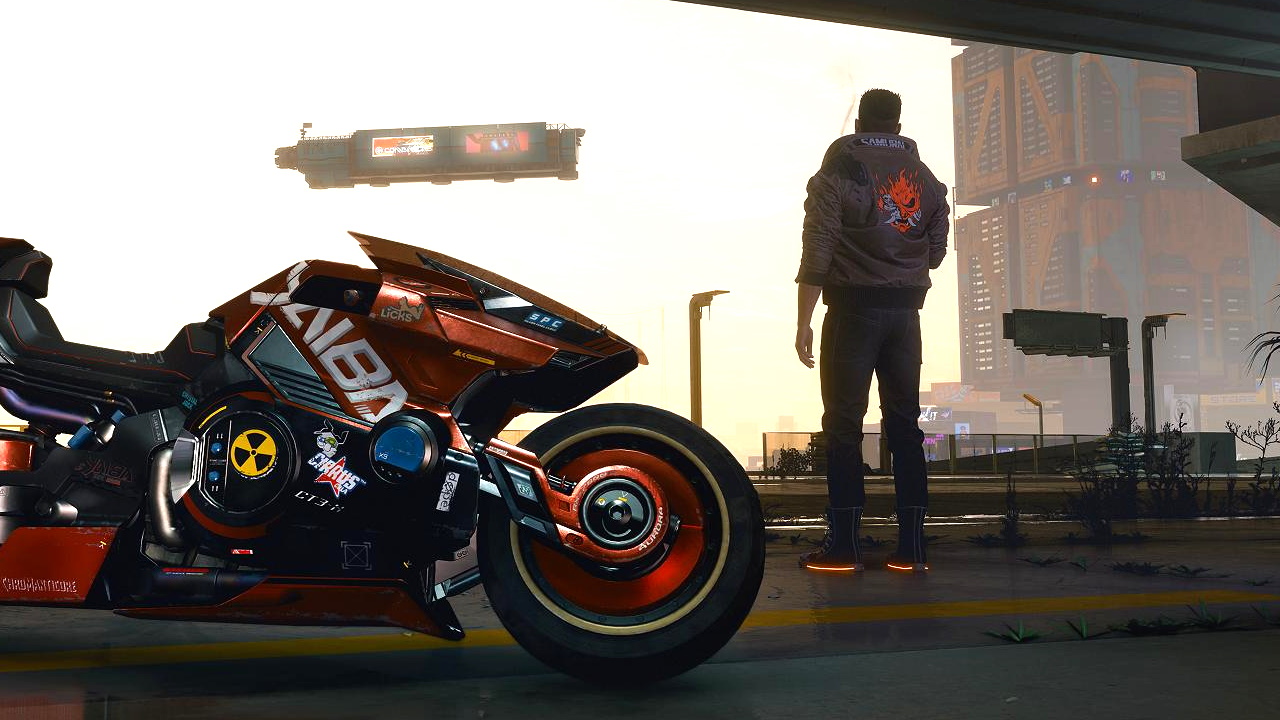
Finally, Akira makes cyberpunk themes more dazzling, including environmental collapse, body transformation, the undercurrent of consciousness, human evolution, artificial intelligence, trust totalitarian, and has become the best role model for film and television entertainment, and video games, some creations are even completely imitated and then modified to their own, which is why some critics always adopt a satirical attitude towards cyberpunk works of today by saying they are owing debt to Akira, as according to Campbell (2018). threads of Akira’s influence can be found in all aspects of popular culture today. For example, like the Japanese animation Ghost in the shell and the Hollywood movie Matrix with many figures of Akira including; complex technology, garbled screens, and the dark fallen world (Campbell, 2017). Furthermore, a new upcoming game Cyberpunk 2077(see the attach) is very enlightened by Akira. For example, in the customization mode, players can change motorcycles outlook into the similar one used by Kaneda in Akira, which is also a tribute to Akira by the production unit (Sheridan, 2019).
Popular genres have always been excluded from academic literacy in the past as pop genres are not regarded as higher art or literature compared to high prose academic literature and high classical dramas that are valued as privileged status (Nick, 2020). Pop genres such as Comics, science fiction, fantasy novels, and other entertainment works are all regarded as non-serious literature. After all, pop genres are only entertainment for leisure time. Therefore, pop genres have never been mentioned in educational literature, only outside of school or university.
Pop genres have always been criticisms with stereotypical marks. There are five points in the following. First: Pop genres often use formulaic plot structures, which means all story plots, character settings are arranged in order, and the same arrangement pattern is not repeated. Therefore, the audience also anticipates the next plot as expected (Mountfort, 2020). For instance, the protagonist of justice will be the winner, no matter how many difficulties experienced. The best example is the protagonist of the Dragonball series; Son Goku, no matter how many edges of life and death he had been through, he still defeats the evils; even if he is dead, he can still be resurrected, and every time he comes back, his power will break the norm as every audience can expect (Lopez, 2014). Second; Characterisation is often two-dimensional or flat that is a character with little or no complex emotions, motivations, or personalities. Features including; no internal conflict, conform to a stereotype, never experience character development and Lack a multi-faceted personality (Courneen, 2020). For example, Action heroes like Superman and Batman are always young, and middle-aged appearances and strong or immortal physical, and are always upright heroes (Mountfort, 2020). Third, Pop genres are Multi-modal as every creation of work has frequent use of various special effect techniques including; visual, audio, writing materials, and other technical means, which also imply that pop genres are nothing if without multi-modal. Fourth, pop genres are the products of technology development as pop genres represent the technology of the era as each popular creation requires technological equipment (Mountfort, 2020). In other words, pop genres require technology to be produced, and the advancement of technology products are influenced by pop genres. Finally, pop genres are non-realism as they are imaginary creations as purely fictitious (Mountfort, 2020), even though many creations are based on realistic backgrounds, the development of the story plot is always based on the preferences of the audiences. For example, idol romantic dramas are created to match to the taste and fantasy of most audiences, thus misleading many audiences to believe that love is beautiful, somehow forgot the crucial of reality (Paul, 2016).
Even though pop genres have encountered many criticisms and exclusions, but due to the change of the times and the continuous development of humanity, the contents of pop genres have also begun to be introduced into the scope of academic literature. It is significant to look at the elements or contents of pop genres. First, pop genres also follow the social footsteps of the times. Any film and television works have colors that reflect the contemporary society in which traditional literatures do not have (Mountfort, 2020). Second, pop genres have promoted the development of technology (Mountfort, 2020, such as the smartphones we use that changed the way we communicate, the way to enjoy entertainment, and the way to do business or study, which must not be ignored, otherwise will not keep up with the times. Third, every pop genre creation has the seriousness meaning and reflection from the author. For example, Romeo and Juliet by Shakespeare reflects blind hatred and love tragedies in the society we live seem to occur every day, and what we can do is prevent tragedies by taking predecessors as an example to introspect, hoping that there will be good changes, thus the society in the writing of Shakespeare will not need to use the death of beloved to gain consciousness (White, 2016). Finally, Pop genres also represent the cultural gestalt of the country, region, and ethnic group. For example, in addition to showing Japan’s soft power, Japanese animations often have cuteness characters that symbolize Japan’s preference for a warm and harmonious society. They are all worth exploring.
Reference:
Mínguez-López, X. (2014). Folktales and other references in Toriyama’s Dragon Ball. Animation, 9(1), 27-46. DOI: 10.1177/1746847713519386
Mountfort, P. (2020). ENGL602 Popular Genres: Introduction [PowerPoint Slides]. Blackboard. https://blackboard.aut.ac.nz/
White, R. S. (2016). Shakespeare’s cinema of love: A study in genre and influence. Manchester University Press. DOI: 10.7228/manchester/9780719099748.001.0001
In what ways can cosplay be understood in terms of notions such as affect, transportation, transubstantiation and mediated fantasy?
Cosplay is an art of entertainment which combines costume and role play. Participants known as cosplayers will play virtual roles by copying the outfits, the mannerisms and gestures of those particular characters (Mckay, 2019). The term of cosplay was convinced from the Japanese term “Kosupure” by a Japanese animation director Nobuyuki Takahashi (Runnebaum, 2019), who witnessed Western sci-fi costume culture and activities, and brought this popular culture into Japan, making some anime lovers dress up as Japanese anime characters. Since then, Japan has become a place to promote the culture of cosplay.
Cosplay can be interpreted as mediated fantasy. The cosplayers bring themselves into illusory roles from anime or fictional works by acting as virtual characters, transforming themselves into the dreamy and perfect self like anime. Thus, leaving the seemingly ordinary and humble of themselves from reality. This is also called as psychological transportation.
Psychological transportation, in simple terms, is to transform oneself into another character, as Mountfort (2018) said the ability to mimic an animated body and activate virtual characters, and cosplayers will achieve psychological pleasure and satisfaction through cosplay, Just like us need to relieve the stress of life through interests or hobbies. As according to Rahman & Cheung(2012), cosplaying provides performers with a momentary escape from the stresses and monotony of ordinary life; and allows them to enter into a whimsical dream of fantasy.
This is another kind of affective of transformation. The strength of the personality of a cosplayer will be affected by the role he/she plays, that is to put themselves into a specific role, not only the body, but even the personality will be affected by imitation, this is also called an intense corporeal response (Mountford, 2018). For example, a person who tends to be shy, once dressed as an anime character, he/she will be confident and put more efforts to perform in accordance with the level of the role he/she plays. However, this phenomenon is also called Proteus effect, that is cosplay is an asemic medium, the behaviour of the character may become intertwined with a participant self, once that individual exists that role, he/she will take on traits of that role for while, eventually leading to split personality (Lesher, 2017). This is a critique of cosplay is wrong, because there are many controversies, as according to Mountfort (2018) relationships between cosplayers with the source text and the role-playing of popular media avatars are often complex and parodic, in the end, they are merely performers to perform within a certain range. Proteus effect is wrong towards cosplay because ordinary people like us grow up through the influence of the surrounding environment to produce some kind of personalities, but ordinary people do not have the hobby of cosplay.
Finally, cosplay is an emotional and spiritual feeling. Fans of anime love to see the virtual characters to be realized in realistic forms by the cosplayers. For example, the traits of cool, hot, sexy, and cute in the animation are realized or activated. Because of the enthusiasm of fans, cosplayers are highly valued like celebrities, and it also gives cosplayers greater confidence and energy to promote cosplay culture (Rahman & Cheung, 2012). For participants, fictional characters also have personality and emotions, which are self-projection. Therefore, cosplayers are knowledgeable about the characters based on their own experience and regard the characters as their peers. Cosplayers do not play cosplay for being unique, but their love and passion of anime and their ability to improve their self-concept via cosplay, it can be said as the process which they build their self-image.
 Pop Genres 2020