Week 3: Brendan O’Neill

How and why have Tintin’s gender and sexuality been questioned?

No artist, dead or alive, has full control over how their work is interpreted. For Hergé this must’ve been an inconvenient reality, as the likely intentional lack of solid defining traits for Tintin as a character would backfire in the long run. It was to Hergé’s disgust after all, when people began to question Tintin in ways that Hergé would have never predicted. 

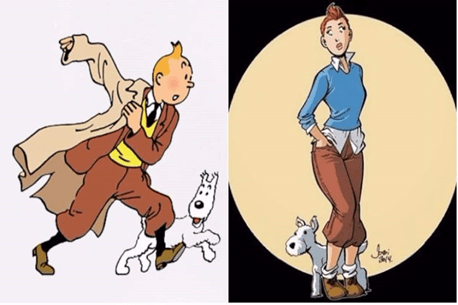
The first aspect of Tintin that has been brought to question is his gender. In terms of personality traits, Tintin doesn’t seem to strongly lean either way, for a character that exists within a ‘boys world’ he is surprisingly lacking in masculine traits. Furthermore, when in relation to Captain Haddock, Tintin begins to adopt feminine traits like being observant, silent, and tender. Tintin has the physical attributes of a teenager, despite almost certainly seeming to be an adult, since he provides for himself and is mostly independent, we never see even a strand of hair on his face or chest, and we have certainly never seen his genitals. The evidence that Tintin is a girl isn’t exactly substantial, and yet the same can be said for him being a guy. For a world that was designed to be for boys, that girls don’t belong in, Tintin doesn’t seem to entirely fit into that, and that is suspicious. The implications are that Tintin is a tomboy, rather than a real one, which may have some logic behind it. If I were a female journalist traveling the world in the time period of Tintin, I imagine I might dress as a boy to avoid prejudice. 

The second aspect of Tintin that is in question is sexuality. Not once does Tintin show any kind of sexual or romantic desire towards anyone, which leaves it up to the reader to speculate. The lack of any kind of carnal desire from Tintin would immediately suggest that perhaps he is asexual, but there is still another option. All of Tintin’s strongest relationships are with men. As I mentioned before, Tintin’s personality had a slight change after he met Captain Haddock, and the two of them sometimes live together. There is also the strange scene where Haddock attempts to uncork Tintin, some saying this is Haddock symbolically penetrating and screwing Tintin. The character that Tintin seems to emotionally care about the most is Chang. Tintin dreams of Chang, cries out his name in waking, and weeps for Chang (Mountfort, 2020.)               

Ultimately the actual arguments for Tintin being a girl or being gay or asexual are not particularly convincing, but it is equally impossible to prove that Tintin is a heterosexual male. The reason that these aspects of Tintin are questioned so intensely then, is because Tintin, by complete accident it seems, is an unidentifiable unknown, a puzzle with no intended solution.

Mountfort, P. (2020). Tintin, gender and desire. Journal of Graphic Novels and Comics. https://doi.org/10.1080/21504857.2020.1729829
     

Week 3: Mollie Chater

  1. What gaps are there in Hergé’s representations of women?

The adventures of Tintin see women take a backseat throughout Herge’s work with very little female characters and when there are females withing the works, the are depicted as oblivious, fragile things in a foolish way.

One way to look at the lack of female representation in Tintin is to understand the times at which the works were created. Even as time continued however it became apparent that Herge would do nothing to change the way women were seen in both his work and to him. At one stage Herge claimed that ‘’Women have nothing to do in a world like Tintin’s” (Mountfort, 2020). When women do feature in Herge’s work they are always seen as wives or houseworkers aiming at being a subtle nod that Herge himself did not have much if any respect for women.

Herge paints Tintin as the hero in ‘The adventures of Tintin’ to give the idea that Tintin lived in a man’s world, by always making the women seem as if they were the damsels in distress when featuring them.

Herge does not have a representation of real women in his work, he has a representation of what he believed at the time women should be like and how they should behave, and how men were the dominant sex during ‘The Adventures of Tintin’. So the gap of women’s representation within Herge’s work is that there are no proper representations at all.

References

Mountfort, P. (2020). Tintin, gender and desire. Journal of Graphic Novels and Comics. https://doi.org/10.1080/21504857.2020.172982

Week 3

Week 3 Questions – Tintin

Why might the queering of Tintin offer new life to the series?

Herge wasnt well known for his inclusivity of other cultures and their beliefs, and his depictions of other races were blatantly racist which could be due to his upbringing in a very conservative home. So, especially in today’s political climate, we must look at the text with the death of the author and detach his intended message, and view the text in another context. With this, readers today can enjoy the text without accepting Herges intention with the racist depictions, and readers are able to realise the damage it caused to these communities as the albums were so popular. The “Queering”, of Tintin, is just one way of today’s readers being able to interact and “talk back”, to the text.

These claims that Tintin is either gay or Asexual arent unsubstantiated, as the reader is never shown any romantic interests and the fact that Tintin surrounds himself with only male friends makes a greater cause. He even moves in with Captain Haddock but only as “friends”, which many gay couples used to do to avoid being labelled as homosexual by their peers. The two share an unbreakable bond, where they would risk their lives for each other, and after years and years of adventuring have become each other’s confidants. Tintin also never shares his past life, and according to an article on Business insider, “Tintin never talks about his parents or family, as though trying to block out the very existence of a father or mother. As psychologists will confirm, this is common among young gay men, some of whom find it hard to believe that they really are their parents’ child. The “changeling” syndrome is a well-known gay fantasy…”. (King, 2009)

This topic can be greatly debated, but there is no denying that perhaps subconsciously, Herge was writing the adventures of a closeted gay man, who faces danger alongside his life partner. Or it could just be about two “bachelors”, living the life, travelling the world together, having a blast.

Tintin and Herge, haven’t always portrayed acceptable representations of minorities, and depictions of other races and cultures could sometimes be problematic in today’s standards. Depictions of black and Asian characters always seem to end up as mere caricatures, while Tintin and other white characters are portrayed as the moral compass and heroes, even the Captain who is an alcoholic which is played off as comedy. “Tintin in Congo”, “Recently a Congolese resident in Belgium, Bienvenu Mbutu Mondondo, has litigated to get the album banned, or at least relegated to the adult shelves of bookshops and libraries” (Mountfort, 2012). However, despite the shortcomings of both the author and his series, they remain classics to this day, being enjoyed all over the world, even warranting a Speilberg film adaptation. But as the world moves toward a more progressive outlook, the Tintin albums may fall into obscurity. So by finding new perspectives to look at this text we may be able to interpret the new meaning behind the text, giving Tintin a new lease on life, exposing the next generations to his antics.

References

Calamur, K. (2016, June 03). Coming to Terms With Tintin. Retrieved November 6, 2020, from https://www.theatlantic.com/entertainment/archive/2016/06/tintin/485501/

King, R. (2009, January 07). Breaking: Tintin Gay. Retrieved from https://www.businessinsider.com/2009/1/tintin-revealed-to-be-gay?r=AU&IR=T

Mountfort, P. (2020). Tintin, gender and desire. Journal of Graphic Novels and Comics. https://doi.org/10.1080/21504857.2020.1729829

Mountfort, P. (2012). ‘Yellow skin, black hair … Careful, Tintin’: Hergé and Orientalism. Australasian Journal of Popular Culture, 1(1), 34-49. https://doi.org/10.1386/ajpc.1.1.33_

Week 3: Sia Caldwell

What gaps are there in Hergé’s representations of women?

Throughout the adventures of Tintin there are very few female characters. One of the woman characters that seems to have some sort of a character is Biana Castafiore. However, she is represented as an oblivious and foolish woman. Herge supposedly created The adventures of Tintin with a masculine dominance but was not intentionally trying to bring any disrespect to woman by creating mostly men characters. (Ideology of Tintin, n.d.). Herge insisted that ‘for him, women had nothing to do in a world like Tintin’s, which is the realm of male friendship….’ (Ideology of Tintin, n.d.).

However, by creating this setting with a male dominance it presents a disturbance to modern day readers. Tintin was written in 1929 so it’s understandable that the time and opinions of woman were different then, but it was a comic written for children and it displays a majority of the female characters ranging from mothers, caregivers, wives, nurses, maids or housekeepers. “In many of Hergé’s albums there is an almost total absence of female characters, and the only women we do see are background characters who do not speak” (Mountfort, 2020). Unfortunately, these characters don’t actually have very much development physically, mentally and emotionally. By creating prejudice female characters in his comics, Herge appears as ignorant towards feminism and woman rights.

Herge’s representation of women in his comics inforce the idea that men are dominant, that women are inferior. It leads us to believe that his perspectives are prejudice and that woman are not capable of that of man and they have roles in society they must fulfill. This would seem ridiculous in today’s society and if comics presenting such ideals, prejudice and opinions were printed for children they would not be tolerated.

References:

Ideology of Tintin. (n.d.). Retrieved August 20, 2020, from        

https://tintin.fandom.com/wiki/Ideology_of_Tintin

Mountfort, P. (2020). Tintin, gender and desire. Journal of Graphic Novels and Comics.

Week 3 response – Leo Ballantyne

Why might the queering of Tintin offer new life to the series?

It can hardly be contested that the Tintin comic series has had a tumultuous past in regards to appropriate and respectful representation. Between historical issues with overt racist messaging and a consistent scarcity of positively presented, independent female characters (Mountfort, 2020), controversy and criticism have been persistent fixtures within the series’ lifespan. While Herge was for the most part able to remedy the most egregious of the racist themes present within his earlier works from The Blue Lotus onwards, his representation of gender and sexuality have progressed at a relative snail’s pace in comparison. This lack of progression has led many academics to search for sublimated representation in response. Tintin, having been designed to be intentionally lacking in both sexuality and traditional masculine features, has been the target of the vast majority of this speculation. It has been suggested repeatedly, that although never explicitly stated, Tintin was coded to operate outside of traditional sexual and/or gender norms. The claims vary significantly in nature, from suggestions that Tintin was bisexual with near incestuous attraction to his parental figures, to claims he is a homosexual man in a relationship with Captain Haddock (McCarthy, 2006), a tomboy, a transgendered man or a genderqueer individual (Mountfort, 2012). If any of these prior readings turned out to be true, even the stranger claims, they would undoubtedly act to provide new life to the comic series by retroactively addressing Herge’s lack of progressive commentary revolving around sexuality and gender norms. 

Tragically, considering Herge’s conservative roots, I would contend none of these potential readings were intended by the author. Additionally, since Herge never made any explicit claim to confirm such notions, we cannot reasonably consider any of these readings as representation, since queer-coding is no substitute for open and clear representation. If those who currently control the creative direction of the Tintin franchise were to inexplicably decide to retroactively queer Tintin, the question remains how such a retcon would best be performed in order to breathe new life into the series. Many of the potential options posited by academics would likely be read as disingenuous, problematic and more harmful than helpful in many cases. The stereotype that a gay couple requires a traditionally masculine and feminine pairing that many earlier academics derived their queer claims from, are reductive and shouldn’t be used as a basis for this queering. On a similar note, a homoerotic relationship between the Captain and Tintin is open to problematic readings regards the power dynamic between the two, especially considering Haddock is often read as a father figure and guardian to Tintin, who in turn is implied to potentially be much younger than him. Characterising Tintin as having a gender identity outside cis male also has a number of troubling implications, even when ignoring the fact that queering which undermines pre-existing canon is often seen as patronising and disingenuous to queer audiences (see the many criticisms of J.K. Rowling’s retroactive world building). This change would enforce the toxic stereotype that cis men cannot be seen as feminine or androgynous without being secretly queer in some regard. This implication would be doubly troublesome if Tintin were to be reinvented as a trans man, with the suggestion that trans men are inherently less masculine than biological males. With these considerations in mind, I would suggest the most respectful and genuine means to queer Tintin would be to present him as Asexual. This avoids many of the pitfalls that other options present.

Making Tintin Asexual fits somewhat neatly within pre-established cannon considering Tintin has never overtly expressed sexual attraction to any gender, therefore perfectly meshing with Tintin’s existing identity. Such a change would also communicate to readers that one does not require a romantic or sexual partner in order to live a complete and exciting life, while avoiding any harmful stereotypes often associated with this given sexuality. Although this change would do very little to address Herge’s lack of meaningful gender discussion, I would argue introducing a new character who could address these issues would enable the creators to avoid the problems associated with queering Tintin in this manner. This potential representation would also encourage the exploration of Tintin’s platonic love through his enduring relationships with characters such as Haddock and Chang, while providing desperately needed representation to a thoroughly underrepresented queer demographic. Representation is incredibly important, providing vulnerable demographics with messaging which confirms their validity and allows them to enhance their understanding of self and self-worth (Cogo, 2017). Queering Tintin would undeniably assist in the admirable pursuit of respectful and fair representation, in a series which has been historically lacking, however we must ensure such changes are made respectfully to both the identity of the text and those that require representation.

Mountfort, P. (2020). Tintin, gender and desire. Journal of Graphic Novels and Comics. https://doi.org/10.1080/21504857.2020.1729829

Mountfort, P. (2011). ‘Yellow skin, Black hair … careful, Tintin’: Hergé and orientalism. Australasian Journal of Popular Culture, 1(1), 33-49. https://doi.org/10.1386/ajpc.1.1.33_1

McCarthy, T. 2006. Tintin and the Secret of Literature. London: Granta


Cogo, F.  Why Queer Representation Matters. New America. https://www.newamerica.org/weekly/why-queer-representation-matters/

blog three

How and why have Tintin’s gender and sexuality been question?

The gender issues are controversial in the Tintin universe, even the author of the Tintin collections, Hergé, had been argued that he tried to hid his femininity behind the character of Tintin (Bremner, 2017). There are two main issues in the Tintin universe been identified. That are, rare female characters’ existences in the Tintin universe and asexuality of Tintin. Hergé once admitted that he liked women whereas he did not want to caricature them and he also considered and acknowledged that women were rare existences in comic books and cultures. More importantly, Hergé believed that women were not capable to fit in the Tintin universe and thus women characters appeared hardly flattering in the Tintin collection. Furthermore, there is another issue that appeared in Tintin collections, that is, the characters in the collections are often commented and considered genderless. This perspective was firstly from a French philosopher, Vincent Cespedes. Vincent Cespedes (O’Connor, 2017) even argue and doubt that Tintin is a girl and her (Tintin) female features are not obvious due to Herugé tries to represent and build Tintin’s image as a tomboy. More importantly, Hergé tried to hide his femininity behind the Tintin. One of the key factor that Hergé built this tomboy character is that male appearance and disguised as a man can help Tintin to travel the world easier (O’Connor, 2017). Several things indicate that Tintin is a girl. Firstly, Tintin showed several traits that directly connected with femininity. For instance, in The Crab With The Golden Claws collection, Tintin’s attitudes and actions toward drunk captain were easily interpreted as a stereotype of femininity in that century (O’Connor, 2017). Secondly, Tintin wore female clothes whereas it was not necessary in those contexts (O’Connor, 2017). The aforementioned two key factors lead people to question Tintin’s gender.

References

Bremner, C. (2017). Great snakes! Is Tintin actually an asexual girl? THE TIMES. https://www.thetimes.co.uk/article/great-snakes-is-tintin-actuallyan-asexual-girl-v56jxxd25

O’Connor, R. (2017). Tintin is a girl and ‘probably asexual’, French philosopher claims. INDEPENDENT. https://www.independent.co.uk/arts-entertainment/books/news/tintin-woman-girl-femme-asexual-comic-character-herge-vincent-cespedes-philospher-theory-a7960561.html

W3: Question

  1. Why might the queering of Tintin offer new life to the series?

We’re in a new era of LGBT representation. Moving past the stereotypes that used to be the only way to write queer characters; the overtly feminine gay man, the promiscuous bisexual/pansexual/polysexual, or the classic sexually deviant lesbian. Where Triple A video games can have an LGBT cast as their main characters, and not simply NPCs to fulfill quotas. Where Netflix’s revival of ‘The Baby-Sitter’s Club’ can rewrite one of the sitter’s clients as Bailey, and have an entire segment of Mary-Anne calling out the prejudice of the doctors who purposefully misgendered her. The LGBT community is louder than ever, asking for appropriate representation from writers; where they don’t simply die because the writers don’t know how- or worse, don’t want- to write a satisfying end for them. 

We’re also in an era of remakes, with companies picking up old stories and modernising them. Disney’s newest projects have been remaking all their old animated movies into live-action, Dreamworks picked up ‘Voltron’- a badly dubbed show from the 80s- and attempted to make the story into something cohesive; horror movies have also been doing this for a while longer, from classics like ‘The Thing’ and ‘Evil Dead,’ to less known horrors like ‘Let Me In’ and ‘The Crazies.’

Other remakes have even revived themselves with LGBT rep in them. As the mentioned above ‘Voltron,’ has a gay man and a non-binary character within the main crew, or ‘She-Ra’ with both protagonist and antagonist as lesbian women- which isn’t even mentioning their entire cast of characters. So, remaking Tintin with either Tintin himself as a part of the LGBT community or with a crew of representation, wouldn’t be too far out of a concept.

The creators of Spongebob have- again- confirmed the title character to be asexual (since, y’know, sea sponges do reproduce asexually). A lovable character created in the 90s confirmed to be within the LGBT community. While this was confirmed back in the early 2000s, the news again made a resurgence when Nickelodeon let out a tweet hinting at his sexuality. I bring this up to show that even an iconic character like Spongebob Squarepants was met with positivity and support.

Reviving Tintin which included LGBT rep will certainly bring in a larger audience as well; while Tintin is widely known, a lot of people haven’t actually seen or read any of Tintin’s adventures. If a new series was to be made and made with new characters for this purpose, Tintin lovers would certainly go view it and it would also attract us LGBT folk who are starved for good representation.

References:

Flood, A., & Cain, S. (2017, September 25). Is Tintin a girl? Philosopher says his theory was ‘fake news’. The Guardian. https://www.theguardian.com/books/2017/sep/25/is-tintin-a-girl-philosopher-says-his-theory-was-fake-news

Gupta, S. (2017, September 23). Tintin is a girl, probably asexual, claims French philosopher. Deccan Chronicle. https://www.deccanchronicle.com/lifestyle/books-and-art/230917/tintin-is-a-girl-probably-asexual-claims-french-philosopher.html

Mountfort, P. (2020). ‘Tintin, gender and desire’. Journal of Graphic Novels and Comics, 1-17. https://doi.org/10.1080/21504857.2020.1729829

Opie, D. (2020, June 15). SpongeBob Squarepants’ queer identity is more complicated than you think. Retrieved from https://www.digitalspy.com/tv/ustv/a32866498/spongebob-squarepants-asexual-lgbtq-queer-gay/

Week 3

  1. How and why have Tintin’s gender and sexuality been question?

The discussion about Tintin’s gender online has been constantly debated. But the absence of female or physically attractive characters in Tintin does not represent his gender or sexuality. There is no complete sexual dimension in Tintin comics, and homosexuality is a clear choice of sexual behavior, and in this book there is no such story at all.  In Tintin comics, you can find the same answer as why no character dies. Because it’s a children’s cartoon for children’s readers. Judging gender and his sexual identity in it is a groundless generalization.

When you think about Tintin in the cartoon, there is no description of the main character’s family. There is no sexual description at all. Even him. Someone say they don’t know if it’s a man or a woman.  Not getting old, not getting age.  But this is also an advantage for readers of different ages and genders to empathize with him.  His smooth face is also a device that everyone can assimilate.

Captain Haddok or Professor Calculusis so strong that it is difficult to assimilate.

In the case of Tintin, as the series progresses, there is less clear information about which country the land is from. This can have the effect of making it easier for foreign readers to immerse themselves in the main character when the cartoon is translated into a foreign country.

Hergé intentionally made Tintin avoid the feelings of love, and in the cartoons, there were blondes and young women.

Scenes were mainly used as a means to create intrigue or action.

The lack of heterosexual love in Tintin requires some understanding of the laws of pre-World War II publications in France. At this time, the legal regulations for children and adolescents were severe. The newspaper where Tintin was serialized was also a Catholic newspaper, so it helps us understand why Tintin does not have a sexual dimension.

TinTin was made to be read by teenagers, so the moral purpose is clear.

  1. Brave. He’s up against danger.
  2. be decisive  Once you start, you don’t stop.
  3. To be dynamic.  have creativity and mechanical talent
  4. Pure. No moral defects.
  5. Be active. Take the initiative.
  6. To stand up to the strong and help the weak.
  7. Clever. Use your wisdom to get through difficulties. Or coaxing or coaxing friends to reach the same goal.
  8. Charming.
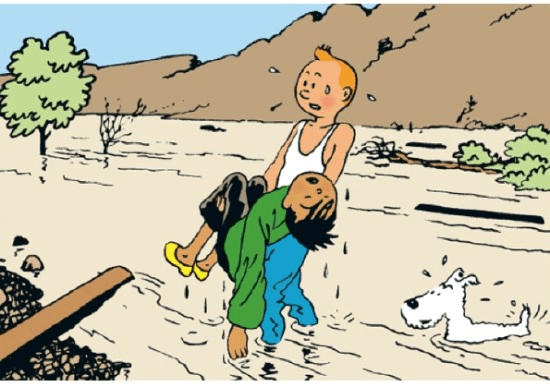
  9. He is philanthropists. He saves people from trouble without racial distinction.

Tintin to save a Chinese boy from drowning in the river

According to author Hergé, his brother is the model of Tintin. His hairstyle was the same as his brother’s hairstyle. But since Tintin became famous, my younger brother, who was a career soldier, was so stressed out that he looked like Tintin that he shaved his head. Hergé used it as a model to create a character, so the character that was born was Colonel Spons, the villain

But Tintin’s adventures are part of literature, so how to interpret them is up to the reader.

Reference

Mountfort, P. (2020). Tintin and gender part 1 [PowerPoint Slides]. Blackboard. https://blackboard.aut.ac.nz/

Mountfort, P. (2020). Tintin, gender and desire. Journal of Graphic Novels and Comics. https://doi.org/10.1080/21504857.2020.1729829 

Week 3 – Tintin

What gaps are there in Hergé’s representations of women?

Tintin is inarguably a male dominated series, with all the reoccurring characters being men. The biggest gap in Hergés representation of women is including one that is not a background or minor character. Any women seen in the Tintin comics are delegated to being mothers, wives of male characters, caretakers, or simply just standing around in the background. In fact, in the first ever comic, Tintin in the land of the Soviets, there are no women in the comic, with them simply being in the background.

Hergé was once quoted as saying that “women have nothing to do in a world like Tintin’s. I like women far too much to caricature them…” (Cited in Sadoul, 1989, p.93) This is blatantly false as any female characters, when his comics do feature speaking women, are very caricatured and stereotyped. They are the wives, mothers, and housekeepers of Tintin’s world. Not only that but “tears are an exclusively female predilection in the Adventures, reproducing nineteenth-century clichés of women as the psychologically ‘weaker sex’.” (Mountford, 2020) Only the female characters are ever seen crying, such as the Congolese woman in Tintin in the Congo who is crying for her sick husband. The women are also depicted as being in distress, for example in Cigars of the Pharaoh (1955) a woman is depicted as being in trouble and Tintin swoops in just in time to catch her as she faints. And, in The Crab with the Golden Claw (1943) Mrs Finch, Tintin’s housekeeper, is clearly distressed as she recalls to Tintin watching a man being kidnapped. This is an event that would likely not have caused Tintin much distress and Tintin would likely have chased after the kidnappers as he is the hero of the stories.

The only female character to have a seemingly fleshed out personality is Bianca Castafiore. She is loud, spontaneous, consistently interrupts conversations, and is quite materialistic. In this way she is a caricature of a typical celebrity. While she is one of the most fleshed out female character’s in Hergé’s work, she is far from the ideal feminist representation. Her character has been criticised for being reduced to a sexual symbol or object. Especially in The Castafiore Emerald in which she is the main character. There are multiple references to sexuality within the comic, McCarthy (2006) discusses the emerald as being one of the most obvious references to sexuality. Another reference is seen on page 24 where Castafiore has Haddock smell a rose and when he is stung by a bee she places the rose’s petal on top of his nose. Flowers are common symbols of female sexuality and this is a very obvious reference to that.

Tintin is a man’s world, and Hergé has shown this to his audience by creating female characters with little to no influence on the plot. They sit in the background or exist to cry and give Tintin the chance to be the hero. In the rare case of Castafiore they are comic relief with sexual undertones. Despite his claims of not caricaturing women, Hergé’s ladies are not representations of real women.

Reference List:

McCarthy, T. 2006. Tintin and the Secret of Literature. London: Granta.

Mountford, P. (2020): ‘Tintin, gender and desire’, Journal of Graphic Novels
and Comics, DOI: 10.1080/21504857.2020.1729829

Sadoul, N. [1975] 1989. Tintin et Moi: entretiens avec Hergé (Tintin and Me: Interviews with Hergé). Tournai: Casterman

Week 3: Tintin

What gaps are there in Hergé’s representations of women?

There are many gaps in representations of minority groups in Hergé’s “The Adventures of Tintin” one of them being the representation of women Hergé’s believed “that there was no place for women in the world of Tintin” This belief is shown through his work repeatedly where women are seen to have little to no role in the comics they are either wives, mothers, caretaker or nurse or just crowd fillers. Although, Madame Castafiore and Peggy Alcazar are the only two women in “The Adventures of Tintin” that Hergé’s gives important roles to that really have voice.

Madame Castafiore is the only female character that has an album dedicated just for her which is ‘The Castafiore Emerald’ where she is an independent, self-made and famous women. Even though she posses these admirable qualities she is still objectified in the story and does not contribute much to the story although the story is dedicated to her she’s almost seen unwelcomed in conversations which kind of gives the audience a perception that she is not an important character. Which shows Hergé’s ideaology of women and how he precieves them as not important and their voices and opinions are not welcomed into the world of Tintin which is an awful example to set because of how much popularity the Tintin series has gained globally and how many kids around the world read the series.

Peggy Alcazar is another character from the album “Tintin and The Picaros” where she is seen to be a matriarchal women who constantly bullies her husband her husband is seen to be doing ‘womenly’ jobs which gives the perception that she is a dominating making her by far the only dominating women in any of ‘The Adventures of Tintin’. Hergé portrays Peggy in a very negative light to show that women have no place in the world of Tintin by doing this Hergé is he has contributed to the inequality in the representation of women in books, films and etc.

Refrences;

Mountfort, P. (2020). Tintin and gender part 1 [PowerPoint Slides]. Blackboard. https://blackboard.aut.ac.nz/

Mountfort, P. (2020). Tintin, gender and desire. Journal of Graphic Novels and Comics. https://doi.org/10.1080/21504857.2020.1729829