Week 6

 What is the philosophy of cosmicism and how is it used to convey a sense of dread in both The Shadow Over Innsmouth and The Colour out of Space?

Cosmicism is a philosophical view symbolizing cosmic fear, which refers to the overwhelming despair and fear of space, disaster, and transcendental God, which appear in places like the unknown, deep-sea, and cosmic world that we have not yet recognized. Even in Lovecraft’s novel, the theme is the fear of extraterrestrial species with secrets that give us the mystery of the universe that humans cannot know or fear, which can be seen as Cosmicism. Cosmic horror is a sub-genre of horror that utilizes Cosmism. Cosmicism is based on fear, which is told with important feelings in myths and religions. These Cosmic horror are written on the subject of human fear and end nihilism in a dystopian atmosphere. Especially easily seen around us, “Alien” and “Budbox” and “The Mist” are well-known cosmic-themed films in which humans are brutally attacked and killed by unknown alien species and supernatural beings.
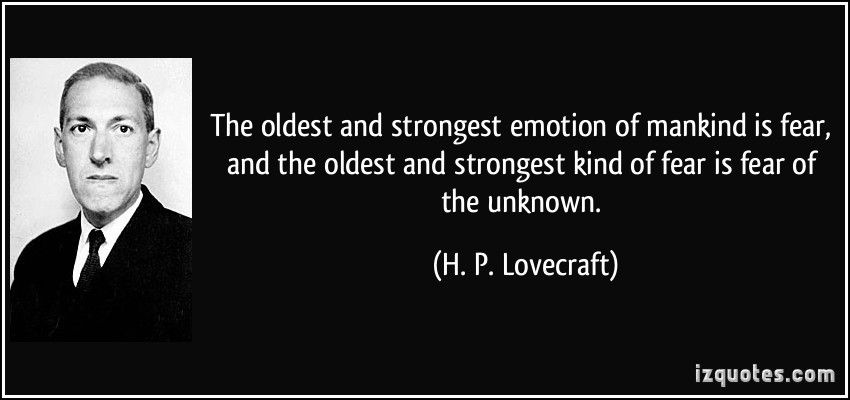
Lovecraft said this in his essay book. It is a sentence that reflects Lovecraft’s opinion of fear. To describe Lovecraft’s philosophy of work in one word, it is Cosmicism. The fear expressed in his novel has a distinct element from the visual and auditory fear revealed in the general work. The fear of unknowns, vast universes, or beings that cannot be seen, heard, or felt, is revealed in the work. The images and moods of these horror descriptions serve as a tool to express his unique sense of subject matter very well. Cosmicism is a philosophical view of fear.

Lovecraft’s creation, Cthulhu, also sleeps deep in the sea, and Dagon s also a monster living in the sea and his subordinate species, respectively. In the West, people are disgusted by marine animals, and in the case of deep-sea creatures, they are more disparate in appearance.

 The outward grandeur or creepy external portrayal of the extraterrestrial life, Old One, and Shogos or architecture can be frightening.

There could be a violent situation and a primal fear of death being slaughtered by them. However, the theme of “human beings are very insignificant” in the absolute ancient alien civilization is a typical characteristic of Lovecraft’s Cosmic Horror. This is quite out of the ordinary plot.

The horror monster shown in the general myth is the object of Oedipus overcoming. However, the monster in Cosmic Horror is like unknown mother nature that humans cannot resist.

The distinction between traditional cosmic horror is that the genre deals with cosmicism, or unknown fear, and cosmic fear. This sense of subject sets the plot apart. Thus, in general, works of the Cosmic Horror genre are tragic. In particular, Lovecraft’s unique horror philosophy is contained in “Shadow over Innsmouth”. Human beings are weak and cannot solve cases in the climax. Experience the greatest fear in the climax and fall into despair. As a result, many works face tragedy at the end of the play or merge with fear, as Nietzsche said.

Reference

Stableford, B. (2006). The cosmic horror. Icons of Horror and the Supernatural: An Encyclopedia of Our Worst Nightmares

Cosmicism. (n.d.). Retrieved September 06, 2020, from https://en.wiktionary.org/wiki/cosmicism

The H.P. Lovecraft Archive. https://www.hplovecraft.com/.

Week 6 Response – Chloe Pope

Reyes (2014), describes Body Horror as being a “fictional representation of the body exceeding itself or falling apart, either opening up or being altered past the point where it would be recognised by normative understandings of human corporeality.” How do The Colour out of Space and Lovecraft’s The Shadow Over Innsmouth make use of this definition to explore themes of the unknown?

One example of the use of body horror in ‘The Colour Out of Space’ by H.P. Lovecraft is the deaths of three members of the Gardner family at the center of the story. One by one, Thaddeus, Nabby and Nahun, son, wife and husband, all fall victim to a horrific death brought on by the alien entity that has overtaken the farm following the meteorite’s fall. The nature of their deaths falls firmly into the category of ‘body horror’ – however, the audience is not entirely privy to what this death looks like initially. The first death, Thaddeus’, is given little description, as in the text, Ammi is only told of the death by Thaddeus’ father Nahun. The death and it’s nature is only given a single sentence; ‘The death had come to poor Thaddeus in his attic room, and it had come in a way that could not be told.’ (Lovecraft, The Colour Out of Space, 1927)

While, initially, this line could easily be looked over, upon subsequent readings and analysis, it actually serves to emphasize the body horror aspect of the deaths of the family, which are expanded upon with Nabby and Nahun’s deaths. It does this by introducing, early on, the idea that the nature of death was not comprehensible to the human mind – a key aspect of body horror in the definition provided by Reyes, ‘fictional representation of the body exceeding itself or falling apart, either opening up or being altered past the point where it would be recognised by normative understandings of human corporeality.’ (Reyes, 2014)

In The Colour Out of Space, in the very same sentence that human death is introduced, so too is it’s psychological impact (and incomprehensibility), before the author even begins to dive into the visuals of it. It is this which makes the text not just an effective body horror text (although this is clearly true), but also an effective horror, as it shows an intent to not simply shock the audience with frightening visuals, but to disturb them on a psychological level and disrupt the audience’s knowledge and expectations of the world. While it is a key aspect of body horror, aiming to inspire fear in the audience by targeting the intrinsic human fear of the unknown is a key aspect in horror fiction in general. It was a key aspect for the works of H.P. Lovecraft, as well, who remains famed for the presence of the unknown within his works. Dubbing it the ‘cosmic mystery’ or ‘weirdness’, in the essay, ‘Supernatural Horror in Literature’, Lovecraft writes that, ‘The oldest and strongest emotion of mankind is fear, and the oldest and strongest kind of fear is fear of the unknown’. (Lovecraft, Supernatural Horror in Literature, 1927)

While the psychological aspect of body horror is arguably that which makes it most effective in disturbing the audience and therefore that which should be focused on, the visuals should not be brushed over, either. In ‘The Colour Out of Space’, the audience is finally shown – as any reader can be shown in a written text – the nature of the alien death with Nabby and Nahun. For the first, it is through Ammi’s eyes as he discovers Nabby’s half-dead body. For the first time the reader is given visual clues as Ammi describes Nabby’s body in the corner of the attic, ‘But the terrible thing about this horror was that it very slowly and perceptibly moved as it continued to crumble’. (Lovecraft, The Colour Out of Space, 1927) The movement of the body – incredibly slow – and the single word ‘crumble’ both go against regular, ‘natural’ human behaviour and decay as the reader would know it, falling in line with the already introduced psychological aspect of the unnatural. While this is not expanded much further with Nabby’s death, it doesn’t need to be, as very shortly after comes the death of Nahun. This final death of the Gardner family is a key point in the text as it seems to be the point in which the possession of the farm by the alien entity and it’s horrible effects go from rumour and inference to known by the protagonist who’s eyes the reader sees through, Ammi. Nahun’s death is described extensively (especially in comparison to the previous deaths); ‘collapse, greying and disintegration’, ‘a horrible brittleness…dry fragments were scaling off’, ‘the distorted parody that had been a face’,  and ‘cleft, bulging lips’. (Lovecraft, The Colour Out of Space, 1927)  These descriptions are entirely devoted to producing the image of something inhuman and unnatural in the minds of the reader. Falling in line with the description of the visual aspect of body horror provided by Reyes – ‘the body exceeding itself or falling apart, either opening up or being altered’ (Reyes, 2014) – while not being the only instance of body horror in the text, it stands as an example of the introduction and then realization of body horror within the text, as the seed of fear of the unknown that was planted in the minds of the readers with Thaddeus’ death is completely realized, in horrifying visuality, with Nahun’s death.

References

Lovecraft, H. (1927). Supernatural Horror in Literature.

Lovecraft, H. (1927). The Colour Out of Space. In H. Gernsback, Amazing Stories. New York: Experimenter Publishing.

Reyes, X. A. (2014). Body Horror. In X. A. Reyes, Body Gothic : Corporeal Transgression in Contemporary Literature and Horror (pp. 52-74). University of Wales Press.

Week 7 Questions

Carroll (2003) and King (2010) discuss how the “monster” is really a defining feature of a horror story. Using references, explain in your own words how a monster in horror differentiates from monsters in other popular genres. 

Monsters have been a prevalent theme and feature of the horror genre long before the horror genre was even clearly defined. Ghosts and ghost stories alike have been around even prior to civilisation. Using monsters as a mark of horror can be useful, however, the term can be broad as many different genres incorporate their own sense of a supernatural being. An article by Bell (2017) identifies four broad categories of monsters found in films, plays, novels, and other media, such as monsters from nature, which embodies the human fear of an uncontrollable force in the natural world (e.g. King Kong, the Loch Ness Monster), they are often elusive and mysterious. Monsters associated with the fear of science are also prominent, such as Frankenstein’s monster. The Jekyll and Hide type monster eludes to a psychological aspect which presents that people have double lives or selves, and their monstrous qualities are of one’s repressed self. Lastly, there are monsters from the past, such as Dracula, which take revenge on modern living and progress and provide unconventional ideas (e.g. promise of immortality).

Monsters are typically found dispersed in more than just the horror genre, and where it is a very large aspect of horror content, it also plays a big role in sci-fi, fairy tales, myths, and odysseys (Carroll, 2003). However, many sci-fi experts explain that monsters in this genre are secondary to the imagination and fantasy of alternate universes/technologies. Monsters can either be supernatural beings or have sci-fi origins, this often distinguishes horror from other stories which are called tales of terror, for example, William Maginn’s ‘The Man in the Bell.’ The presence of monsters helps clarify what is horror from terror – which can incorporate other features like abnormal psychologies. In relation to fairy tales and myths, monsters also inhabit these worlds greatly, however they are not considered horror. This often has to do with the attitudes of the surrounding characters and their encounters with the monsters. Horror fiction depicts that humans find the monsters abnormal and unnatural, but in fairy tales, monsters are an ordinary characteristic of their universe. For example, in Star Wars, the beast-like character Chewbaca is regarded as one of the ordinary characters, but in a film like The Howling, a similar beast-like character that resembles a wolf would be regarded as a dangerous monster by the human characters. In myths, creatures like griffins, chimeras, dragons, and satyrs are common and bothersome creatures in their worlds, but are not implied to be unnatural, instead they are explained by the metaphysics and cosmology that creates them. Carroll (2003) simplifies this argument by demonstrating that monsters are extraordinary characters in our ordinary worlds, and in contrast, monsters in fairy tales are ordinary creatures in extraordinary worlds.

Moreover, prior to horror becoming a more prolific genre for books and movies from the 80’s, there was a thread of gothic tales that were prevalent in the 1960-1974. One of its defining features was the usual terrified women running away from a dark, brooding house, and the genre was known as “gothic romances,” that were mainly adult-based fairy tales. These paperback novels took inspiration from the 18-19th century gothic literature, and involved themes of murder, confinement, and ancient curses, with the major plot of a young woman falling in love with a dark, handsome, but brooding master (Hendrix, 2018).

Overall, horror movies and novels have always been popular to some extent, and sees a cycle of increased popularity and visibility every couple of decades (King, 2010). These periods often coincide with serious, real-life events of economic or political strain, and the fictional narratives often reflect those anxieties. The over-arching theme of a ‘monster’ takes on a different shape according to the anxieties felt by the people during these periods, and are often symbolic and allegorical. The idea of escapism thrives on the horror genre as the grotesque and scary features of the genre can be appealing to the public, and provides a space to indulge dark fantasies. Monsters are almost always prevalent in these horror stories, and depending on the genre, have differing encounters with the human characters.

References

Bell, S. (2017, October 30). Monsters on our minds: What our fascination with frightful creatures says about us. https://news.usc.edu/130364/monsters-on-our-minds-what-our-fascination-with-frightful-creatures-says-about-us/  

Carroll, N. (2003). The Nature of Horror. Retrieved from http://ebookcentral.proquest.com  

Hendrix, G. (2018) Paperbacks from Hell.  

King, S. (2010) Danse Macabre.  

Week 6 question

What is the philosophy of cosmicism and how is it used to convey a sense of dread in both The Shadow Over Innsmouth and The Colour out of Space?

Cosmicism is a philosophical concept made famous by American writer H.P Lovecraft. The idea of cosmicism is shown throughout many of Lovecraft’s stories such as The Colour out of Space, The Shadow Over Innsmouth, and one of Lovecraft’s most popular fictional universes, The Cthulhu Mythos. It is stated by Slåtten (2016), that Lovecraft first started expanding the idea of cosmicism when he was just 13 years old. He got the idea from studying astronomy explaining that humanity is nothing compared to the ever changing cosmos. 

Cosmicism, in easier words, describes the universe and cosmos as vast and that compared to this, the human race is insignificant. This idea is explored throughout many of Lovecraft’s works due to the science-fiction and horror components. Logic is often obliterated throughout many of Lovecraft’s works which shows the ignorance that humanity has towards anything beyond Earth. 

The Colour out of Space and The Shadow Over Innsmouth both convey a sense of dread through cosmicism because they essentially present the fear of the unknown. The Colour out of Space (2020) film essentially depicts a family losing their minds due to a meteorite crashing into their front garden out of nowhere with extraterrestrial forces attached to it. Soon after, the wildlife and animals start to mutate and eventually die from the power of the light that comes from the mysterious meteorite (Burleson, 1993). This shows the reader the classical Lovecraftian style of weird horror by mutating living things and turning them into something unfamiliar and incomprehensible to the basic human mind.

Lovecraft has presented his audience with uncertainty which soon converts to horror and dread. Slåtten (2016) explains that the story shows human incompetence with the cosmos and almost ignorance due to the lack of information about the universe outside of Earth and the Milky Way. This creates a sense of dread because it is in the nature of humans to fear the unknown, and that is exactly what is presented through extraterrestrial beings. Within The Shadow Over Innsmouth, dread is projected through the loss of sanity and mutation, which is often used in many of Lovecraft’s stories. Lovecraft presents his readers with mixed feelings when describing the ‘eye’s’ of the people in Innsmouth (Snyder, 2017). The Shadow Over Innsmouth conveys horror through the townspeople, due to the fact that they are other-worldly after interbreeding with ‘the Deep Ones’. They are described as superstitious creepy hybrids with bulging eyes and many warn not to engage with them. The narrator of the story, and main protagonist, shows a progression into madness when he later finds out that he shares family bonds to the Deep Ones due to an early ancestor (Snyder, 2017). This madness can be compared to the sense of dread that the reader is experiencing because it describes the character as morphing into the other-worldly thing he later despises. This relates back to cosmicism because of outer-worldly aspects that essentially portray fear through mysterious, dark entities that prey on the human fear of the unknown.

References

Burleson, D. R. (1993). Lovecraft’s the colour out of space. Explicator. 52(1), 48-50. doi:10.1080/00144940.1993.9938737

Slåtten, K. Ø. (2016). Humans in a hostile cosmos: Science, cosmicism and race in HP Lovecraft’s Cthulhu mythos. Master’s thesis. University of Stavanger, Norway.

Snyder, P. J. (2017). “Dreadful Reality: Fear and Madness in the Fiction of H. P. Lovecraft”. Honors Thesis. 540. https://aquila.usm.edu/honors_theses/540

Q for week 6

4. Stableford (2007) details the historical formation of Cosmic Horror prior to Lovecraft. Describe in brief this formation and how it affected the Lovecraftian School of Cosmic Horror which would soon become the gold standard. Can you see any of these historical movements having an influence in The Shadow Over Innsmouth or The Colour out of Space?

Lovecraft school of witchcraft and wizardry. No, sorry.  Lovecraft school of weird fiction!

Stableford (2007) writes about H.P. Lovecraft and his works of Cosmic Horror and how the genre developed over the years. Lovecraftian fiction is simply explained, stories where the horror arises from knowledge that are too much to handle, though Lovecraft was not satisfied by this and wanted to take his work to the next extreme level.
Clark Ashton Smith helped Lovecraft transition from cosmic fear to a more detailed, full-fledged notion of Cosmic Horror. Lovecraft and Smith pioneered the hybridization of horror and sci-fi, and it was later taken further by Donald Wandrei and Frank Belknap Long.
Lovecraft wrote The Color out of Space in 1927 which makes Cosmic Horror manifest as a kind of ancient, parasitic sheen.
I’ll come back to Lovecraft in a bit but before that I want to talk about some of the other things and authors that influenced the Cosmic Horror phenomenon and I want to start with the sublime.
The sublime originates from the fundamental emotion of astonishment and Stableford (2007) writes that according to Edmund Burke sublimity is associated with danger, power, vacuity, darkness, solitude, silence, vastness and so on. Sublimity always have an element of horror.
Scientific discoveries such as Newtons conception of the universe and the discovery of the Milky Way played a huge part in feeding the writers imaginations. Proto-Meteorogist Adam Walker’s notion that the world of ordinary sensory experience, mundane time calculation and social interaction were nothing, but a network of appearances was also a contribution to the Cosmic Horror development. 
Stableford writes on about how the tradition of Cosmic Horror fiction can be seen as a heroic attempt to communicate the uncommunicable, “by suggesting—in the absence of any possibility of explicit description—the sheer enormity of the revelation that would be vouchsafed to us, were we ever granted permission to see and conceive of the world as it really is, rather than as it appears to our senses: deflated, diminished, and domesticated.”
Next up is the Romanticism’s rebellion against “Classism”, who took many forms, the most outstanding is the nostalgic interest in the fantastic and folkloristic and “its championship  of  the  spontaneity  of  psychological  and  aesthetic  responses against  the  imposed  order  and  discipline  of  formal  representation.”
Then we have the Gothic Horror Fiction which is one of the main extensions into prose fiction.
Stableford points out that Romanticism were a good breeding ground for developing a type of Cosmic Horror who weren’t just supernatural, but also embodied a new exaggerated sense of sublimity and attitude. A good example of this is Mary Shelly’s Frankenstein.
Speaking of Mary Shelly, she was one of several authors who helped push the progress forwards, some of the others were Robert Browning, Edward Bulwer Lytton and Edgard Allan Poe. We also have the work of Gustave Flaubert who presumably inspired what Stableford describes as one of the 19th centuries most striking accounts of existential breakthroughs of Cosmic Horrors: Jules Richpin’s La Machine à métaphysiqe or The Metaphysical Machine.
Some other influences and inspirational fountains were of course opium and other types of drugs who helped feed the writers imagination.

Lastly Stableford talks about the works of the Lovecraftian School. Now I’d like to mention that Lovecraft’s Cthulhu Mythos were continued by his disciples, in fact he encouraged people to use his motifs in their own work. 
The Lovecraftian School continued it’s work but moved from Cosmic Horror to a more intimate form of psychological stress. It became pointless to them to describe the indescribable, it was to repetitive and ex-Lovecraft authors such as Fritz Leiber and Robert Bloch became more effective when they moved away from Lovecraft’s template.
The arrival of pulp sci-fi switched added an ideological force and the wonder component who used to be horror was switched out with the more important aspect of the modern experience of the sublime. 
Other influences were Olaf Stapleden and John W. Campbell, who took the work in a different direction. Pierre Teilhard’s The Omega Point and Frank Tipler’s reconfiguration of it also triggered responses in the world of sci-fi writers.

The Colour our of Space is a psychedelic Cosmic Horror film where we watch the characters slowly lose their mind. We see some classic Lovecraft elements in the monstrous blobs of various animals and humans fused together into something indescribable and of course in the colourful light that can’t be explained, “not like any colour I’ve ever seen before.” The film shows the hybridization of horror and sci-fi that I talked about earlier but also plays more on the psychological aspects of cosmic horror. We see elements of the sublime in how the family is isolated from the rest of the world (solitude), there is an obvious danger and power they can’t understand or fight against, and we find darkness both in the sense of scenes set at night but also in the characters.
The scientific progress and discoveries a about the universe who inspired various writers can be seen in the ‘bad guy’ who is an alien being or presence if you like. Then again you could argue that the bad guy is actually the human main characters, considering how the ‘thing’ draws out the worst in them and they become increasingly more aggressive towards each other as the movie progresses.
We also see the addition of psychological stress as the movie goes on, the characters are pushed closer to the edge as the entities power over them grows stronger. There is no clear understanding of what the colour/creature is, what it wants or where it actually came from, although we do get a look of it’s home planet which is a nightmare-ish place full of worm-like tentacles. Tentacles or roots are a repeated element in the movie together with horrific scenes where people are melted together with each other. People die and come back to life and are in the end absorbed by the colour.

Sources:

Stableford, B. (2007). The Cosmic Horror.
https://blackboard.aut.ac.nz/bbcswebdav/pid-5308458-dt-content-rid-12699223_4/institution/Papers/ENGL602/Publish/Cosmic%20Horror%20Article%20final%281%29.pdf

Week 6 Question

Q)According to Joshi (2007), a tale from the Cthulhu Mythos has several defining features that occur regularly throughout Lovecraft’s work. What are these features and how are they used in The Shadow Over Innsmouth? Furthermore, can you see any of these features being used in The Colour out of Space?

The Shadow Over Innsmouth (1931) is an original, published work of H. P. Lovecraft, and is a part of the Cthulhu Mythos. There are several defining features that form the basis of Cthulhu Mythos, much of which are inspired in Lovecraft’s upbringing and convictions, and are present in The Shadow Over Innsmouth (1931), and The Colour Out of Space (1927)(Joshi, 2007). The Mythos was a result of Lovecraft’s philosophical convictions and the influence of intellectual frenzy of early 20th century; his works reflect his awareness of uncertainty in the knowledge of his time (Joshi, 2007). His convictions acted as a persuasion to challenge beliefs, and passed the notion that norms of humanity have no mere significance in front of looming uncertainty of the universe (Jones, 2020).

The defining features of the Mythos are categorized and explained in four concrete elements: a ‘largely imaginary New England topography – a recurring setting inspired in a number of works (Joshi, 2007). New England in Lovecraft’s works are reminiscent of the seventeenth century which was a haven of religious fanaticism, witchcraft, and invocations – incursions of tampering with the unnatural orders of nature (Joshi, 2007). The fictitious seaport in The Shadow Over Innsmouth is a part of mythical cities loosely based on real places that Lovecraft travelled to and visited (Joshi, 2007). The city Arkham in The Colour out of Space is loosely based on Salem. Aquatic hybrid creatures in Innsmouth (1931) are imagined from Massachusetts’ coastline, and Joshi (2007) asserts that the reservoir in The Colour out of Space could be an influence of the Quabbin reservoir in Massachusetts.

The second feature elaborates on ‘ancient and modern occult books’ of Lovecraftian library (Joshi, 2007). Joshi (2007) explains it as ‘a band of scholars who seek out texts… carry out the spells and incantations… to combat them’. In The Colour out of Space, this feature is not entirely present, but researches of the Miskatonic University venture out to study the strange meteorite. Lovecraft crafts the plot around the knowledge of supernatural horror; alien entities in the particular story are rather inexplicable, misshaped, and incomprehensible compared to human bodily structures (Joshi, 2007). This feature however in Innsmouth (1931) is replicated in the form of the odd townsfolk of Innsmouth, and the Deep Ones in the form of fish that deliver prosperity along with jewellery. The interest in the town’s half humans and objects are analogous of the feature’s explanation of quests ventured in such fictions, which in this case was the narrator (Joshi, 2007).

Third of the concrete elements is the ‘gods’, their human followers,’ and their monstrous ‘minions’ or acolytes (Joshi, 2007). Cthulhu Mythos worked around entities that were known as the ‘Elder Gods’, ‘Great Old Ones’, and ‘Outer Gods’ – beings that ruled the earth long before the existence of humankind (Cthulhu Mythos, n.d.). In Innsmouth (1931), they are reminisced as Deep Ones, inadequate in a manner of description, as the entities are incomprehensible to a human mind (Jones, 2020). Misquoted from Lovecraft, the sheer knowledge of unknown entities or the lack thereof is sufficient for a human to lose control and sense of reality as known (Jones, 2020). This is clearly portrayed in The Colour Out of Space (1927), wherein entities were defined by an odd colour apart from grotesque features.

The last feature elaborates on ‘a sense of the cosmic, both spatial and temporal’ (Joshi, 2007). Tales of Cthulhu Mythos are more firmly linked to science fiction rather than supernatural, however The Colour Out of Space deals with cosmic entities, a strong trait of the feature, that seem to be preeminent origins of intergalactic realms (Jones, 2020; Joshi, 2007). Entities in both  The Shadow Over Innsmouth (1931) and The Colour Out of Space (1927) appear to abandon laws of matter; in the form of aquatic human hybrids and the odd parlance of the townsfolk that go against the human ability to comprehend alternative existence. As for The Colour out of Space (1927), the oddity that spread and manifested itself, in whatever encountered its existence in a remote area of the Gardners, was enough to enkindle insanity. A sense of revolt and trepidation carried on in the tale, reiterating the feature that occurs in terms of spatial and temporal dimensions.

References

Cthulhu Mythos, (n.d.). Retrieved from https://lovecraft.fandom.com/wiki/Cthulhu_Mythos

Joshi, S. T. (2007). The Cthullu Mythos, in Icons of horror and the supernatural: An encyclopedia of our worst nightmares. Greenwood Publishing Group.

Jones, N. (2020). Lovecraftian Horror Video Lecture. Retrieved from AUT Blackboard.

Lovecraft, H. P. (1927). The Colour out of Space. Retrieved from AUT Blackboard.

The Shadow Over Innsmouth – 1931 (n.d.). Retrieved from

https://lovecraft.fandom.com/wiki/The_Shadow_Over_Innsmouth

Week 6 Question

What is the philosophy of cosmicism and how is it used to convey a sense of dread in both The Shadow Over Innsmouth and The Colour out of Space?

Cosmic horror is a subgenre of horror fiction made famous by author H. P. Lovecraft. One of the defining features of the philosophy of cosmic horror is its use of anti-anthropocentrism. Lovecraft regularly overshadows the significance of humanity in many of his stories by hinting at a universe that is far greater and more important than that of our own. Lovecraft states that “my tales are based on the fundamental premise that common human laws and interests and emotions have no validity or significance in the vast cosmos-at-large” (as cited in Joshi, 2007, p. 103).

In ‘The Shadow over Innsmouth’ (Lovecraft, 1936), Lovecraft imagines this greater cosmos through the ‘Deep Ones’. A race of human-fish hybrids that encompass the small, rundown fishing town of Innsmouth. The ‘Deep Ones’ possess immortality and often hide in the massive underwater city of ‘Y’ha-nthlei’ when their mutations become too apparent to outsiders. The ‘Deep Ones’ eventually plan on expanding to the surface world in tribute of the Great Cthulhu residing in R’lyeh, located in the depths of the South Pacific (Wikipedia, n.d.).

While in ‘The Color out of Space’ (Lovecraft, 1927), the meteorite that lands in Arkham, demonstrates the otherworldliness of Lovecraft’s work. Its appearance and characteristics are unlike that of anything seen before. The meteorite radiates strange colours and causes the environment nearby to act and mutate in uncharacteristic ways. After feeding on the mind and body of living things around it, an entity hiding from within the well returns home in a bright column of colour ascending to the outer reaches of space. Both of these tales hint, either directly or indirectly, at universes far superior to that of mankind. Therefore, implementing one aspect of the philosophy of cosmic horror.

Furthermore, characters that attempt to comprehend the newfound expansiveness of the cosmos often succumb to insanity, as their newfound knowledge shatters their understanding of the universe. Stableford (2007) elaborates that part of the terror from cosmic horror comes from the “knowledge that is too much to bear; the ultimate knowledge of that kind is, indeed, related to unplumbed space rather than the shallows of human evil, and to assaults of chaos” (p. 66).

In ‘The Shadow over Innsmouth’ (Lovecraft, 1936), as the main protagonist begins to uncover more about the inhabitants and the happenings of Innsmouth, his mental fortitude begins to breakdown. Stating “It was the end, for whatever remains to me of life on the surface of this earth, of every vestige of mental peace and confidence in the integrity of Nature and of the human mind” (Lovecraft, 1936), eventually succumbing to the ‘Deep Ones’.

In ‘The Color out of Space’ (Lovecraft, 1927) the meteorite that lands in Arkham has drastic psychological effects on nearby residents. An unfortunate victim of which, Mrs Gardner, has strange visions of things shifting unnaturally, along with mysterious “things” in the air that she is unable to describe. Eventually dying to the strange entity from within the meteorite.

This inability for humanity to comprehend the greater cosmos intern heightens the anti-anthropocentrism within the philosophy of cosmic horror.

References.

Joshi, S. T. (2007). The cthullu mythos. Icons of horror and the supernatural: An encyclopedia of our worst nightmares, 97-128.

Lovecraft, H. P. (1927). The color out of space.

Lovecraft, H. P. (1936). The shadow over innsmouth.

Stableford, B. (2007). The cosmic horror. Icons of Horror and the Supernatural: An encyclopedia of our worst nightmares, 66-96.

Wikipedia. (n.d.). Cthulhu. https://en.wikipedia.org/wiki/Cthulhu

Week 6

What is the philosophy of cosmicism and how is it used to convey a sense of dread in both The Shadow Over Innsmouth and The Colour out of Space?

First what is cosmicism as stated by the Wiktionary cosmicism is “The literary philosophy developed by the American writer H P Lovecraft, stating that there is no recognizable divine presence, such as God, in the universe, and that humans are particularly insignificant in the larger scheme of intergalactic existence.”(cosmicism 2020) from this alone we can infer alot especially in the context of the texts of Shadow Over Innsmouth and the Colour out of Space during one scene of the colour out of space where the Hydrologist was staring into the eyes of the now mutated teenage girl he could see a world a world that was not our own maybe it was the future what was to become of earth maybe it was the home world of what ever had contaminated and mutated the residents of the forested area,One thing that was to be discerned was that there was no human presence nor of any life that wasn’t part of the one the giant worm creature that inhabited the planet in her eyes.After the area was annihilated as the creature had either returned home or traveled somewhere else and the surrounding area consumed by water of the newly built dam we hear the hydrologist talk about how this wasnt the end and something would be coming and we see the mutated pink praying mantis that was the first creature mutated flying across the screen showing that the thing was still here.

Shadow over Innsmouth the dread that is conveyed is through the near limitless number of the creatures that seemed to have been spawned by earth that were anthropomorphic in nature but with fish heads ‘blasphemous fish-frogs'(LOVECRAFT, 1936) as they were called in text being as they are near limitless in number with horrific visages you can see they they understand from the line “It was the end, for whatever remains to me of life on the surface of this earth”(LOVECRAFT, 1936) that they understood that life was over and that the creatures that had come about in never ending numbers would be taking over.

Cosmicism. (n.d.). Retrieved September 06, 2020, from https://en.wiktionary.org/wiki/cosmicism

LOVECRAFT, H. (1936). SHADOW OVER INNSMOUTH. Visionary Publishing Company.

Week 6: Body Horror

“Fictional representation of the body exceeding itself or falling apart, either opening up or being altered past the point where it would be recognised by normative understandings of human corporeality.” (Reyes, 2014). This is how Reyes describes Body Horror which is a term in Gothic and Horror studies, describing “broadly speaking, body horror features the graphic depiction, destruction or degeneration of the human body” (Reyes, 2014). Body Horror are technique to generate viewer’s physical reaction through using the extreme gruesome imagery of body and corporeal transformation or mutation. As well as shocking viewers into experiencing sense of fear, dread and disgusted.

Film like the 2019 ‘Colour out of Space’ which are adapted from H.P Lovecraft’s short story “The colour Out of Space”, make use of the Body Horror to explore themes of the unknown. Colour out of space is “a freaky-deaky, retro-cosmic science-fiction horror about a meteor that slams into Earth unleashing an extraterrestrial organism.” (Clarke, 2020). The family of five witness flashes of purple and found a meteor, that is when the terror began as something unknown is effecting the area and the livings. Everyone in the family, even the dog starts to behave weirdly from usual, the garden has lush mutant flowers grown. After that things got worst and it was gobsmacking and gagging repulsive. The body horror is used within the film to explore themes of the unknown with the representation of an unknown being that seems to be some kind of alien, or some other extra-terrestrial and its power to make the body of human and animals mutated.

At first no one has any idea what that being is, what is its plan or purpose, both viewers and characters in the story were totally in the dark. This is also another way that can create sense of fear for both viewers and characters in the story as according to Lovecraft, “the oldest and strongest emotion of human mankind is fear, and the oldest and strongest kind of fear is fear of the unknown.” (Jones, 2020). However, as the story goes on we were given a glimpse of the true horror when a scary unknown creature ran passed the front of Nathan and Teresa’s car. When the two brothers, Benny and Jack found their alpacas in a state of mutation that are beyond human’s recognition of living animal. Then flashes of purple light fuses Jack and his mother, Theresa’s body together into a deranged massand later also transform into an unknown being looking like a monster.These imagerieswere really gruesome, gobsmacking and gagging repulsive, it shocked me into experienced the sense of fear, dread and disgusted. It was really extreme that I did not want to watch it, but at the same time, I was curious into knowing what the creature is and its power. 

So Body Horror in this film are the extreme imageries of the mutated bodies of human and animals from the power of the Unknow purple light or being that shock viewers into feeling scared, dread or disgusted.

References:

Clarke, C. (2020, February 27). Color Out of Space review – Nicolas Cage goes cosmic in freaky sci-fi horror. The Guardian. https://www.theguardian.com/film/2020/feb/27/color-out-of-space-review-nicolas-cage-joely-richardson-richard-stanley

Reyes, A. (2014). Body Gothic: Corporeal Transgression in Contemporary Literature and Horror Film. University of Wales Press. 

Jones, N. (2020, August 26). Lovecraftian Horror Lecture [Video]. https://blackboard.aut.ac.nz/bbcswebdav/pid-5273120-dt-content-rid-12699658_4/institution/Papers/ENGL602/Publish/Lovecraftian%20Horror%20Lecture.mp4

Week 6 – Cosmic Horror

H.P Lovecraft ( Howard Phillips Lovecraft) born Aug. 20th 1890 was an American writer from Providence, Rhode Island. He prolifically wrote novels and short stories which were sometimes described as fantastical or macabre and pioneered the movement of Gothic tale of terror  writing in the 20th century.

 Lovecraftian horror is defined as a subgenre of horror fiction which is conceptually synonymous with cosmic horror. This type of horror focuses on the danger of the unknown and the terror which can stem from horrific  beings or occurrences which we cannot see, rather than the gory, graphic side of other horror genres. “the monsters in Lovecraft’s tales aren’t the true horror. The true horror and essential element of Lovecraft’s tales is the sense of helplessness and insignificance of humanity that the existence of the monsters signify.” Lacroix, (April 6th 2020)  This is the true defining quality of Lovecraftian horror, which brings a philosophical quality to the discussion of horror and terrifying things. More mainstream genres of horror focus on amplifying the shock factor and emphasising violence as a way of increasing adrenaline. Some interpretations will suggest that horror is a way of facing the ugly side of human nature and that explicit content is a reflection of the sides of ourselves we do not wish to face. When it come to H.P. Lovecraft’s cosmic horror though, there is a testament to existentialism, as human life is seen as pointless and futile, in comparison to the vast and unknown landscape of cosmic knowledge. Lovecraft established a strong understanding of fear in his work, distinctly when it came to cosmic fear which differs from physical fears or fear of the  gruesome.  In the article The Outsiders and Others the following is said about cosmic horror : “that most terrible conception of the human brain—a malign and particular suspension of those fixed laws of Nature which are our only safeguards against the assaults of chaos and the daemons of unplumbed space.’’ Lovecraft (1939) Stableford, (2007) P, 66.

The Shadow Over Innsmouth (1936) is a horror novella by H.P. Lovecraft, forming a part of the Cthulu Mythos, telling the story of a malign undersea population. The story is set in New England, the protagonist being a young student who is on an antiquarian tour of New England, and hears of a horrifying story about aquatic monsters who can interbreed with humans to produce amphibian hybrids. Some critics believe that there might be a personal connection between the cosmic horror portrayed in The Shadow Over Innsmouth and H.P. Lovecraft himself. Both of his parents had been admitted to mental hospitals, where they had stayed until the end of their lives, this suggesting that there was a genetic history of mental illness in Lovecraft’s family. Having such a personal experience of watching his family go through debilitating mental illnesses most probably projected a serious fear onto H.P. Lovecraft when it came to phycological issues. Losing ones sanity or control over their minds is a terrifying leap into the unknown  and is the kind of fear associated with cosmic horror. Mental illness is something that can’t always be seen and lacks a sense of physicality, making it a force of horror which differs from the obvious visual forms. When the narrator is shown things that exist outside his perception of reality, his mind begins to deteriorate, and mental illness ties in with the terrifying creatures and unknown qualities of existence.

The Colour Out of Space (1927) is a short story written by H.P. Lovecraft, featuring an unnamed narrator, set in Arkham Massachusetts. The narrator is trying to piece together the story of a place called the “blasted heath” in the wild hills of Arkham. It is revealed that a meteorite had crashed into that place, changing the landscape grotesquely, affecting the vegetation, mutating the animals and causing the humans to die. H.P. Lovecraft’s intention was to create a story about an alien that was truly alien, because of its mysterious manifestation and elusive entity. He had become disillusioned by stories which featured aliens which took form in illustrated, human perception fuelled ways. An entity from a different planet, or simply just from the cosmos is something beyond our limited earthly perception, and H.P Lovecraft wished to demonstrate the true terrifying quality of this.

“It was a scene from a vision of Fuseli, and over all the rest reigned that riot of luminous amorphousness, that alien and undimensioned rainbow of cryptic poison from the well—seething, feeling, lapping, reaching, scintillating, straining, and malignly bubbling in its cosmic and unrecognisable chromaticism.” H.P. Lovecraft, The Colour Out of Space.
References :
Stableford, B. (2007). The cosmic horror. Icons of Horror and the Supernatural, 66-96. 
The Editors of the Encyclopedia of Britannica, (2020. Aug.16) H.P. Lovecraft
https://www.britannica.com/biography/H-P-Lovecraft

LaQroix, P, (2017) What is Lovecraftian Horror? https://eldritchpaths.wordpress.com/2017/08/23/what-is-lovecraftian-horror/

The Shadow Over Innsmouth (2020) https://lovecraft.fandom.com/wiki/The_Shadow_Over_Innsmouth

The Color Out of Space (2020) https://lovecraft.fandom.com/wiki/Colour_Out_of_Space#

e”