blog seven

King (2010) describes Horror as being defined through three basic elements. Explain, using references, what these three elements are. Think of a horror story you’ve read/watched/heard that makes use of all three of these elements and show how King’s definition is at play in that narrative.

King (2010) states three basic elements to identified horror genres, terror has considered as the most attractive top element and the following elements are revulsion and horror. The author even claims to be not proud if his collections receive both horror and revulsion feedback and reactions from the readers.

The most imperative and essential factor to create horror collections is terror. Terror is “…the unpleasant speculation called to mind when the knocking on the door begins in the latter story.” King (2010, p. 20). This relative definition could be found in several scenes from ‘The Exorcist’ (1973) that I watched years ago. The unpleasant speculations significantly increased after audiences found out that the 12-year-old girl Regan started to act creepy and disturbing. One of the most famous scenes is that Regan’s mother heard weird sounds from upstairs and she quickly went to the room to check and the moment she opened the door, she saw her daughter was holding the seizure and stabbed herself with the cloth that covered by massive blood. Audiences already knew Regan acted abnormally before this scene, and therefore the unpredictable situation in the room can lead the unpleasant speculation among audiences.

The second basic element is horror. Kind (2010) describes that horror is “… emotion of fear that underlies terror, an emotion which is slightly less fine, because it is not entirely of the mind. Horror also invites a physical reaction by showing us something which is physically wrong” (King, 2010, p. 20). This emotion of fear can also be found in the aforementioned sense from ‘The Exorcist’ (1973). Regan was covering with blood and it continually dripped with her stabbing, and later she turn her head 360 degree to stare at her mother is the most horrific scene in this movie as people knew that human being is not capable to turn their head to the back, and thus audiences can be shocked due to fear and dread. Both physic and scenery can actively make audiences to produce the feeling of dread and fear.

The least vital element is revulsion. King (2010) describes that it is the lowest criteria to create the horror collections as revulsion is a “chest-buster” reaction from the readers and audiences. The “chest-buster” scenes are not many in ‘The Exorcist’ (1973). From my perspective, the last exorcism between Regan (evil) and Doctor Karras may fit the description of revulsion. The disturbing face and background music, obscene language and slimy liquid and blood dripping off from Regan’s mouth, creepy eyes and violent actions are factors to lead to this reaction. 

From my perspective, prominent and attractive horror collections are no only to make audiences feel an adrenaline rush while they watching but also people can still feel fear and dread when they recall the works. Moreover, it should emphasize the importance of terror. For instance, cultivate the terrifying atmosphere within the cinema or among audiences and to utilize properly the physical reaction. Maybe this is why ‘The Exorcist’ (1973) still popular after several decades.

References

King, S. (2010). Danse Macabre. Everest House.

The exorcist. (1973).

Week 7:

King describes horror as being defined through three basic elements. Explain, using references, what these three elements are. Think of a horror story you’ve read/watched/heard that makes use of all three of these elements and show how King’s definition is at play in that narrative.

The three basic elements that define horror are said to be terror, horror and gag reflex by the famous author Stephen King. These elements can be seen in the 2019 film “In the Tall Grass” directed by  Vincenzo Natali based on the Stephen King and Joe Hill’s 2012 novella of the same name the film is a good example of how these three elements come into narrative.

Terror is the feeling of dread it is basically induced by the mind because the human mind fears the unknown. This can be seen in the film where “Becky” and her brother “Cal” panic because when they enter the field the grass randomly changes their course which leaves them in even more fear when they weren’t able to run back to the car because they weren’t able find their way back to the car. This when the terror kicks in when watching the film because the audience get to witness the actors expression of dread and fear of the unknown.

Secondly, Horror is something that humans cannot comprehend it is beyond the human imagination. This can be seen the film “In the Tall Grass” where “Becky” gets carried by the unknown grass entity who take her to the rock that has prophetic drawings on it which tells her the future about her pregnancy. This leaves not only “Becky” horrified by what is happening to her but also the audience because we aren’t able to comprehend what is going on and how its possible for a rock to tell “Becky’s” future.

Lastly, revulsion is when the audience is disgusted by the horror of certain aspects of the story having a story that can cause the audience to be disgusted has a greater impact on an audience when it is exhibited through a film because of the graphics that is produced so it helps the audience feel disgusted. We are shown this in the film where “Becky” stabs the chracther “Ross” although she was trying to escape from “Ross” who was going to attack her it still leaves the audience in disgust because of how visually grpahic the scene is.

References:

King, S. (1981). Danse Macabre.

In the Tall Grass (film). (2020, October 28). Retrieved September 26, 2020, from https://en.wikipedia.org/wiki/In_the_Tall_Grass_(film)

Week 7 Question

King (2010) describes Horror as being defined through three basic elements. Explain, using references, what these three elements are. Think of a horror story you’ve read/watched/heard that makes use of all three of these elements and show how King’s definition is at play in that narrative.

Horror is a diverse genre with many elements that create excitement, uneasiness, terror, and even disgust. According to The Editors of Encyclopaedia Britannica (n.d.), horror first emerged through ‘gothic’ literature in the early 18th century and has been growing in scale ever since. When it comes to horror, Stephen King stands out as one of the most prolific horror authors around. His books have been so successful, that many of them have been adapted into movies that went on to win awards. 

Through the years of horror writing, Stephen King has developed a hierarchy of scares, and uses this as a method when frequently crafting his horror novels. Suderman (2017), wrote an article that discusses one of King’s books titled Danse Macabre. Danse Macabre was written about horror fiction and details observations and stories of horror from King’s perception. One of the stronger parts of the book discusses three main elements that potentially makeup horror and describe it for what it is. The three main categories of horror are categorized in order and start at the least intense before moving to the main event. The first element is labelled as The Gross Out which explains the gorier and more repulsing side to horror. It could be anything from slime monsters to the insides of a person falling all over the floor. The second element is The Horror. The Horror is often associated with more unnatural things such as animals that are two sizes too big, corpses that wake up and start walking around, and disfigured people that hunt humans. The third and final element is Terror. King describes terror as the most intense and favourable elements, to which he strives for through his books (Suderman, 2017). Terror is described as an eerie sensation that you feel when the hairs on the back of your neck stand up, or when you feel something lurking in the dark, you hear it and feel its breath on your skin, but when you turn the lights on there is nothing there. Suderman (2017) says that King will ultimately try to terrorize his readers because terror is the superior element, however, if he cannot terrorize them he explains that he must try to horrify and gross them out. The outcome is not as satisfying, but it gets the job done. 

One horror story that incorporates King’s three elements is his own masterpiece, IT. King obviously knows how to successfully write powerful stories with his own three defined elements, the horror, the terror, and the gross-out. It is the perfect example because the book and even the film incorporates all three of these categories. The book and the film of IT both display scenes of gore when Georgie gets his arm bitten off and when Beverly gets drenched in blood from the sink scene. They also display horror when the scene in the restaurant shows weird creatures coming out of the fortune cookies and when Pennywise transforms from his clown form into his sci-fi alien form at the end. The film and the book also portrays the element of terror through the incredibly creepy sewers that Pennywise inhabits and the way that he tends to show up out of nowhere, terrorizing the loser’s club. King shows his own definition of horror through most of his works and this is what makes him one of the most successful horror authors of the 21st century.

References

Suderman, P. (2017, February 7). Stephen King’s hierarchy of scares remains the best explanation of how horror movies work. Vox. https://www.vox.com/culture/2017/2/7/14492124/stephen-king-rings-horror-movie-scares

The Editors of Encyclopaedia Britannica (n.d.). Horror story. https://www.britannica.com/art/horror-story

Week 7 Question

Both Hendrix (2018) and King (2010) take us through the horror history of the 60s 70s and 80s. Using references, explain this process in your own words, then think about the current trends of horror movies in your life time. What kinds of social of political changes in the world during these times do you think can be reflected in the horror you’ve read/watched/heard from that particular era?

In the 1960s, changes were abundant concerning control over a woman’s body. In 1960, ‘The Pill’ was released in the public market, a drug with the ability to contain a woman’s hormones to prevent pregnancy. IUDs were released into the market in 1968. And then in 1973, abortion was legalized. Many horror films in this period also featured “evil children”. These children were prevalent in films of this era precisely because of the increasing fear regarding children, birth and pregnancies. Children in these films were “evil” in various ways, whether they were feral, ghosts, possessed or a result of monstrous births (Renner, 2016). However, in most of these pieces, the children were merely vessels of evil, they were faultless and absolved of sin (Renner, 2016). Though the blame most often lied with demoms/devils, often blame lies on absent or neglectful parenting. This brings up fears in parents. Especially with new medicines and technologies regarding children, inner fears were raised as to whether these could result in long-term harm to children. Some iconic evil children in media during this time period include the baby from ‘Rosemary’s Baby’ (1968), Damien from ‘The Omen (1976), the children in ‘The Brood’ (1979) and Regan from ‘The Exorcist’ (1973).

The 1970s had a rise in horror films of two genres, the haunted house genre and folk genre. The early 70s was the height of the hippy movement, with many people forsaking traditional religion and leaving “city life” for a more rural existence. This spawned the existence of folk horror, which usually involved an ancient rural cult discovered by an unsuspecting visitor (often from the city). Some famous movies from this genre are ‘The Blood On Satan’s Claw (1971) and ‘The Wicker Man’ (1973). The haunted house genre became prominent in the late 70s. Janicker (2014) says the haunted house is “a byword for the dark side of domesticity and the underbelly of normal society”. In the time this genre became prominent, there was rising unemployment and a national recession. There were anxieties regarding class, mortgages and equity. The ideology of the “perfect” family was obsolete. Some iconic media from this genre includes ‘The Sentinel (1988) and ‘The Shining’ (1980).

In the 70s and 80s, more woman were moving into the workforce. Because of this, their children were often sent to childcare, raising anxieties as to their children’s welfare, especially considering that the workers were usually strangers. This anxiety and paranoia was a major trigger for ‘satanic panic’. It involved hundreds of accusations that devil-worshipping paedophiles were operating America’s white middle-class suburban day care centres (Hughes, 2017). Most of these accusations were unsubstantiated, and was simply the result of mass hysteria. The panic both reflected and shaped a cultural climate dominated by the overlapping worldviews of politically active conservatives (Hughes, 2017). As a result, this time period was bombarded by films and novels based around satanic rituals, cult and possession. Some iconic media from this genre is ‘The Exorcist’ (1973), Possession (1981) and Poltergeist (1982).

There are two current trends in horror. There has been a surge in folk horror, in films such as ‘Heriditary’ (2018) and ‘Midsommar’ (2019). This could be linked to environmental and global warming concerns, and more citizens turning to a ‘green’ lifestyle. There has also been an increase in apocalyptic horror, such as ‘A Quiet Place’ (2018) and ‘Bird Box’ (2018). This also attributes to uncertainty about humanity’s future, due to both environmental and political reasons.

References

Jackinder, R (2014) The Literary Haunted House: Lovecraft, Matheson, King and the Horror in Between. McFarland & Company.

Hughes, S (2017) American Monsters: Tabloid Media and the Satanic Panic 1970–2000.  Journal Of American Studies. Vol. 51, no. 3. 691-719.

Renner, K (2016) Evil children in the popular imagination. Palgrave Macmillian.

Week 7 Questions

3. Carroll (2003) and King (2010) discuss how the “monster” is really a defining feature of a horror story. Using references, explain in your own words how a monster in horror differentiates from monsters in other popular genres.

Monsters as a defining feature of horror is something that can also be said for several other genres and subgenres outside of horror, such as science fiction, fairy tales, myths and odysseys (Carroll, N., 2003). However, both Carroll and King agree on the way in which the monsters in horror stand out and display three distinct themes: the terror, the horror and the disgust (King, S., 1982). Where the monsters in science fiction are often described and portrayed as species whose origins are placed in far away galaxies, undersea societies or communities deep within the earth, the monsters of horror are distinct in the way in which they are both familiar and unfamiliar (Carroll, N., 1990).

Carroll mentions that monsters seen in horror are often portrayed as abnormalities, a mutation or a “disturbance of the natural order” (Carroll, N., 2003). The monster is identified as being an extraordinary creature in a mediocre and ordinary world and this is shown through the means of which that the human characters of the story behave and react in the face of the discovery of such a creature. The human creatures will experience the initial terror and fear of the monster they are witness to, a primal reaction to an impossible threat (King, S., 1982) which is shortly followed by the horror at the realization that such a thing could exist at all in ordinary society to only then to finally experience the last of the trademark reactions to a monster from horror, which is the disgust (Carroll, N., 2003). The revulsion and the nausea that the characters experience, and the inevitable recoil from the monster’s physical contact with the characters. There are numerous examples of this revulsion, but we see it in Harker from Bram Stoker’s Dracula, in which Harker shudders when he is touched by the Count.

As the Count leaned over me and his hands touched me, I could not repress a shudder. It may have been that his breath was rank, but a horrible feeling of nausea came over me, which do what I would, I could not conceal.

Carroll argues that monsters within horror are “impure” (Carroll, N., 2003), that they are not so removed from reality that audiences cannot find something familiar in them, but see it as perverted or twisted by the monstrosity of it. Hanscomb provides examples within his study Existentialism and art-horror: living and dead (vampires, zombies, Frankenstein’s monster), human and beast (werewolves, the Fly), human and supernatural entity (demons, omens), the innocence and corruption/insanity (child possessions and poltergeists), and others (Hanscomb, S., 2010).

King goes further, arguing that what makes a horror monster is the reactions that it elicits from its audiences, the readers or the viewers of the horror tale. The emotions and reactions of the human characters within the creative text of horror must reflect the emotions and reactions of the audience, when a character withdraws into themselves as the monster approaches, the audience must also withdraw. When a character experiences the nausea and the revulsion at the sight of the creature coming towards them, the audience must also experience the same feelings of disgust and discontent (King, S., 1982).

References

Carroll, N. (1990). The philosophy of horror: Or, paradoxes of the heart. Routledge.

Carroll, N. (2003). The nature of horror. Blackwell Publishing.

Goss, T. (2012). What the freak and monster tell us. Conjunctions.

Hanscomb, S. (2010). Existentialism and art-horror. Berghahn Books.

King, S. (1982). Danse Macabre. Everest House.

Sauchelli, A. (2014). Horror and mood. North American Philosophical Publications.

Week 7 Response – Chloe Pope

Both Hendrix (2018) and King (2010) take us through the horror history of the 60s 70s and 80s. Using references, explain this process in your own words, then think about the current trends of horror movies in your life time. What kinds of social of political changes in the world during these times do you think can be reflected in the horror you’ve read/watched/heard from that particular era?

As put simply by Grady Hendrix in Paperbacks from Hell: ‘More than any other genre, horror fiction is a product of it’s time’, and this trend can be seen clearly when examining horror fiction throughout the 20th century. (Hendrix, 2017) The 30s, a time of intense economical hardship for many, especially Depression-era America, saw a boom in horror, both written and in film. The decade following, however – torn apart and left scarred by WWII – saw interest wane and nearly die off completely. Similar is seen when comparing the sixties, a time of civil and international unrest with a similar disinterest in horror, to the seventies and eighties, which once again experienced a horror boom. ‘These periods almost always seem to coincide with periods of fairly serious economical and/or political strain, and the books and films seem to reflect these free-floating anxieties,’ said Stephen King in describing the cycle in The Danse Macabre, ‘They have done less well in periods when the American people have been faced with outright horror in their lives.’ (King, 1981)

Being a child of the 2000s (2000, to be precise), I have grown up in an era arguably defined by one thing more than anything else: the internet. While the internet existed prior to the new millennium, it is during the two decades since 2000 to now that it has become ubiquitous, ever-present in almost all of our lives, and a force more powerful than perhaps anything else. Accompanying it, from 2010 onwards came the rising force of social media, connecting everyone to everything almost all of the time, for better or for worse.

Aspects from horror media of the past have made reappearances since the millennium – from Warner Brothers’ lacklustre attempts at monster flicks with Dracula Untold (2014)and The Mummy (2017) and the massive resurgence in the popularity of vampires with Twilight, although perhaps the series would be considered horror of a different kind. Internet, however, and it’s presence whether literally or through allegory, seems to be one of the unique aspects of horror in the 21st Century, especially within the latter decade.

There have been a multitude of horror films to have come out that have focused upon internet and social media. 2014 saw the release of Unfriended, which focused on the haunting and torturing of a group of teenage friends through Skype by a classmate who had been cyberbullied into suicide. While the film’s story was generally panned by critics and audiences alike, it was positively commended for it’s innovation in the incorporation of the internet, both in it’s extensive online marketing, the use of various online applications such as Skype and Chatroulette within the film as storytelling devices, and the theme of cyberbullying and reckless internet usage itself. (Debruge, 2013) While the ‘antagonist’ in the film is represented as the ‘ghost’ of their dead classmate communicating to them through Skype and other applications (‘billie227’), it is clear that this ‘monster’ is more of a representation of the internet in general. As said by King, ‘the tale of horror, no matter how primitive, is allegorical by it’s very nature…it is symbolic’. ‘billie227’ knows almost everything about you; she, he, it, has access to information, images, media, that you forgot or didn’t know you had shared, or perhaps thought was safe in the hands of a single other person; it can expose you with these things at any time should you go against what it asks of you and ruin your life; it can follow you from platform, to platform, to platform – just like the internet.

References

Debruge, P. (2013, August 3). Film Review: ‘Unfriended’. Retrieved from Variety: https://variety.com/2014/film/reviews/film-review-cybernatural-1201274261/

Hendrix, G. (2017). Paperbacks from Hell. Philadelphia: Quirk Books.

King, S. (1981). Danse Macabre. New York: Everest House.

Week 7

1. King (2010) describes Horror as being defined through three basic elements. Explain, using references, what these three elements are. Think of a horror story you’ve read/watched/heard that makes use of all three of these elements and show how King’s definition is at play in that narrative.

According to King (2010), there are some who think fear is of no value other than simply stimulating human peripheral nerves, while others who like and enjoy horror genres may be considered abnormal. Horror speaks bluntly of symbolic things that we fear to talk about,  and thus, through books or movies, we indirectly contact these elements and use them as a tool to infinitely unfold the world of our imagination which previously may have been closed. He states that Horror is a useful being that gives us the opportunity to exercise the emotions they continuously demand.

“Monstrosity fascinates us because it appeals to the conservative Republican in a three-piece suit who resides within all of us. We love and need the concept of monstrosity because it is a reaffirmation of the order we all crave as human beings…and let me further suggest that it is not the physical or mental aberration in itself which horrifies us, but rather the lack of order which these aberrations seem to imply.” (Danse Macabre, 1981 p.50)

The research on fear is vast. According to psychologist James Gere’s Fear Survey Schedule, what people are afraid of is “war, snakes, futures, test failures, presentations in front of people, crimes…..” The reason we feel fear stems from a particular memory of an individual or a natural desire to avoid pain, distress, or suffering instinctively.      However, unlike the fear of certain events with obvious risk factors, such as the fear of heights which can be described as logical as it is in human nature to fear falling and being hurt. While we sometimes feel that something is difficult to explain and ‘creepy’ although it is not scary, which is often things such as the paranormal or supernatural. 

Horror novelist Stephen King classified these horrors into three categories. Specifically things classified as a subgenre of horror and refers to psychological horror. 

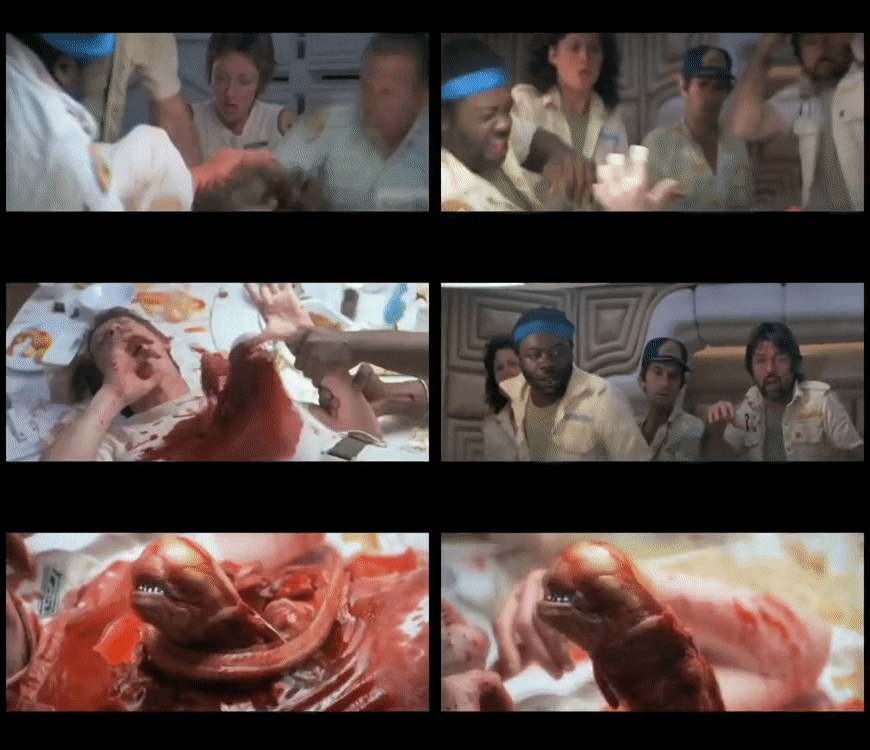
The first category is ‘Revulsion’ (Gross-out), an emotion linked to the instinctive feeling of disgust toward an occurrence that may be considered unsanitary or unnatural to the highest degree. It could be a scene in which pus or mucus is exposed in sometype of living creature, or fungi that covers the whole body. For myself, the most memorable scene in my head is the birth scene in “Alien”.


Seth Grahame-Smith on the 'viciousness' of the Stephen King's IT reboot

Secondly is ‘Horror’. Horror refers to huge events that humans do not usually experience and have little to absolute no power over. Examples of this can be the Cthulhu myth, or an apocalyptic event such as a Zombie epidemic or a Nuclear war.


Third and finally there is  ‘Terror’. King(2010) said Terror is the most sophisticated horror, which refers to an unpleasant feeling in situations where we don’t know if you are safe or unsafe. Often this comes from a lack of understanding about the situation one might be in along with little knowledge as to deal with a certain situation. 

So then where do we draw the lines between these ambiguities and uncertainties?

Obviously, it can’t specifically be called dangerous due to our lack of knowledge during such a situation, but when it comes to dealing with something that is not inherently safe or unsafe, our human brain becomes confused in judging its level of harm, which in turn leads to an unpleasant and creepy emotion.


The best examples of uncertainty are the clowns and wearable masks that many fear. Since the mask temporarily hides the face that reveals human emotions and intentions, it has the effect of isolating the object from the most basic social communication. In other words, because it blocks the primary basis for judging whether there is any expression under the mask or whether it is a harmful person or not, the ambiguity of the object is amplified, and confusion and fear of the unknown as well as uncertainty is expressed. In King’s work, Terror brings fear to the audience by using mental factors such as guilt, trauma, doubt, and paranoia of the protagonist. Also, it has the characteristic which many symbols that indirectly show the psychological state of the protagonist appear throughout the work.

This film best expresses the gloomy and terrorist atmosphere of <Pet Sematary 2019>.

Reference

Stephen King’s 3 Levels of Horror. Regal Reel. (2019, August 27). https://www.regmovies.com/static/en/us/blog/stephen-king-3-levels-of-horror.

Wikimedia Foundation. (2020, September). Pet Sematary. Wikipedia. https://en.wikipedia.org/wiki/Pet_Sematary.

King, S. (1981). Danse Macabre.
Vsauce
. (2013). Why Are Things Creepy?. https://www.youtube.com/watch?v=PEikGKDVsCc

Week 7: Horror Elements

“It is not the physical or mental aberration in itself which horrifies us…but rather the lack of order which these situations seem to imply” (King, 2010).

Horror is a genre of story and film, an entertainment category that the audience read or watch to get scare and frighten. This genre comprises of things that are mysterious, creepy, gruesome, and shocking, both in the story form and imagery form, able to make their audience react physically. According to Stephen King (2010), horror appeals to people because it representing many things that people are afraid to say out loud and allowing them to experience emotions that people are not usually familiar with in normal society. Horror genre “begins to coalesce between the last half of the eighteenth century and the first quarter of the nineteenth” (Carroll, 2003). In the 1930s, horror was popular during that period, as people when through the Depression days, and decided to let go of their anxieties with horror. This period was also “the rise of the so-called ‘Shudder Pulps’, which encompassed everything from Weird Talesto Black Mask.”(King, 2010). 

According to King (2010), Horror can be defined with three basic elements which are‘Revulsion, Horror and Terror’. These three things are the layered elements which made the horror genre works, keeping the audience on edge and interest in the story. 

First, the ‘Revulsion’, this are the moments that created the feeling of disgust for the audience. Can be clearly seen in horror films because of the imagery, an example is the american horror movies franchise, Saw. This movies franchise has many disgusting and gruesome moments, such as in Saw II where the character has to get the key by digging into their eye socket or have his head squashed by helmet with spike. 

Second, the ‘Horror’, this are about the “graphic portray of the unbelievable” (King, 2010). These are moments when audience are face with something that are not natural, abnormality or implausible, as facing with something that are difficult to understand often spark sense of fear in people. For example, the supernatural like aliens, vampires and ghost, these things created sense of fear in people. 

Lastly, the Terror, this are when fear is stimulating by imagination, somethings that are unknown can sock the audience into terror. For example, in the 2019 film ‘Colour out of Space’, the characters experienced and faced with an unknown being which can control them into behaving weirdly.

For myself, a horror story I’ve watched that makes use of all three of these elements are the action/science-fiction horror movies franchise, ‘Alien’. The story has all three elements, the Revulsion, Horror and Terror. Revulsion are for scenes in which we see the aliens comes out from its eggs and attaching itself to a human’s face to later burst out from the character’s chest. Or when human and alien fight and kill each other. Horror as the characters are fighting with extraterrestrial species creatures which are really ugly. Lastly Terror as they are fighting with creatures that they do not have any information on and was not yet understood.

References:

Carroll, N. (2003). The philosophy of horror: Or, paradoxes of the heart. The Nature of Horror. Retrieved from http://ebookcentral.proquest.com

Fandor. (2017, September 12). 3 levels of Horror According to Stephen King [Video]. YouTube.https://www.youtube.com/watch?v=F-EC0DoaaCY

King, S. (2010). Danse Macabre. USA. Retrieved from https://blackboard.aut.ac.nz/bbcswebdav/pid-5320793-dt-content-rid-12699647_4/xid-12699647_4

Week 7 Question

King describes horror as being defined through three basic elements. Explain, using references, what these three elements are. Think of a horror story you’ve read/watched/heard that makes use of all three of these elements and show how King’s definition is at play in that narrative.

Renowned American author Stephen King describes the horror genre as being defined through three central elements. These three elements are as follows, “terror on top, horror below it, and lowest of all, the gag reflex of revulsion” (King, 1981, p.37). A perfect example of a film that utilises all three elements of horror is John Carpenter’s “The Thing” (1982).

Firstly, terror. King (1981) states that genuine terror is the “unpleasant speculation called to mind” (p.34). Terror focuses less on the visual and more on the psychological aspects of horror by allowing the audience’s imagination to speculate the true dread. King (1981) elaborates that terror is “what, the mind wonders, might have been” (p.34). In “The Thing” (Carpenter, 1982), the alien’s true form is never actually revealed to the audience. Instead, the alien manifests and transforms itself into numerous distinct forms. This adds to the psychological terror of the film, as we are never able to gain a concrete understanding of the alien. Additionally, its ability to perfectly shapeshift into camp members instils the audience with a prolonged sense of paranoia throughout the film.

King (1981) states that horror is “that emotion of fear that underlies terror…because it is not entirely of mind. Horror also invites a physical reaction by showing us something which is physically wrong” (p.35). In “The Thing” (Carpenter, 1982), the physically wrong is presented though the alien and its numerous forms. The alien is often presented as exceptionally abnormal and frightful with tentacles and slime. Even when it assimilates to an animal or human host, it often deforms the host’s appearance when assaulting the camp inhabitants. For example, the character Bennings is taken over by the alien, eventually forming mutilated and visceral features.

Revulsion can be defined as the grotesque, unnatural and “gross-out” (King, 1981, p. 37) imagery commonly associated with the horror genre. King (1981) defines revulsion through the example of “Foul Play”, in which the baseball diamond is comprised of human viscera. In “The Thing” (Carpenter, 1982), the alien’s many forms are exceedingly visceral and slimy, closely resembling human flesh and intestines. Combined with acclaimed practical effects, the alien becomes truly disgusting and revolting in appearance.

By utilising all three of King’s (1981) elements of horror, “The Thing” (Carpenter, 1982) succeeds in horrifying audiences, cementing itself into horror history.

References.

Carpenter, J. (1982). The Thing.

King, S. (1981). Danse Macabre.

Week 7 Question

Horror as a genre has its origins dating back to the Spanish inquisition in the 13th century. The genre revolved around religion and its components were used as a propaganda to evoke submission from the general public (Jones, 2020). Known as pre-modern horror until the 19th century, stories usually comprised of acts that were deemed scandalous and gruesome, which were later on defined through characters such as vampires and witches in Gothic horror (Jones, 2020). Modern horror, as from late 19th century, gradually begin to revolve around local incidents and economic instabilities, such as local crime and post war adversity (Jones, 2020). From late 20th century to current era, horror novelist Stephen King has made exceptional strides in both horror literature and film industry. King (2011) describes three basic elements of horror that prove success in appeal to audiences.

King (2011) asserts that the horror genre presses on issues relevant to the decade such as economic instabilities; for example, the 70s experienced high inflation and high interest rates, buying a house was a huge accomplishment if achieved, and so horror films like The Amityville Horror, King’s The Shining were classics that were box office hits (Hendrix, 2017). In King’s explanation (2011), the three basic elements are revulsion or the ‘gross-out’, horror, and terror. The first tier of fear known as the ‘gross-out’ is a method of physically revolting the audience with something extremely graphic (Regal, 2019). As a classic example, The Shining (1980) begins with the revulsion factor by the backstory of the Overlook Hotel, where the previous owner Grady brutally murdered his entire family (Bracken, 2020). The specific details of all the murders cause physical recoil in the audience.

The second tier of fear is horror. This element is basically the graphical portrayal of ‘the unimaginable’, wherein something is visually beyond comprehension to the extent that it evokes fear and audiences would struggle to put the pieces of the story together (Regal, 2019). In The Shining, this element is displayed through a number of scenes; Danny is encountered with disturbing apparitions, ghastly figures, the vision “REDRUM” of murder spelt backwards is seen repeatedly, and a hose that chases Danny down the hallway (Bracken, 2020). The element is further fuelled with the fact that Danny’s parents are reluctant to believe in his visions, ghostly encounters, his bruise from being strangled and ultimately when Jack, the current caretaker, and Danny have several encounters upon Grady’s ghost’s persuasion to kill the family.

The final element and top of the tier is terror, which is the kind of fear induced through imagination (Regal, 2019). The audience is given specific unknowns towards the end of the story/film that they will explain it to themselves with a number of possible scenarios built in imagination (Regal, 2019). The element of terror could also be in the form of realisations that characters have about themselves, their lives, or possibly about the environment they are in. towards the end of the film, a picture is shown of guests in a ballroom which dates back to 1921. Upon closer look, viewers realise that Jack is in the picture, up front and centred. This leaves the audience with terrifying thoughts and possibilities about Jack and possibly his past life.

References

Bracken, H. (2020). The Shining. Retrieved from https://www.britannica.com/topic/The-Shining-novel-by-King

Hendrix, G. (2017). Paperbacks from hell: The twisted history of ‘70s and ‘80s horror fiction. Quirk Books.

Jones, N. (2020). A history of modern Horror Video Lecture. Retrieved from AUT Blackboard.

King, S. (2011). Danse macabre. Simon and Schuster.

Neilan, D. (2017) Stephen King breaks down the different levels of horror. Retrieved from https://www.avclub.com/stephen-king-breaks-down-the-different-levels-of-horror-1806112160

Regal (2019). Stephen King’s 3 levels of horror. Retrieved from https://www.regmovies.com/static/en/us/blog/stephen-king-3-levels-of-horror