Blog Feed

Week 10 Blog Post

On what grounds does Mountfort (2018) dispute Williams’ (1990) view that the I Ching does not figure in the novel aside from a few oracle consultations? 

The Man in the High Castle by Philip K. Dick is an alternate history novel presenting a world where Germany and Japan have won World War Two. Featuring throughout the novel is the I Ching or Book of Changes – a Chinese oracle or divination text that help the characters determine their next course of action. Mountfort (2016) disputes the view of Williams (1990) that the I Ching does not figure in the novel aside from a few oracle consultations, arguing that the I Ching is a central plot device that underlies the novel’s construction and philosophy. 

Philip K. Dick consulted the I Ching to help him write and develop The Man in the High Castle (MHC) (Mountfort, 2016). He posed questions to the oracle during crucial junctures of his writing, such as what would happen to his characters, how they should behave, and how the plot should move forward. Mountfort (2016) describes this as a metafictional discussion between the author and the protagonists and therefore the reader and the text. This is because Dick’s use of the oracle as a deciding factor for his next move as a writer mirrors his characters’ use of the oracle to decide how they will proceed in their lives. 

Williams’ view of the I Ching in relation to MHC is that the novel’s plot does not come from I Ching readings directly, and that it only participates in the novel when the characters are consulting it (Williams, 1990). In other words, Williams’ view is that the I Ching is a feature of the plot rather than a driving force of the philosophy behind it. Mountfort (2016) disputes this view and argues that the I Ching underpins the entire fabric of the novel. 

For example, the I Ching provides the philosophical foundation of the novel, particularly the concept of synchronicity (Mountfort, 2016). This is described as events being meaningful coincidences where they have no causal relationship but are still purposefully related (Tarnas, 2006). Synchronic philosophy is evident in each major character using the I Ching to guide their next course of action. Mountfort (2016) argues that there are twelve instances of oracular consultations that take place in the novel, each revealing patterns that mirror each other. For example, four of the twelve consultations involve characters Frank Frink and Mr. Tagomi consulting the oracle twice and in a similar pattern (Mountfort, 2016). Their first question (respectively) is about meeting someone and how to go about a delicate interpersonal situation, in Frink’s case with his boss Wyndham Matson, and in Tagomi’s case with obtaining a gift for an important visitor from Robert Childan (Mountfort, 2016). The answers to their second questions are both concerned with the inner nature of a person rather than what they outwardly appear to be, in Frink’s case his ex-wife and in Tagomi’s case his business contact (Mountfort, 2016). What’s significant about this is that Frink and Tagomi’s paths intersect towards the end of the novel, without either character having met each other (Mountfort, 2016). Tagomi ultimately saves Frink from being surrendered to the Nazis, thereby intimately connecting the two characters while they each have no idea of the impact they’ve had on each other’s lives (Lison, 2014). This is integral to the philosophy of the I Ching as the two characters are meaningfully connected as their fates interlock together (Mountfort, 2016).  

Lison (2014) argues that Frink and Tagomi’s storyline is predicted by the I Ching. This is because when Frink consults the oracle as to whether or not his jewelry business will succeed, he receives a mixed reply where it says the business will bring good fortune, but also warns of a future catastrophe unconnected to the jewelry business (Lison, 2014). This refers to the destruction of Japan due to Operation Dandelion, which Frink is unaware of. Lison (2014) argues that the oracle passes favorable judgement on Frink’s business while simultaneously indicating that it is dwarfed by a larger concern. They argue that this mirrors the narrative structure of the novel, in which small moments of favor, such as Mr. Tagomi’s act of kindness to Frink, are dwarfed by the larger concern of the characters’ reality not being real, as revealed at the end of the book (Lison, 2014). 

Another way that the I Ching is central to the construction of the novel is how it presents alternate worlds. MHC presents us with three alternate worlds – the world the novel is set in, the world presented in the novel within the novel (The Grasshopper Lies Heavy), and the world of the reader (Mountfort, 2016). This many-worlds interpretation ties in with the I Ching as they are both based on the element of chance, suggesting that alternative possibilities in different realities always exist (Mountfort, 2016). The fate of each character is decided by a text in which multiple scenarios are possible. Again, this is mirrored by the multiple universes within the novel. Even the ambiguous ending of the novel emphasizes how there is not one reality in which the novel should end, but rather multiple possibilities as determined by the aleatory nature of the I Ching (Mountfort, 2016). 

References 

Lison, A. (2014). “The very idea of place”: Form, contingency, and Adornian volition in The Man in the High Castle. Science Fiction Studies, 41(1), 45-68. 

Mountfort, P. (2016). The I Ching and Philip K. Dick’s The Man in the High Castle. Science Fiction Studies, 43(2), 287-309. https://doi:10.5621/sciefictstud.43.2.0287 

Tarnas, R. (2006). Cosmos and psychePlume. 

Williams, P. (1990, December). The author and the oracle. PKDS Newsletter, (25), 1-10. 
Week 5 Questions

6. What is the ‘shōjo’ and how does it often function in anime?

According to Yukari (2012), Shōjo, which literally translates into “young woman” in English, falls under a category of Manga and Anime films that are primarily targeted towards a young female audience, with Tokyopop and VizMedia claiming that the demographic for shōjo manga ranged from girls aged 12 to 17 years old (Takeuchi, K., 2010). Shōjo is often characterized presently by passive personal narratives, the pursuit of romantic relationships and the internalized musings of and about human relationships.

However, Shōjo goes further than this oversimplified classification. Truly beginning in the 1960s, a group of female shōjo manga authors led the “radical diversification” (Aoyama et al., 2010) of the genre through a series of subgenres within manga which included family stories, school stories, science fiction, fantasy, and comedy as a way of studying the many layers of the human psyche. By saturating the works of shōjo manga with human psychology, these authors established patterns of the shōjo genre that would continue to be utilized onward (Yukari & Thorn, 2012).

Within anime, shōjo stories have been quoted to bring readers “a sense of liberation from social norms and restrictions” through the telling of stories which focused upon the personal and interpersonal identity (Takeuchi, K., 2010). Shōjo was able to both address and transcend the conventional and traditional views and ideas of modern society as far as gender identity, representation, sexuality and sense of personal narrative, belonging and empowerment were regarded (2010).

Furthermore, shōjo is a demonstrative genre which explores themes of philosophy, while questions about identity are prevelant within shōjo, so too are core stories about human nature and existence, the struggles of connectivity among the wider communities and how often within shōjo stories which explore the magical girl trope, address the means of saving the world through understanding and compassion (Coates, J., 2018).

References

Aoyama, T., Dollase, H., & Kan, S. (2010). Shōjo manga: Past, present, and future. University of Hawai’i Press.

Coates, J. (2018). Mediating memory: Shōjo and war memory in classical narrative Japanese cinema. The Hakubi Project, Kyoto University.

Takeuchi, K. (2010). The genealogy of Japanese “shōjo manga” studies. University of Hawai’i Press.

Yukari, F., & Thorn, M. (2012). Takahashi Macoto: The origin of shōjo manga style. Mechademia, 7, 24-55. Retrieved October 11, 2020

WEEK 9 COSPLAY

WEEK 9 COSPLAY 

  1. In what ways can cosphotography be understood as a form of “fan capital”? 

Many cosplayers create their own costumes, but some prefer to buy them. Cosplay requires tremendous skill, dedication and ingenuity, and the finished costumes can be genuine works of art. Making or buying costumes may prove difficult, but there is also the time and effort spent on make-up preparation including hair and wig styling, the task of travelling to venues and of course the courage required to wear the costumes in public.  

Cosplay is an art-form, alive and temporary and photography plays a significant part (Mountfort, 2018). As photographers it is their job to let the costumes shine and capture the true essence of those creations and to know that another work of art has been documented for posterity.  

Cosphotograhy is a two-way exchange whereby the cosplayer provides the photographer with a subject and the cosplayers efforts and dedication are rewarded with acknowledgement and something tangible to take away, in what is a reciprocal relationship (Mountfort, 2018). Just as there are thousands of people who like to dress up as their favourite characters there are legions who love to photograph them. By being photographed and filmed the cosplayer can achieve visual tokens of private value and fan capital that circulates online and reaches a wider audience. While online galleries are still the dominant visual discourse of cosphotography, books, prints, coscards and emerging genres of moving image media are increasingly important, from fan-directed cosplay music videos (CMVs) and indie documentaries to network-based reality television shows (Mountford, 2018). 

This fan capital or hipness allows us to understand the tension between fan-directed cosplay and commercial cosplay, heterotopian versus hegemonic control of cosplaying spaces, and supportive audience responses versus the exploitative (Mountford, 2018). 

One of the tag lines is cosplay is for everyone so TV series “Heroes of Cosplay”, which followed cast members competing in cosplay events across the United States is widely panned by cosers and critics alike for its Idol-style format, misrepresented cosplay as being all about winning (Mountfort, 2018).  

Because the cosphere is a community where visual tokens are in the centre of attention and exchanged between people, it is likely that these tensions will continue to circulate within the community. 


REFERENCES 

Mountfort, P., Peirson-Smith, A., & Geczy, A. (2018). Planet cosplay: Costume play, identity and global fandomIntellect. 

Week 4 Questions

What features make Akira cyberpunk, and how does it reference the wider subgenre?

According to Jorgensen (2020), Cyberpunk refers to a sub-genre of science fiction and features highly advanced technological societies, cities and landscapes, heightened scientific research platforms and displays urban, dystopian futures with a film noir aesthetic. Cyberpunk contains various characteristics that have become trademarks of the genre such as dystopian futuristic settings, combinations of low-life and high tech, massive class divides between the grossly rich and the poverty and addiction ravaged lower class societies, vast technological advancement to the point of the total destruction and extinction of natural and organic resources as well as the corruption of governments or the systematic oppression by major mega-corporations (Cavallaro, D., 2000).

Akira contains several of these trademark characteristics of cyberpunk such as a dystopian earth. A world based on a near-future earth where technology has become deeply enmeshed in everyday human existence (Nicholls, P., 1999.) as seen with the highly modified street racer motorcycles that are seen prevalently among the youth biker gangs as well as the advanced military technology such as the compression laser weapons used by the Japanese army and military factions as well as the satellite weapon used to injure Akira’s leading antagonist Tetsuo.

One of the other trademark features portrayed within the film is the high tech, low life archetype. Following the destruction of Tokyo, the generational youth have grown up within an advanced technological world which both supports and controls them (Iglesia, M., 2018). We see this with the high presence of law enforcement and military personnel seen interfering with the working-class protests as well as with the youth groups violent criminal rebellion against rival biker gangs. The police and law enforcement presence in Akira is violent, oppressive and utilize advanced machinery such as high surveillance and jet bikes which utilize highly lethal miniguns as a form of intimidation and execution (Otomo, K., 1988).

Akira also uses several tropes from old noir movies, many of the characters represented within Akira are cynical, bitter and disillusioned by the violence and oppression of their every day lives. Kaneda is portrayed as a violent delinquent and malcontent whose only interest is in his biker gang and chasing the skirts of other lead character Kei but is later portrayed as the reluctant hero only after Tetsuo murders their close friend and ally Yamagata with his driving force behind this decision being that “If anybody should be killing him [Tetsuo] it should be us!” (Otomo, K., 1988).

One final feature demonstrated within the film is the existence of a higher authoritarian organization, while in most cyberpunk this power is often demonstrated through mega-corporations which control the earths planetary resources, services and industries, with a largely powerless government, or vice versa, Akira demonstrates this controlling organization as the military, led by Colonel Shikishima, who overthrows the existing government by staging a coup and turns the remaining military to his control by using the fear and uncertainty created by Tetsuo’s supernatural and psychic abilities as well as the prophesized threat of Akira (Otomo, K., 1988).

References

Cavallaro, D. (2000). Cyberpunk and cyberculture: Science fiction and the work of William Gibson. The Athlone Press.

Iglesia, M. (2018). Has Akira always been a cyberpunk comic?. Institute of European Art History.

Jorgensen, D. (2020). 2019: The year of our cyberpunk future. Artlink.

Nicholls, P. (1999). Cyberpunk. In the Encyclopaedia of science fiction. London: Orbit.

Otomo, K. (Director), (1988). Akira [Film]. Tokyo Movie Shinsha.

Week 8 – Cosplay as Citation

Referring to Mountfort et al. (2018), in what ways is cosplay analogous to citation?

On the surface, cosplay is universally associated with fans dressing up as characters from comics, film, tv and many other popular media texts. This practise can be seen as analogous to citation, due to it’s act of requiring a source text to reference. Mountfort (2018) explains this concept with the example of walking through a convention space occupied by cosplayers. The costumes, props and movements performed in this space are live and ‘in action’ acts of referencing by cosplayers of a variety of source texts.

We can look at cosplay and the process of direct quotation/paraphrasing as very similar. Cosplayers choose characters from a source text and recreate them, providing their understanding or view of said source text, in the same way we might incorporate a direct quote or reword a portion from a peer reviewed journal in order to clarify our stances or claims in a piece of academic writing. The difference here is in the visual, performative nature of cosplay – which acts as citation itself – as opposed to written citation where authors and referenced texts are expected to be present through the use of in-text citation and bibliographies. Citation is otherwise understood as a form respect and acknowledgement for existing work, so it is no surprise that cosplays modern take has been criticised as ‘textual poaching’ of popular culture (et al. 2018).

Cosplay and citation also have in common that their sources could be potentially ‘messed’ with (Mountfort, 2018). Citation in writing is used to either support and negate ideas, resulting in carefully picking references that fit the preferred argument. This could be data, quotes and other findings on an argument. The other side to this is that sources are not immune to being manipulated to appear as though it supports or negates certain ideas. With cosplay, a source is also required for reference and support however it is a single source text that is used, since the physical body is the ‘canvas’ more or less where the citation occurs. The source text here, is used to provide a base for the creation of costumes, props and performances by the cosplayer. Like citation, these texts are also not immune to being manipulated, however, it is the vast layers of interpretation that are a pillar of cosplay itself. Gigaba notes this freedom-of-expression aspect has created a blur between appreciation and appropriation (2017), especially in instances where political or cultural histories are utilized for ‘play’ by cosplayers who may or may not have prior knowledge of such things. For example, a non-white cosplayer darkening their face as part of their costume is in essence blackface, however in the context of a cosplay convention this would be overlooked by many, perhaps the cosplayer himself. “Politically correct cosplay requires a critical consciousness and willingness to compromise certain representational aspects of our personal heroes of fiction” (Gigaba, 2017).

References

Mountfort, P., Peirson-Smith, A., & Geczy, A. (2018). Cosplay as Citation. In Planet Cosplay: Costume Play, Identity and Global Fandom (pp. 23-38). Chicago, Illinois: The University of Chicago Press.

Mountfort, P., Peirson-Smith, A., & Geczy, A. (2018). Cosphotgraphy and Fan Capital. In Planet Cosplay: Costume Play, Identity and Global Fandom (pp. 23-38). Chicago, Illinois: The University of Chicago Press.

Gigaba, A. (2017, June 27). Cosplay – A Blurred Distinction Between Appreciation And Appropriation. Retrieved from https://www.huffingtonpost.co.uk/ayanda-gigaba/cosplay-a-blurred-distinction-between-appreciation-and-approp_a_22492070/?guccounter=1&guce_referrer=aHR0cHM6Ly93d3cuZ29vZ2xlLmNvbS8&guce_referrer_sig=AQAAAKHjl0cWxGpVAvpiOgfiR4lwW8f6wKlJuHb4Y0rTAaP4e9RzE6evs0jVfg4AVhDydzXDJxcMfZPhUweZIBd02lxHFfZKoD4iOXTK1ceNALRMDy-RsjyKApFrd4v4Aj52xCkiogM2snqLcjBjKejDtrr60I3JjpgrEVhiOZv8KGe5

Week 4: Anime

Part 1: What features make Akira cyberpunk:

Cyberpunk is a combination of Cybernetics and Punk. In terms of the artistic creation of film and television entertainment; it is a branch of science fiction stories based on information technology with a combination of low-life and high tech. The animation Akira is fully conformed to the features of cyberpunk, including cyberspace, cybernetics, urban expansion and ghetto, mega enterprise, human augmentation, genetic engineering, terrorism and anti-hero as seem from the Cyberpunk documentary(Indigo Game, 2019). The only difference is the combination with Japanese-style cultural relics in the background (Suzuki & Shunzo, 1988).

From the appearance of the Neo-Tokyo represent high-tech dark city as there are many futuristic high-rise buildings, and there are also many Japanese-style buildings such as restaurants, temples and other signs with Japanese language characters on the streets under the overwhelming high-rise buildings, the dazzling lights and the gloomy scenery (Suzuki & Shunzo, 1988).

Social chaos in the story have become incurable; violent incidents like drag racing, explosion and destruction, and anti-government activities such as protest movement and demonstrations. The school has become a gathering place for degraded ethnic groups; students do not study, and the faculty teachers are helpless. The high-level government is even more corrupt, intrigue, and only for their interests, regardless of whether they live or die (Suzuki & Shunzo, 1988).

In terms of technology, buildings are similar to robotic styles, including vehicles, networks, digital spaces, mechanical pipelines, and complex electrical circuits are all-important technological elements. For example, the low-floating vehicles, high-tech surgical laboratory which transformed Tetsuo into Akira like superpower, and the coverage of high-tech underground base (Suzuki & Shunzo, 1988).

In terms of human nature, Akira showed the evil thoughts, hatred and greed of humans; it also explained that power is like money; once you got it, you will want more. For example, when Tetsuo has achieved superpower, he changed from a weakling to a madness killer and slaughtered those who got his way from achieving Akira’s power, including his friend Kaneda who used to look down on Tetsuo (Suzuki & Shunzo, 1988).

Part 2: How does it reference the wider subgenre:

Akira is undoubtedly the most successful Japanese animation in the Western market. While producing Akira, Katsuhiro Otomo also referred to the film and television works from various parties. Afterward, Akira has also become the inspiration for cyberpunk entertainment works. In other words, Akira and Western film and television inspire each other. As for which subgenres Akira referred, Otomo has combined his life experiences, including people and things, and the early robotic animations and the Hollywood movies he saw into a world, which is the Neo Tokyo in Akira.

First; the Neo-Tokyo in Akira derived from what Otomo saw and heard on the streets of Tokyo in the 60s and 70s, including the post of World War II, the Tokyo Olympics in 1964, and the security struggle in the 70s has become the corrupt elements shown in cyberpunk. For instance, Katsuhiro came to Tokyo after graduating from high school, witnessed the drastic changes that Tokyo was going through before and after the 1964 Tokyo Olympics, he then saw student demonstrations, cyclists, political movements, gangs, and homeless teenagers (Kodansha Comics, 2019).

Second; two early Japanese animes inspired Otomo, one is from Yokoyama Koki’s Iron Man no.28, and the other is Osamu Tezuka’s Astro Boy, both are about the abuse of technology in wars and peace (Fuller, 2020). In short, these two works have inspired Katsuhiro in character and story setting. For example, the two protagonists, “Kaneda Shotaro” and “Shima Tetsuo” are named after Iron Man 28. In the story of “No. 28”, Shintaro Kaneda is the protagonist who is the pilot of no.28 robot, and Tetsuo is taken from the scientist Dr Shikishima Tetsuo. Furthermore, the number 28 in Akira’s hand is the tribute message to the glory of Yokoyama’s
Iron Man no.28 (Barber, 2017). As for the prototype setting of Akira, it was inspired by a character from the version of Tezuka’s Journey to the West Xiaolong, who poses deep, crying and sad expression, so he used this as a prototype with the combination of mysterious superpower developed by dark technology (Kodansha Comics, 2019).

Third, Akira’s setting is inspired by American film and television works, especially the Blade Runner which directed by Ridley Scott and has similarities with Akira. For example, Neo Tokyo is much like the cyberpunk scene of Los Angeles in Blade Runner; more smog, more neon lights, more holistic and more technological elements like projection advertising (Surat, 2017). Yet, the true ancestor of cyberpunk is the French manga master Moebius. Through the blade runner, Katsuhiro Otomo realized the drawing of cyberpunk from Moebius’s artwork, which later inspired him on the technology settings because of the urban landscape and visual style that influenced the aesthetics of the movie in Blade Runner are everywhere in the shadow of Moebius (Campbell, 2017).

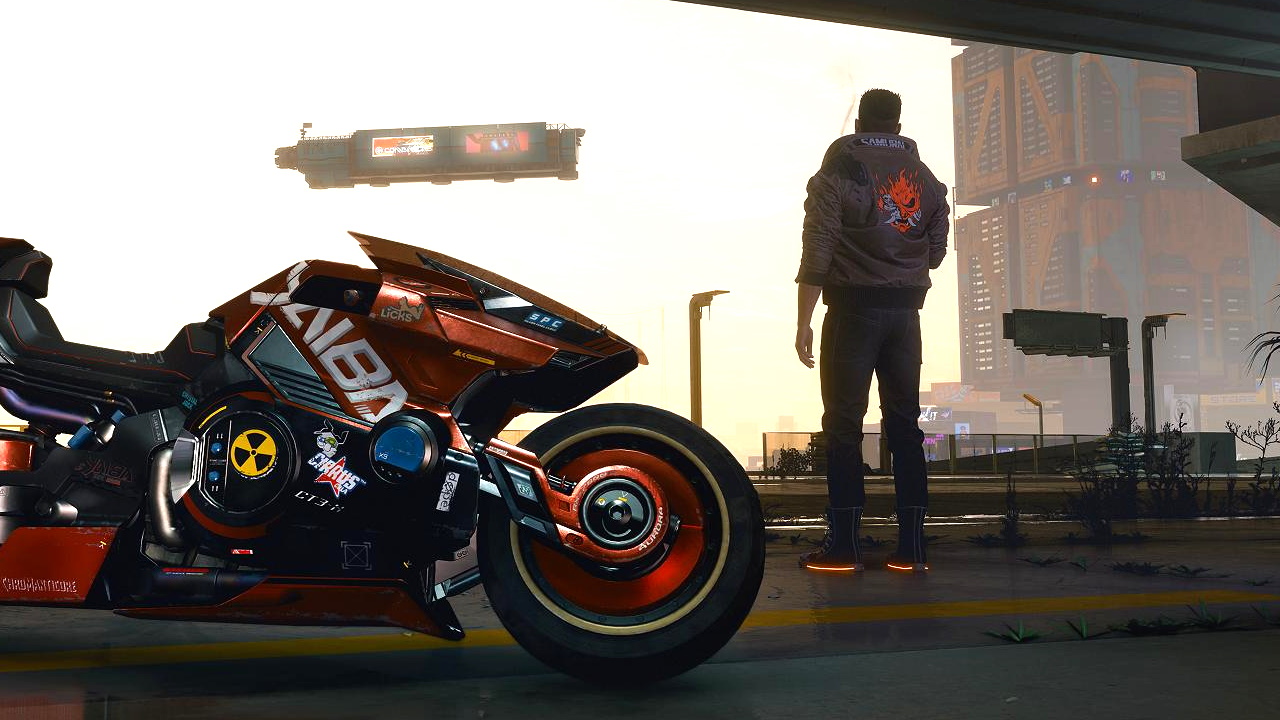
Finally, Akira makes cyberpunk themes more dazzling, including environmental collapse, body transformation, the undercurrent of consciousness, human evolution, artificial intelligence, trust totalitarian, and has become the best role model for film and television entertainment, and video games, some creations are even completely imitated and then modified to their own, which is why some critics always adopt a satirical attitude towards cyberpunk works of today by saying they are owing debt to Akira, as according to Campbell (2018). threads of Akira’s influence can be found in all aspects of popular culture today. For example, like the Japanese animation Ghost in the shell and the Hollywood movie Matrix with many figures of Akira including; complex technology, garbled screens, and the dark fallen world (Campbell, 2017). Furthermore, a new upcoming game Cyberpunk 2077(see the attach) is very enlightened by Akira. For example, in the customization mode, players can change motorcycles outlook into the similar one used by Kaneda in Akira, which is also a tribute to Akira by the production unit (Sheridan, 2019).

New Cyberpunk 2077 motorcycle screenshot shows a very Akira bike you can  add to your garage | GamesRadar+
Video game: Cyberpunk 2077

Reference:

Indigo Gaming. (2019). Cyberpunk documentary part 1: Neuromancer, Blade Runner, Shadowrun, Akira [Video]. YouTube. https://www.youtube.com/watch?v=sttm8Q9rOdQ&feature=share&fbclid=IwAR0ZOnQmyGabIr8FMiM6Lkz-DBE1–cZrqPuIA2StGx-4WIjVmBrOKS9GeA

Suzuki, R. & Shunzo, K. (Executive producer). (1988). Akira. Tokyo Shinsha. https://www.youtube.com/watch?v=ooKBenGK3R4

Fuller, F. (2020). The deep influence of the A-bomb on anime and manga explained. https://www.penncapital-star.com/commentary/the-deep-influence-of-the-a-bomb-on-anime-and-manga-explained/

Barber, O. (2017). Katsuhiro Otomo on creating Akira and designing the coolest bike in all of mega and anime. Forbes. https://www.forbes.com/sites/olliebarder/2017/05/26/katsuhiro-otomo-on-creating-akira-and-designing-the-coolest-bike-in-all-of-manga-and-anime/#40481c266d25

Kodansha Comics. (2019). Akira: Otomo interview, rightstuf exclusive pins, sweepstakes and more. https://kodanshacomics.com/2019/01/09/10-years-kodansha-comics-akira/

Surat, D. (2017). Blade Runner’s unbelievable influence on anime. Anime News. https://www.animenewsnetwork.com/feature/2017-10-06/blade-runner-unbelievable-influence-on-anime/.122391

Campbell, O. (2017). Mind blowing artwork from the anime classic Akira. Dazed. https://www.dazeddigital.com/artsandculture/article/32448/1/the-french-sci-fi-comic-that-inspired-blade-runner-and-akira

Sheridan, C. (2019). New cyberpunk 2077 motorcycle screenshot shows a very Akira bike you can add to your garage. Game Radar. https://www.gamesradar.com/cyberpunk-2077-motorcycle/

Week 10 Questions

2.What distinctions are there between alternate history, postmodern alternate history, and uchronie genres?

Alternative history has been regarded as a subgenre of literary fiction, science fiction, or historical fiction, with a series of fiction genres starting from the assumption”What if humanity’s history had evolved differently from previous facts?” Alternative history is mainly intertwined so closely that it cannot be discussed apart from intersecting time, time splitting that it is distinguished in many ways: alternative history, postmodern alternative history and uchronie genres.

Mountfort (2016) distinguishes the three genres with Philip K dick’s The Man in the High Castle, published in 1962 in research. High Castle is one of the most well-known of all alternative histories and is one of the most popular themes in the whole field of history. Also, The Man in the High Castle was inspired by I Ching, an ancient Chinese literary device also known primarily as the text of divination, or the Book of Changes. In the novel, it transcends the philosophical complexities of the story, given that the Nazi win World War II. However, many opinions are divided depending on whether they are viewed from a diachronic or synchronic perspective. 

“Amy Ransom argues that critics discussing alternate history (AH) have often neglected to distinguish among the more conventional forms, which are underpinned by a linear, causal, or diachronic view of time, and the more synchronic view implicit in the French term for the genre, uchronie”(Mountfort,2016).

First of all, alternative history usually has the straightest and diachronic view of time. A diachronic perspective can be understood as the concept of time from one point to another, which varies with the changes of the times. Also, unchronie has a synchronic view of time, which can be understood by the concept of a single point in time associated with the same era. In fact, many academic sources study High Castle as a formative example of alternative history, but mostly as a novel of a diachronic genre. However, “Dick’s notion of history is certainly synchronic rather than diachronic, in the terms of Jameson’s analysis, both in his evocation of a web of interrelationships and in his sense that the profusion of possible realities could radically undermine our sense of the real”(Mountfort,2016). 

This is linked to the concept of “synchronicity” that Carl Jung and other scholars have tried to explain. “Ransom describes Jung’s synchronicity concept as “related to that associated by Jameson and Alkon with the postmodern”. he defined synchronicity both as an “acausal connecting principle” and as “meaningful coincidence” or “cross-connection”.”(Mountfort,2016). It shows that the work is linked to the Postmodern Alternate History time view. From this, we can see that the three genres of alternative history are distinguished by whether we have a diachronic or a synchronic view, and these are dependent on how we accept stories.

References

Mountfort , P. (2016) The I Ching and Philip K Dick’s The Man in the High Castle SF-TH Inc

Week 10

Rija Faisal

How does Dick use the I Ching and how did his views on the oracle and its role in the novel shift over time?

In The Man in the High Castle, Philip K Dick uses the I Ching or The Book of Changes, as an oracle to aid him in the construction of his novel. (Mountfort 2020) The central plot element of the novel is the use of the I Ching by the main characters. Dick’s obsessive consultation of the oracle provided him with answers which then acted as key elements in the writing of the novel. (Mountfort 2020)

Mountfort writes that this helped to set up a powerful metafictional dynamic between the author and his protagonists of the The Man in the High Castle. While Philip Dick does in fact use the oracle to help him in his writing, it is mentioned by Mountfort that Paul Williams did an analysis of the most important points in the text where the I Ching was used, and Williams concluded that he did not believe the plot of the novel was gained only through the reading of the I Ching, and that the I Ching was not used throughout the book’s development, but rather only when the characters in the novel used it themselves.

Mountfort (2016) argues that the I Ching provided a philosophical base for the story of the novel, in the, quote : “synchronistic notion of simultaneity” or the “meaningful coincidence” which is contrary to classical western views of causality. He argues that the I Ching does not not merely act as a consultation device for certain points in the plot, but rather, it is a device that actually unifies both the stylistic and the philosophical levels of the novel.

In the end, however, as helpful as the I Ching may have proved to have been for philip Dick, it turned out to be quite the opposite. The oracle suddenly transformed from a helpful guide into this bitter version of an antagonist.  

The ending of the novel never truly satisfied Dick, and he wrote that he would have liked to have an ending that was “stronger and better” than the one he had ended up with. He blamed the oracle for it, in fact, believing that it had both misled and betrayed him, giving him an unsatisfying ending to the novel, and that it had done so on purpose.

References

 Mountfort , P. (2016) The I Ching and Philip K Dick’s The Man in the High Castle SF-TH Inc

Week 10 Questions

What distinctions are there between alternate history, postmodern alternate history, and uchronie genres?

Alternate history, postmodern alternate history, and uchronie genres all fall under the specific literary, fictional genre, that involves the concepts of parallel worlds and timelines. The alternate history genre can be seen as an overarching genre which involves narratives where one or multiple historical events may occur differently. The uchronie genres, derived from a French term, includes an ‘alternative history,’ where a story occurs in a similar world to ours until a specific event is altered to what we believe is true. In Mountfort’s (2016) research, subgenres of the uchronie genres are identified, and there appears to be three different variations such as ‘pure uchronie,’ involving a singular alternative world, ‘plural uchronia,’ consisting the existence of an alternative world in parallel, and ‘infinite uchronia,’ where there is the possibility of many or infinite parallel worlds.

In addition, the term uchronie mostly emphasizes a less causal or ‘diachronic’ form of history, but rather a ‘synchronic’ one. Mountfort (2016) explains the relevance of Philip K. Dick’s The Man in the High Castle (TMITHC), as one of the most critically acclaimed, and a prime expample of the uchronie or alternative history genre. TMITHC was primarily inspired by the I Ching, which is an ancient, Chinese literary device also known as a text of divination, or the ‘Book of Changes.’ Dick’s novel inspires the use of this in it’s main plot, and figuratively uses it and gives the reader a sophisticated postmodern fiction that examines the extremities of the text and the world in which it occurs. In fact, many academic sources have studies TMINHC as a formative example of alternate history, but specifically as a novel of the uchronie genre. However, Dick uses a more synchronic view of history than diachronic in TMINHC.

Moreover, other scholars such as Carl Jung have also tried to explain theories behind the concept of ‘synchronicity,’ which is a major element in the alternative history genre, as it involves the altering of certain events in history. Jung describes synchronicity as something related with the ‘postmodern,’ which was objectively true, but a distinct factor of Jung’s understandings were that he was concerned with the simultaneities between the objective events of the genre and the related subjective states (which often had a psychological or spiritual quality to them). Jung addressed synchronicity as an ‘acausal connecting principle,’ and as a ‘meaningful coincidence.’ Where, the critical disjunctions found in the linear timeline is a factor of the uchronie genre.

Overall, alternate history, postmodern alternate history, and uchronie genres all involve the existence of an alternate world, where although it is similar to our world, events may occur differently to what we believe. The major distinguishing features between these three concepts is whether they involve a more synchronic or diachronic narrative to them.

Week 10, question 4.

4. How does Dick use the I Ching and how did his views on the oracle and its role in the novel shift over time?

According to Mountfort (2020) Dick used the I Ching as an oracle to help him write his novel, the answers he got was a key element when he wrote the story. The main characters use of the I Ching acts as the novels central plot element and Dick used the I Ching obsessively when he wrote the book (Mountfort, 2016). Dick (n.d.) said himself that he used the I Ching because several of his characters used it. When one of the characters asked a question, he’d throw the coinsand and write the hexagram lines they got. This resulted in twelve I Ching results that highlights the central concerns of the novels main characters. It connects characters who never meet, but their actions still affect each other in specific ways (Mountfort, 2016).
Mountfort (2016) writes that Dick’s obsession with using the I Ching helped setting up a “powerful metafictional dynamic” between Dick and his protagonists. Although Dick uses the oracle to help him in his writing, Mountfort (2016) mentions that Paul Williams wrote an useful analysis of the most important points where the I Ching is used in the text, Williams doesn’t believe that the plot were gained mainly through I Ching reading, but that it were used only when the characters used it in the story.
Mountfort (2016) writes on that the I Ching added a philosophical base for the story in the “synchronistic notion of simultaneity or “meaningful coincidence” that is contrary to classical western views of causality” and he argues that the I Ching is a device that unifies stylistic and philosophical levels of the book.
As for Dick’s relationship with the I Ching it seems to have had its ups and downs. Dick was never satisfied with the ending of his novel ad he blamed the I Ching for not providing him with a satisfying ending, he wrote that he would have liked it to have a “stronger, better ending”. Dick actually came to a point where he believed that the oracle had misled and betrayed him on purpose, although this conflict with the I Ching didn’t last very long (Mountfort, 2016).
The oracle shifted from being a key element to his writing to becoming the villain in a way, considering how Dick thought the I Ching had given him an unsatisfying ending in purpose.  

Sources:

Mountfort, P. (2016). The I Ching and Philip K. Dick’s The Man in the High Castle. SF-TH Inc.

Mountfort, P. (2020). Week 10: The Man in the High Castle, uchronie and the I Ching. PowerPoint.