Blog Feed

What is the ‘shōjo’ and how does it often function in anime?

Shojo is a manga that has a young teenage girl target demographic; young girls who are transitioning from adolescence to adulthood, typically aged 12 to 13. Cavallaro describes shōjo as “nestled between adulthood and childhood” (2006).The term literally defines a ‘young woman’. According to Oxford Lexico (2020), Shojo is “A genre of Japanese comics and animated films aimed primarily at a young female audience, typically characterized by a focus on personal and romantic relationships”. Shojo manga doesn’t adhere to a fixed genre however, it utilises a number of narrative styles inclusive of sci-fi, action, horror etc with the prime focus being on the romantic relationships present within them, under a magic filled dreamy setting. Additionally, another way to look at shojo anime or manga is by understanding that while the demographic is appealing to young girls, the viewers are not necessarily just females as it can appeal to male audiences. In hindsight, shoujo anime explores multiple ideas of innocence, coming of age, femininity and masculinity as well as many other ideologies. According to Susan Napier ‘shoujo characters could embody the potential for unfettered change.”

Shojo anime usually has female leads, and a romantic plotline that amplifies the protagonists inner growth.The imagery used within shojo incorporates not only conventional female images but also aspects of purity, innocence, vulnerability, virginity, and romantic nostalgia- usually “contrasting it with themes of vulgarity and sexuality”. (Berndt, 2019).  Furthermore, shojo within anime allows young girls to maneuver through the many struggles they may encounter within the pre-teen ages. Aspects such as finding oneself, adapting to the new changes in their bodies, building strong personal and interpersonal relationships, under a romantic light, these issues have been prevalent within shojo anime, and have provided encouragement to young girls. (Mesuda, 2015). 

The creation of shojo started to progress during the pre-war era in which men who were influenced by a male dominated government began to write articles. The Meiji Restoration period, following 1898 called for the westernisation of Japan as the country forced gender segregation through dictating and implementing strict dress codes which allowed Japanese Men  to wear westernised clothing whereby Women were restricted to the traditional Japanese Meiji civil code. without room for discussion. The code enforced Women to carry out orthodox roles such as living life as an obedient wife and exceptional mother, limiting their freedoms, and giving absolutely no right to career choices amongst society. It is interesting to note that, although heterosexuality was something that was a norm in Japan during the time, so was intimate relationships between girls in an all girls school. Sasaki (2013) makes readers aware of this by stating how female same sex relationships were“an accepted means of delaying heterosexual experience until girls were old enough for marriage.” ( Sasaki, 2013). Shojo anime uses same sex relationships between girls in their works, in order to break free from an anti-heteronormative view.  Examples of this are shown in the series Sasameki Koto and  Maria-sama ga Miteru. As Napier (2005) states, shojo “encapsulates both the increasing fluidity of gender identity in contemporary popular culture and the tensions between the sexes that characterize a world in which women’s roles are drastically transforming.” 

Additionally, shojo anime favors romance to fighting which is a bit of a juxtaposition; romance isn’t something often associated with girls of such a young age, and comparing romance to fighting or placing them under the same light doesn’t really seem fair. Moreover, shojo anime strongly encouraged young girls’ physical appearance, by using characters that are exceedingly cute and beautiful. Cute young female characters within shojo anime is really what made it so popular.  “Nozomi Masuda writes in her chapter: “The Japanese word and concept of kawaii (‘cute’) has become popular in East Asia and Europe as a result of manga and anime and related merchandise. Japan may be a unique country in that kawaii is everywhere in Japan and is loved by people of all ages and genders. The kawaii culture developed alongside shojo (girls’) culture, with shojo manga as the benefactor” (p. 23).  Masuda states that  the middle Meiji era accounted for a modernised education system in which the classes were segregated in schools. The creation of shojo anime is a byproduct of Japan’s modernisation process in which males and females were perceived as separate target groups.

Shojo anime can be summarised into a unique sense of femininity, in which girls are acknowledged just as much as boys; breaking free from the past patriarchy of Japan. Shojo characters are metaphors for necessary change in the current times, for females. Its purpose as a genre is significant, as there are many points of self and societal reflection that are presented to the viewers. The deeper messages arising from shojo are disguised under a romantic light to disembark from violent tactics that are sometimes used in other forms of anime.

References

Masuda, N. (2015). Shojo manga and its acceptance: What is the power of shojo manga? In Toku, M (Eds.), International perspectives on shojo and shojo manga: The influence of girl culture (23–31). Taylor & Francis Group. 

Berndt, J. (2019). Introduction: Shōjo mediations. In Berndt, J., Nagaike, K., & Ogi, F (Eds.), Shōjo across media: Exploring girl practices in contemporary Japan (1-21). Springer International Publishing AG. 

Cavallaro, D. (2006). Introduction. In the Anime Art of Hayao Miyazaki (pp.5-13). London: McFarland & Company.  

Mountfort, P. (2020). Pop genres week 5 anime 2 part 1 [PowerPoint Slides]. Blackboard. https://blackboard.aut.ac.nz/

Week 1

Popular genres have always been excluded from academic literacy in the past as pop genres are not regarded as higher art or literature compared to high prose academic literature and high classical dramas that are valued as privileged status (Nick, 2020). Pop genres such as Comics, science fiction, fantasy novels, and other entertainment works are all regarded as non-serious literature. After all, pop genres are only entertainment for leisure time. Therefore, pop genres have never been mentioned in educational literature, only outside of school or university.

Pop genres have always been criticisms with stereotypical marks. There are five points in the following. First: Pop genres often use formulaic plot structures, which means all story plots, character settings are arranged in order, and the same arrangement pattern is not repeated. Therefore, the audience also anticipates the next plot as expected (Mountfort, 2020). For instance, the protagonist of justice will be the winner, no matter how many difficulties experienced. The best example is the protagonist of the Dragonball series; Son Goku, no matter how many edges of life and death he had been through, he still defeats the evils; even if he is dead, he can still be resurrected, and every time he comes back, his power will break the norm as every audience can expect (Lopez, 2014).
Second; Characterisation is often two-dimensional or flat that is a character with little or no complex emotions, motivations, or personalities. Features including; no internal conflict, conform to a stereotype, never experience character development and Lack a multi-faceted personality (Courneen, 2020). For example, Action heroes like Superman and Batman are always young, and middle-aged appearances and strong or immortal physical, and are always upright heroes (Mountfort, 2020).
Third, Pop genres are Multi-modal as every creation of work has frequent use of various special effect techniques including; visual, audio, writing materials, and other technical means, which also imply that pop genres are nothing if without multi-modal. Fourth, pop genres are the products of technology development as pop genres represent the technology of the era as each popular creation requires technological equipment (Mountfort, 2020). In other words, pop genres require technology to be produced, and the advancement of technology products are influenced by pop genres. Finally, pop genres are non-realism as they are imaginary creations as purely fictitious (Mountfort, 2020), even though many creations are based on realistic backgrounds, the development of the story plot is always based on the preferences of the audiences. For example, idol romantic dramas are created to match to the taste and fantasy of most audiences, thus misleading many audiences to believe that love is beautiful, somehow forgot the crucial of reality (Paul, 2016).

Even though pop genres have encountered many criticisms and exclusions, but due to the change of the times and the continuous development of humanity, the contents of pop genres have also begun to be introduced into the scope of academic literature. It is significant to look at the elements or contents of pop genres. First, pop genres also follow the social footsteps of the times. Any film and television works have colors that reflect the contemporary society in which traditional literatures do not have (Mountfort, 2020). Second, pop genres have promoted the development of technology (Mountfort, 2020, such as the smartphones we use that changed the way we communicate, the way to enjoy entertainment, and the way to do business or study, which must not be ignored, otherwise will not keep up with the times. Third, every pop genre creation has the seriousness meaning and reflection from the author. For example, Romeo and Juliet by Shakespeare reflects blind hatred and love tragedies in the society we live seem to occur every day, and what we can do is prevent tragedies by taking predecessors as an example to introspect, hoping that there will be good changes, thus the society in the writing of Shakespeare will not need to use the death of beloved to gain consciousness (White, 2016). Finally, Pop genres also represent the cultural gestalt of the country, region, and ethnic group. For example, in addition to showing Japan’s soft power, Japanese animations often have cuteness characters that symbolize Japan’s preference for a warm and harmonious society. They are all worth exploring.

Reference:

Mínguez-López, X. (2014). Folktales and other references in Toriyama’s Dragon Ball. Animation9(1), 27-46. DOI: 10.1177/1746847713519386

Mountfort, P. (2020). ENGL602 Popular Genres: Introduction [PowerPoint Slides]. Blackboard. https://blackboard.aut.ac.nz/

Courneen, T. (2019). What is a flat character and how to fix one. Reedsyblog. Retrieved https://blog.reedsy.com/flat-character/

Paul, K. (2016). The science behind why you love romantic and sad AF movies. Retrieved https://www.complex.com/pop-culture/2016/06/why-do-we-watch-horrible-romance-movies

White, R. S. (2016). Shakespeare’s cinema of love: A study in genre and influence. Manchester University Press. DOI: 10.7228/manchester/9780719099748.001.0001

Week 10 Question: What distinctions are there between alternate history, postmodern alternate history and uchronie genres?

2. What distinctions are there between alternate history, postmodern alternate history and uchronie genres?

Alternate histories are a science fiction genre that is centered around the premise that some events we are familiar with did not have the same outcome as our world, the result being an entirely different world (Hellekson, 2000, p. 248). Alternate histories may also include other science fiction elements like time travel or parallel worlds that act as their own alternate histories that exist alongside each other. There are several approaches to alternate histories that can be distinguished from one another, these are the alternate history, postmodern alternate history, and uchronie.

Alternate history is the most straight forward genre of alternate histories, as the main distinction between this genre and others of alternate histories is that it has a much more linear and diachronic view of time. A diachronic view of time is a single string of events throughout history, a singular line that encompasses all of history. Applying this to alternate history the line might be altered somewhere along the line which affects everything after so it can be easily changed.

On the other hand, there is the postmodern alternate history, and the distinction between this and other genres of alternate histories according to Ramson (2010, p. 263) is “the postmodern alternate history tends to foreground historical chaos.” The genre of postmodern alternate history was suggested by Paul Alkon and later Amy Ramson, foregrounding historical chaos means placing a highly chaotic and important moment of history at the front of the text and will typically the reason for the alternate history of a text. Postmodern alternate history also predominately uses a synchronic view of time. Philip K Dick’s The Man in the High Castle (1962) is an alternate history novel that could be considered postmodern alternate history. This is because Dick’s view of history is more synchronic than diachronic and the text foregrounds WWII, using one of the most common themes of the genre, the Nazi’s winning WWII.

Finally, there is uchronie which is the French term used for the alternate histories genre and the key distinction of this genre is that it “emphasizes less a causal or diachronic notion of history and more a synchronic or polyphonous one” (Mountfort, 2016, p. 288). This synchronic view of history is one that suggests events that occur throughout history are their moments in history as oppose to the diachronic view which was a single string of linear events. These individual moments may coexist alongside each other and they are all a part of a piece. It shares some similarities to the many worlds theory, which posits that all outcomes of quantum measurements did happen in another world or universe.

References

Dick, P. (1962). The Man in the High Castle. London: Penguin.

Hellekson, K. (2000). Towards a Taxonomy of the Alternate History Genre. Extrapolation.

Mountfort, P. (2016). The I Ching and Philip K. Dick’s The Man in the High Castle. SF-TH Inc.

Ransom, A. (2010). Warping Time: Alternate History, Historical Fantasy, and the Postmodern Uchronie Québécoise. Extrapolation.

Is anime a high or low cultural medium, according to Susan Napier (2005) and what are some of its subgenres

The 1980’s sparked an uproar in anime, allowing it to become mainstream in Japan due to its growing popularity and boom production. Anime otakus’ would  agree that ever since the era of anime uprising, anime no longer identified amongst the niche genres. In fact, it’s previous standing as a low cultural medium promoting fictitious kids cartoons, and trivial themes arise from the stigmatisation and constant  comparison of anime, amongst high cultured Japanese forms of art such as Haiku and woodblock prints. In terms of whether anime  is a high or low cultural medium, Napier (2005)  questions the need to compare anime amongst other high cultured forms of art, her stance questions whether  anime should be analysed as a whole, based on it being a social phenomenon and form of entertainment. 

Unfortunately, vehement debates encouraged by scholars and anti anime ‘fans’ promote anime as being ‘cartoonish’, and unsophisticated- resulting in it being identified amongst a ‘low’ cultural medium. Unsurprisingly, this opinion is inconsistent and rebutted by Napier (2005), who indicates that anime at present belongs to a ‘popular’ or ‘mass’ culture in Japan in comparison to America, where anime is undervalued, and classified as a sub-genre. Anime’s hybrid take on animation and cinematography, in comparison to traditional japanese forms of art have quite frankly left viewers divided when classifying the genre. 

Fortunately, Napier  (2005) nails the root of the problem by diving into the history of animation. She explains the reputation of anime has always been undermined and viewed as a low cultural medium, particularly amongst the western world. Anime has been compared with disney due to it being perceived as entertainment for young children, completely disregarding the complexities of themes present within and beyond the animations, failing to recognise its extensive target audiences. She indicates that the Japanese have always used animations post world war two, and its recognition is respected amongst the Japanese society. Its ability to combine many sub genres into one, alongside making inter textual references from western ideologies rightfully so, classes it as a high cultured medium of art.

Moreover, anime follows similar strategies from other forms of art such as novels, paintings, films and music, often combining various sub-genres in many of its works.For example, Akira is one of the many works that combines post-apocalyptic, cyberpunk, thriller, drama, epic, adventure as well as action altogether. The fusion of sub genres to form anime is notable as it often contains sophisticated and exceptional themes that stimulate audiences in a way that regular or older forms of art could not. (Napier 2005). Napier also points out Shojo, being a popular subgenre as it has a strong  influence on young females worldwide, promoting female  empowerment.

Additionally, the complexity of the themes present within anime makes it far from a ‘low medium’. Naruto is an example of anime that draws on underlying societal issues such as maintaining strong family bonds, and making sure to follow your dreams regardless of the circumstances that one may encounter. Sailor moon also  promotes women empowerment and feminism, an ongoing plight of emancipation from gender discrimainton. The complexity of these themes are usually found in ‘high’ cultured texts globally, so to class anime amongst a low culture medium would be conflicting, at the very least.

Napier (2005) reflects on anime as being an ever changing intellectually challenging form of art. The 1990’s evidenced for anime making its appearance in academic discourse due to it being a high form of art in terms of sociology. To classify anime as  a low culture medium would be discriminatory due to the complex sub genres, themes, intertextual references and engaging animations, present within many of the works. The stigma around anime roots from comparing anime to western animations that are targeted for a completely different audience. Napier (2005) disagrees with the classifying of anime as a ‘high’ or ‘low’ cultural medium,  instead- she evidences the many reasons as to why anime is far more revolutionary.

References

Napier Susan, J. (2005). Anime: From Akira to Howl’s Moving Castle.

Napier, S. (2005). Anime and Local/Global Identity. In Anime: from Akira to Howl’s Moving Castle (pp.15-34). Hampshire: Palgrave/Macmillan.

Denison, R. (2015). Anime: A critical introduction. Bloomsbury Publishing.

W9

W9

2. In what ways can cosphotography be understood as a form of “fan capital”?

Photography plays a big part in cosplay. Photographs and video record people cosplay as a character in anime or manga performance. They are cosplaying, as a character takes time and money. Photography will be a useful resource for fans to look at and refer to someone who already cosplays their favourite character. Cosphotography helps cosplayers exchange their costume in an online network in the cosphere (Mountfort et al., 2019).

According to Elena Dorfman describe in her portraits of cosplayers that the photo of cosplayers represent in the image will show the way it communicates with fandom. Therefore the photo display should be peeled apart (or collapsed together) for the fandom viewed it (Lamerichs, 2011). Cosplayers motivate themselves to cosplay at a character they like in a fan convention. The most common is shown in the fashion delivered where cosplay photos have been taken from the camera.

Fashion show photograph will be an excellent source for fandom because fashion shows are organised for fashion culture with catwalk or stage where cosplayers can show their outfits from various angles (Lamerichs, 2011). Fashion shows where fandom can involve in the costume of the character they are based on or interested in (Lamerichs, 2011). 

The photograph will promote the costume as a central role. The fans model for the photographers can use the pictures to promote their costume activities to other fandoms. Cosplay conveys “cultural capital” (Bourdieu 1986) to other fans with the same exciting areas such as comic book convention (Ramirez, 2017). The convention allows fans to gather and demonstrate their cultural knowledge of the same culture and exciting regions to express them in the same topic or culture that they know.

Not the only photograph will be a source online for fandom, but their communities help fandom gain more knowledge and express their interesting over the internet. They can show their experience, their cultural capital to each other’s on the internet through their photos (Ramirez, 2017). Through the activities of cosplay can help cosplayers escape from reality and enter into their imaginative world. They can transform from an “ordinary person” to a “superhero”, from a game player” to a “performer”, and from adulthood to childhood (Rahman et al., 2012)

Photographed and videoed are not only taken on private value but fan capital as well in wider, mainly online networks (Mountfort et al., 2019). Understanding the subculture or fan capital photograph will help fandom understand more the frame, the issue surrounds cosphotography (Mountfort et al., 2019). Cosphotography has been updated in many platforms but cosers images of their body shaming to advertise or commercial cosplay has a bad outcome and destructive influence on the internet. Online galleries for pictures of cosphotography are in many platforms, and it is essential to commercial cosplay, they still have a cosplay music video in television shows. Cosplay requires time and money; also, it can connect in many particular ways, such as mash-up and parody. This means cosplay is not just fan-based consumerism but also a critical practice (Mountfort et al., 2019). Many cons of commercial media assist cosplayers market online fan cultures.

Cosphotography changes its form to fix with the setting and existence into a broader economy of desire to let fandom see the change of cosphotography in the cosphere that has a vast example of embodying a specific character.

References:

Mountfort, P., Peirson-Smith, A., & Geczy, A. (2019). Planet Cosplay: Costume Play, Identity and Global Fandom. Intellect Books.

Lamerichs, N. (2011). Stranger than fiction: Fan identity in cosplay. Transformative Works and Cultures, 7(3), 56-72.

Ramirez, M. A. (2017). From the panels to the margins: Identity, marginalization, and subversion in cosplay.

Bourdieu, Pierre. 2002 [1986]. “The Forms of Capital.” Pp. 280-291 in Readings in Economic Sociology, edited by Nicole Woolsey Biggart. Malden, MA: Blackwell Pub

Rahman, O., Wing-Sun, L., & Cheung, B. H. M. (2012). “Cosplay”: Imaginative self and performing identity. Fashion Theory, 16(3), 317-341.

Week 7

1. King (2010) describes Horror as being defined through three basic elements. Explain, using references, what these three elements are. Think of a horror story you’ve read/watched/heard that makes use of all three of these elements and show how King’s definition is at play in that narrative.

According to King (2010), there are some who think fear is of no value other than simply stimulating human peripheral nerves, while others who like and enjoy horror genres may be considered abnormal. Horror speaks bluntly of symbolic things that we fear to talk about,  and thus, through books or movies, we indirectly contact these elements and use them as a tool to infinitely unfold the world of our imagination which previously may have been closed. He states that Horror is a useful being that gives us the opportunity to exercise the emotions they continuously demand.

“Monstrosity fascinates us because it appeals to the conservative Republican in a three-piece suit who resides within all of us. We love and need the concept of monstrosity because it is a reaffirmation of the order we all crave as human beings…and let me further suggest that it is not the physical or mental aberration in itself which horrifies us, but rather the lack of order which these aberrations seem to imply.” (Danse Macabre, 1981 p.50)

The research on fear is vast. According to psychologist James Gere’s Fear Survey Schedule, what people are afraid of is “war, snakes, futures, test failures, presentations in front of people, crimes…..” The reason we feel fear stems from a particular memory of an individual or a natural desire to avoid pain, distress, or suffering instinctively.      However, unlike the fear of certain events with obvious risk factors, such as the fear of heights which can be described as logical as it is in human nature to fear falling and being hurt. While we sometimes feel that something is difficult to explain and ‘creepy’ although it is not scary, which is often things such as the paranormal or supernatural. 

Horror novelist Stephen King classified these horrors into three categories. Specifically things classified as a subgenre of horror and refers to psychological horror. 

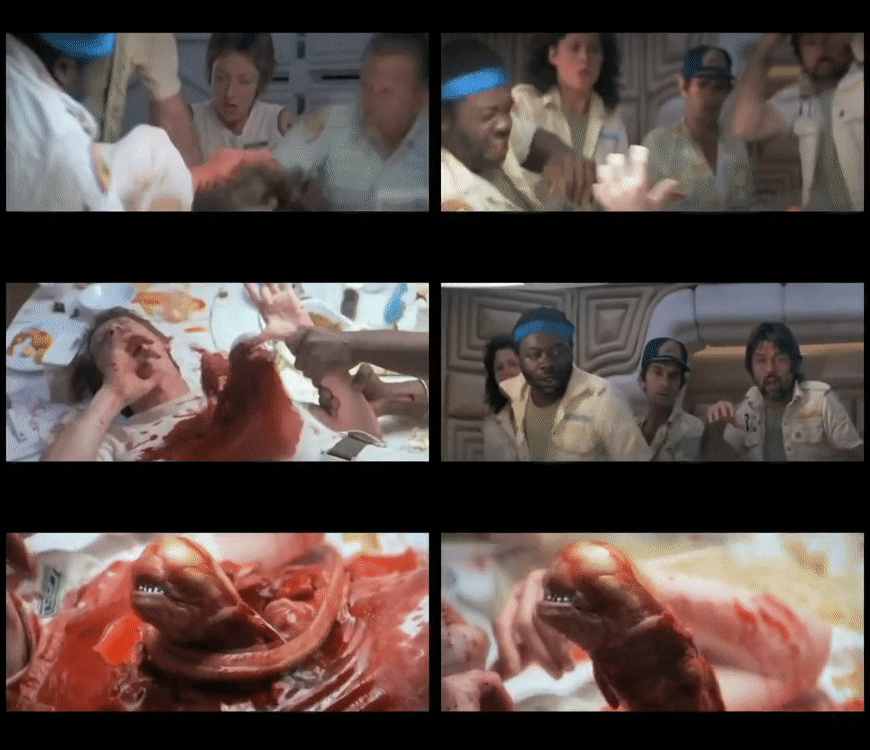
The first category is ‘Revulsion’ (Gross-out), an emotion linked to the instinctive feeling of disgust toward an occurrence that may be considered unsanitary or unnatural to the highest degree. It could be a scene in which pus or mucus is exposed in sometype of living creature, or fungi that covers the whole body. For myself, the most memorable scene in my head is the birth scene in “Alien”.


Seth Grahame-Smith on the 'viciousness' of the Stephen King's IT reboot

Secondly is ‘Horror’. Horror refers to huge events that humans do not usually experience and have little to absolute no power over. Examples of this can be the Cthulhu myth, or an apocalyptic event such as a Zombie epidemic or a Nuclear war.


Third and finally there is  ‘Terror’. King(2010) said Terror is the most sophisticated horror, which refers to an unpleasant feeling in situations where we don’t know if you are safe or unsafe. Often this comes from a lack of understanding about the situation one might be in along with little knowledge as to deal with a certain situation. 

So then where do we draw the lines between these ambiguities and uncertainties?

Obviously, it can’t specifically be called dangerous due to our lack of knowledge during such a situation, but when it comes to dealing with something that is not inherently safe or unsafe, our human brain becomes confused in judging its level of harm, which in turn leads to an unpleasant and creepy emotion.


The best examples of uncertainty are the clowns and wearable masks that many fear. Since the mask temporarily hides the face that reveals human emotions and intentions, it has the effect of isolating the object from the most basic social communication. In other words, because it blocks the primary basis for judging whether there is any expression under the mask or whether it is a harmful person or not, the ambiguity of the object is amplified, and confusion and fear of the unknown as well as uncertainty is expressed. In King’s work, Terror brings fear to the audience by using mental factors such as guilt, trauma, doubt, and paranoia of the protagonist. Also, it has the characteristic which many symbols that indirectly show the psychological state of the protagonist appear throughout the work.

This film best expresses the gloomy and terrorist atmosphere of <Pet Sematary 2019>.

Reference

Stephen King’s 3 Levels of Horror. Regal Reel. (2019, August 27). https://www.regmovies.com/static/en/us/blog/stephen-king-3-levels-of-horror.

Wikimedia Foundation. (2020, September). Pet Sematary. Wikipedia. https://en.wikipedia.org/wiki/Pet_Sematary.

King, S. (1981). Danse Macabre.
Vsauce
. (2013). Why Are Things Creepy?. https://www.youtube.com/watch?v=PEikGKDVsCc

Week 6

 What is the philosophy of cosmicism and how is it used to convey a sense of dread in both The Shadow Over Innsmouth and The Colour out of Space?

Cosmicism is a philosophical view symbolizing cosmic fear, which refers to the overwhelming despair and fear of space, disaster, and transcendental God, which appear in places like the unknown, deep-sea, and cosmic world that we have not yet recognized. Even in Lovecraft’s novel, the theme is the fear of extraterrestrial species with secrets that give us the mystery of the universe that humans cannot know or fear, which can be seen as Cosmicism. Cosmic horror is a sub-genre of horror that utilizes Cosmism. Cosmicism is based on fear, which is told with important feelings in myths and religions. These Cosmic horror are written on the subject of human fear and end nihilism in a dystopian atmosphere. Especially easily seen around us, “Alien” and “Budbox” and “The Mist” are well-known cosmic-themed films in which humans are brutally attacked and killed by unknown alien species and supernatural beings.

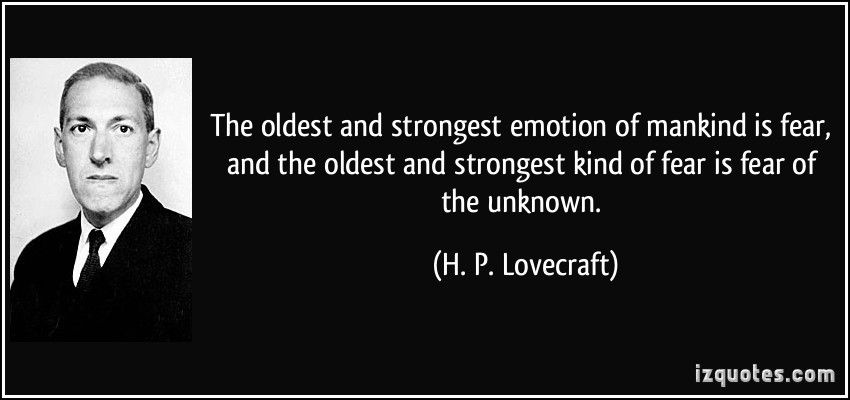
Lovecraft said this in his essay book. It is a sentence that reflects Lovecraft’s opinion of fear. To describe Lovecraft’s philosophy of work in one word, it is Cosmicism. The fear expressed in his novel has a distinct element from the visual and auditory fear revealed in the general work. The fear of unknowns, vast universes, or beings that cannot be seen, heard, or felt, is revealed in the work. The images and moods of these horror descriptions serve as a tool to express his unique sense of subject matter very well. Cosmicism is a philosophical view of fear.

Lovecraft’s creation, Cthulhu, also sleeps deep in the sea, and Dagon s also a monster living in the sea and his subordinate species, respectively. In the West, people are disgusted by marine animals, and in the case of deep-sea creatures, they are more disparate in appearance.

 The outward grandeur or creepy external portrayal of the extraterrestrial life, Old One, and Shogos or architecture can be frightening.

There could be a violent situation and a primal fear of death being slaughtered by them. However, the theme of “human beings are very insignificant” in the absolute ancient alien civilization is a typical characteristic of Lovecraft’s Cosmic Horror. This is quite out of the ordinary plot.

The horror monster shown in the general myth is the object of Oedipus overcoming. However, the monster in Cosmic Horror is like unknown mother nature that humans cannot resist.

The distinction between traditional cosmic horror is that the genre deals with cosmicism, or unknown fear, and cosmic fear. This sense of subject sets the plot apart. Thus, in general, works of the Cosmic Horror genre are tragic. In particular, Lovecraft’s unique horror philosophy is contained in “Shadow over Innsmouth”. Human beings are weak and cannot solve cases in the climax. Experience the greatest fear in the climax and fall into despair. As a result, many works face tragedy at the end of the play or merge with fear, as Nietzsche said.

Reference

Stableford, B. (2006). The cosmic horror. Icons of Horror and the Supernatural: An Encyclopedia of Our Worst Nightmares

Cosmicism. (n.d.). Retrieved September 06, 2020, from https://en.wiktionary.org/wiki/cosmicism

The H.P. Lovecraft Archive. https://www.hplovecraft.com/.

Week 5

What genre or genres is Princess Mononoke? How does it relate to its ‘prequel,’ Nausicaā ?
It is the most remarkable result of Hayao Miyazaki’s macroscopic stories, and a work that perfectly represents his ideas. This is considered one of the best works in animation history. There are also dramatic elements of the main character’s internal conflict, mental growth, awakening to the world surrounding him, and the nature of adventure elements that venture as they leave west to solve their curses. It is an animation that contains various discourse under the big ecological theme of symbiosis between nature and human beings.

Nausicaa is the only person in the film, “Nausicaä of the Valley of the Wind”, who can represent both human and natural positions. She strives for human survival, but on the other hand, she also struggles to tell the truth of nature and bring about coexistence. It was drawn in such an ideal way. In this regard, “Nausicaä of the Valley of the Wind” withholds a strong comparison to “Princess Mononoke”. 

In “Princess Mononoke”, there is no one like Nausicaa, who is a perfect idealist that represents everyone’s position. Ashitaka is a human being who can communicate with animals, but as a result, he has failed to obtain consent from the villagers for his view of nature.

San is a person who grew up with wolves in nature but was not trusted by all the members of nature in “Princess Mononoke”. A herd of wild boars and their chief, Okkoto-nushi, represent the idea that San was not trusted. Unlike the nature of “Nausicaä of the Valley of the Wind”, nature in “Princess Mononoke” is portrayed as something that can act exclusively at any time for survival.

Humans can’t unconditionally define themselves as absolute evils due to the construction of an ideal society that returns by destroying nature. This is a rare sight in the world of Nausicaa. Alternatively, the pattern of the ending is different. With Ashitaka’s efforts to somehow stop the fight, San becomes a little closer to humans, and Eboshi admits to her own mistakes and vows to make a better village. That’s why the problem-solving method, such as taking a slow step forward rather than solving the dramatic problems that Nausicaä’s sacrifice brings, was not only more realistic, but also ignited the possibility of continued development in the future.

Week 4

1. What was the cultural impact of Akira (1988), and why does it occupy a key place in the canon of anime greats?

<Akira> is considered one of the most influential SF animations of all time. Akira is even mentioned as the most important work of the time in the history of Japanese animation. It has become a novelty of the cyber funk genre and is widely popular throughout Japan and internationally.

 similar composition to the production <Akira>

Tetsuo is a monster who has gained overwhelming power after an incident. He elicits a sociological imagination of the ambivalent attributes of modern civilization of science and technology, especially of self-destructive power. Through this, we can say that the belief in “development” and “progress” related to science and technology is an empty hole in optimism about technologically civilized society.    

If Tetsuo’s superpowers were to be associated with the mythical story of Prometheus, we are able to relate this to the concept of ‘fire’. Prometheus is the most humanized god who brought fire to the human world, and he is later punished severely for his actions by Zeus. The issue that should be noted in this myth is the nature of fire in which he gifted to humanity. Fire in this myth is expected to be controlled under the power of Zeus, and human interest in fire is considered taboo. Therefore, Prometheus’ outlandish act of stealing fire and passing it on to humankind is observed to be a challenge to the gods, before it is seen as compassion towards human beings. It symbolizes the deadly nature of human desire to multiply infinitely towards divine tools.

Based on the similarity with Prometheus, I would like to interpret it as “Tetsuo,” who stole technology in a near-future. The tragic end of ‘Tetsuo’ is a punishment for self-cultivated ambitions, and also a destructive overthrow of social desires that have been the foundation of these self-cultivated desires.  

 It can be said that the main character, Tetsuo, declared the end of the Homo sapiens era in a new way. It refers to Homo sapiens who possess the knowledge on how to use tools as a means to supplement intrinsic human abilities. It also contains the narcissistic self-awareness of mankind living as the dominant species of earth. However, it is no doubt that the human body and spirit, as well as human to human network of relationships, are subordinate to technological power today when what was considered a technological tool, began to enter the human interior. Here, we use Akira to illustrate the reversal of the situation in which humans are equipped to the outcome of science and technology. Specifically, after describing a technological civilization that cannot be overcome by relying on natural human power, it shows a situation in which individuals cannot resist such an environment. The explosion of ‘Tetsuo’ makes us reflect very profoundly on the human excesses that have become the driving force. Within the direction and speed of the development of science and technology, it indicates that there is a latent instability factor that the present civilization has not realized.

References

Mountfort, P. (2020). Pop genres anime 1 Akira [PowerPoint Slides]. Blackboard. https://blackboard.aut.ac.nz/

Shin, D. (n.d.). 재패니메이션의 마스터피스, 를 봐야 하는 이유. Retrieved August 21, 2020, from https://m.post.naver.com/viewer/postView.nhn?volumeNo=9312603

Week 3

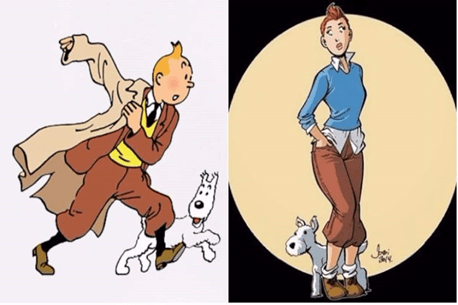
  1. How and why have Tintin’s gender and sexuality been question?

The discussion about Tintin’s gender online has been constantly debated. But the absence of female or physically attractive characters in Tintin does not represent his gender or sexuality. There is no complete sexual dimension in Tintin comics, and homosexuality is a clear choice of sexual behavior, and in this book there is no such story at all.  In Tintin comics, you can find the same answer as why no character dies. Because it’s a children’s cartoon for children’s readers. Judging gender and his sexual identity in it is a groundless generalization.

When you think about Tintin in the cartoon, there is no description of the main character’s family. There is no sexual description at all. Even him. Someone say they don’t know if it’s a man or a woman.  Not getting old, not getting age.  But this is also an advantage for readers of different ages and genders to empathize with him.  His smooth face is also a device that everyone can assimilate.

Captain Haddok or Professor Calculusis so strong that it is difficult to assimilate.

In the case of Tintin, as the series progresses, there is less clear information about which country the land is from. This can have the effect of making it easier for foreign readers to immerse themselves in the main character when the cartoon is translated into a foreign country.

Hergé intentionally made Tintin avoid the feelings of love, and in the cartoons, there were blondes and young women.

Scenes were mainly used as a means to create intrigue or action.

The lack of heterosexual love in Tintin requires some understanding of the laws of pre-World War II publications in France. At this time, the legal regulations for children and adolescents were severe. The newspaper where Tintin was serialized was also a Catholic newspaper, so it helps us understand why Tintin does not have a sexual dimension.

TinTin was made to be read by teenagers, so the moral purpose is clear.

  1. Brave. He’s up against danger.
  2. be decisive  Once you start, you don’t stop.
  3. To be dynamic.  have creativity and mechanical talent
  4. Pure. No moral defects.
  5. Be active. Take the initiative.
  6. To stand up to the strong and help the weak.
  7. Clever. Use your wisdom to get through difficulties. Or coaxing or coaxing friends to reach the same goal.
  8. Charming.
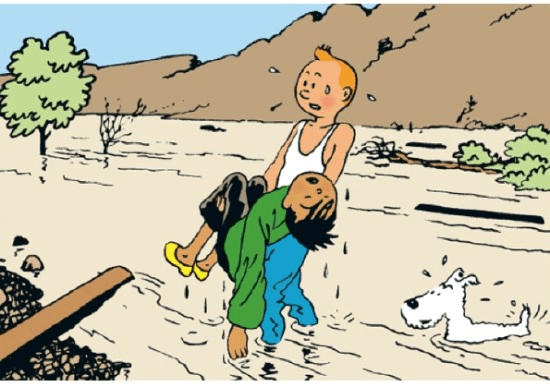
  9. He is philanthropists. He saves people from trouble without racial distinction.

Tintin to save a Chinese boy from drowning in the river

According to author Hergé, his brother is the model of Tintin. His hairstyle was the same as his brother’s hairstyle. But since Tintin became famous, my younger brother, who was a career soldier, was so stressed out that he looked like Tintin that he shaved his head. Hergé used it as a model to create a character, so the character that was born was Colonel Spons, the villain

But Tintin’s adventures are part of literature, so how to interpret them is up to the reader.

Reference

Mountfort, P. (2020). Tintin and gender part 1 [PowerPoint Slides]. Blackboard. https://blackboard.aut.ac.nz/

Mountfort, P. (2020). Tintin, gender and desire. Journal of Graphic Novels and Comics. https://doi.org/10.1080/21504857.2020.1729829