Blog Feed

Week 2

Week 2 Questions – Tintin

What issues do his albums raise in terms of representation of ‘race’, and particularly ethnic and cultural stereotyping?

The legal dispute began in 2007 when Congolese Belgian citizen Bienvenu Mbutu Mondondo filed a lawsuit against the release of the comic book, claiming that the comic book is full of racial demeanor. Mbutu argues that “it makes people think that ‘black people are savage’.”

However, the law ruled, “It is clear that this cartoon came out in 1946, when colonial thinking prevailed, and it was not intended to create a threatening, hostile or contemptuous atmosphere in the plot.”

Mbutu’s lawyer said, “Mbutu will hold on to this case as far as possible,” and said he will appeal.
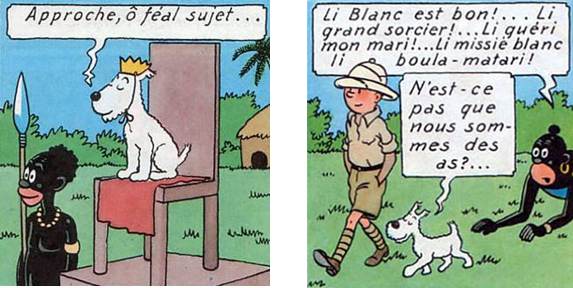
The first edition of the controversial book, <Tintin in the Congo> was published in 1946 when Congo was under Belgian colonial rule. Cartoons have explicit white supremacist views everywhere, with black natives lying flat behind Tintin and puppies, saying, “White people are very great and spiritual,” or riding on a palanquin. Tintin series portrays not only blacks but also Asian and Native Americans as a silly and barbaric image.

Hergé said in a media interview during his lifetime, “When I drew <Tintin in the Land of the Soviets> and the <Tintin in the Congo>. I was fed the prejudices of the bourgeois society that surrounded me, Africans were great big children andI drew cartoons based on that standard,” he once confessed.

Historical background

After the success of <Tintin in the Land of the Soviets>, Hergé wanted to send Tintin to the United States, but Norbert Wallez, the editor of the far right, instructed Hergé to draw a story that took place in Belgium’s ruled Congo. Wallez believed that Belgium’s colonial rule of the Congo at that time needed to be promoted, as Tintinist Michael Farr Pa pointed out. It was in 1928 when the memory of Belgian King Albert and Queen Elizabeth’s visit to the colony was still vivid. During Leopold’s reign, about 10 million Congolese died in brutal rule, such as cutting off their hands if they failed to meet their quotas. Hergé later sarcastically referred to the Congolese as “our beautiful colony that needs us very much.”

On a comparative note, a parody comic book with such racist characteristics has also been created. South African cartoonist Anton Kannemeyer (1967–) tackled the issue of racial relations and imperialism by using the style of <Tintin in the Congo>. He parodies this with Pappa in Afrika (2010), where Tintin is depicted as a white African resident, white liberal or racist, white imperialist. It satirizes the stereotype that whites are superior, knowledgeable and civilized, while whites are barbaric and stupid.

Reference

Independent Digital News and Media. Herge’s ‘racist’ adventures of Tintin? Not so, court decides. The Independent. https://www.independent.co.uk/news/world/africa/herges-racist-adventures-of-tintin-not-so-court-decides-6894770.html.

Vrielink, J. (2012, May 14). Effort to ban Tintin comic book fails in Belgium | Jogchum Vrielink. The Guardian. https://www.theguardian.com/law/2012/may/14/effort-ban-tintin-congo-fails.

Wikimedia Foundation. Norbert Wallez. Wikipedia. https://en.wikipedia.org/wiki/Norbert_Wallez.

유럽 만화의 아버지 에르제. gabiadesign. (2019, June 3). http://design.gabia.com/wordpress/?p=33469.

화상. 에르제 [Hergé] – 벨기에 만화가. 필라테리아. http://m.blog.daum.net/philook/11247978?np_nil_b=1.

Week 1

  1. How has the academic reception of popular genres changes over time?
  2. What might the value be of studying them?

As for the term ‘genre fiction’, many have pointed out problems for a long time. However, there are still no substitutes and inertial use. Genre fiction refers to a popular novel written with certain rules such as romance novel, mystery novel, martial arts novel, fantasy novel, and science fiction. Originally referred to as romance genre, mystery genre, etc., they were collectively referred to as genre fiction, but it is not known precisely when it began. It is sometimes called a subculture novel or a subgenre. Sometimes it is also used as genre fiction, but it does not mean much to write it as genre literature, as it is almost as if there is no literary form other than a novel. However, genre poetry or genre essay cannot exist, but genre criticism can exist, so it can be called genre literature in a broad sense. As it belongs to a field of popular fiction, there is a perception that it is inferior to the novels called full-scale literature or pure literature. This recognition comes from the side that holds the literary power and is spread throughout the pure literature and in the media. Although it is completely separated from the choice of the public to enjoy literature, this recognition inevitably leads to a tendency to lower genre fiction throughout society. Those who have grasped the existing literary power think of genre fiction as an enemy who still steals the pie in their domain. However, they don’t seem to have the idea of ​​being a colleague to think about the future of publishing together. This is the way to go through with changing perceptions of society as a whole. It may be difficult to take the first step in such a problem until we abandon the old-fashioned feelings that the public enjoys and considers giving pleasure to be sinful, solemnity, and agony.

There is no superiority between genres in literature. It is just that there are good and bad works. And if you read it, everyone knows. Every distinction and discrimination is only a system of knowledge created by discourses. There are many people who have gone out as advanced readers through genre fiction, and there are many examples of becoming famous writers. Your thoughts grow as large as your thoughts, and as long as your thoughts are open, you can accept them. Is it all up to you to think about it?

Moreover, genre fiction, which shows off its more significant influence in the era of cultural industry, is at the root of the discovery of cultural archetypes of each nation and strategies for content creation. Also, the solid foundation of the cultural industry is being combined with various cultural industries such as video and music, thereby maximizing its marketability and helping to secure competitiveness. Shortly, world culture icons will flow in the form of a combination of cultural industries such as video, music, and games, and genre fiction is advantageous in bringing out commerciality as one of the cultural industries. In other words, the study of genre fiction will become an increasingly important keyword in the cultural industry in the future. Therefore, it is more important than anything else to have marketability and competitiveness. In particular, since genre fiction is an essential new growth engine of high added value, strategic research is needed.

Reference

The 17 Most Popular Genres In Fiction – And Why They Matter. (2016, January 15). Retrieved July 30, 2020, from https://www.writerswrite.co.za/the-17-most-popular-genres-in-fiction-and-why-they-matter/

Herold. (2019, January 30). Book Publishing Market Overview for Authors – Statistics &amp; Facts. Retrieved July 30, 2020, from https://bookadreport.com/book-market-overview-authors-statistics-facts/

Tale Foundry. (2016). Are Movies Getting Dumber? — “Genre Fiction vs. Literary Fiction”. https://www. https://www.youtube.com/watch?v=GVCtWZSt58w

Mountfort, P. (2020). AUT Blackboard. Popular Genres ENGL602. Powerpoint Week 1. Retrieved from https://blackboard.aut.ac.nz/webapps/blackboard/content/listContent.jsp?course_id=_96250_1&content_id=_5273101_1&mode=reset  

Week 9 Question

1. According to Mountfort et al. (2018), what are the three main genres of cosphotography, and how did they historically develop?

Cosplay fan conventions are known to have developed genres of cosphotography, where people in cosplay do more than wearing costumes, make-up and prosthetics (Mountfort et al, 2018). Cosplay photography is inclusive of poses and gestures made by cosplayers, which is a part of the fan capital; not only does it provide a private value in fan capital, it also gives cosplayers a chance to network and form or join communities that express similar cosplaying interests (Mountfort et al, 2018). The concept of cosplay photography can be traced to its emergence circa 1908 in the United States; William Fell of Cincinnati dressed up as ‘Mr Skygack’ in a masquerade ball (Mountfort et al, 2018). The three main genres of cosplay photography are known as firstly the ‘runway’ snapshots that originated from cosplay costume conventions, the second as ‘hallway’ photography where cosplayers were photographed in informal convention spaces, and the third that developed from hallway snapshots to ‘studio portraits’ (Mountfort et al, 2018).

As the most formal genre of photography, costume convention photography or also known as ‘runway’ snapshots encompassed cosplayers that participated in convention competitions held on stages or runways (Mountfort et al, 2018). Mike Resnick’s account of the annual masquerade that inaugurated in 1940 narrates the first formal photography, while informal photographs were taken in 1939 (Mountfort et al, 2018). Formal cosphotography implied consent from cosplayers to be photographed. With such a distinction in formal and informal convention spaces, it led to the creation of two more genres as known today, those being the ‘hallway’ and ‘studio portraits’. This was enabled through technological advancements and the emergence of mass media, along with cameras that had become affordable to the public (Mountfort et al, 2018). Polaroids and instamatics from the 1950s and 1960s respectively largely contributed to black-and-white photography (Mountfort et al, 2018). Cosplay competitions resembled practices and aesthetics of fashion shows, as photographers would constantly capture different cosplayers and cosplayers would pose or catwalk on stage to display costume capital (Mountfort et al, 2018).

Hallway photography is the least formal genre of cosphotography; cosplayers are often caught out of act while being photographed which explains informality (Mountfort et al, 2018). The Mike Resnick account of the informal snapshots of 1939 convention is the first account of ‘hallway’ or informal cosphotography (Mountfort et al, 2018).  Hallway photographs are taken by an assembly of varied photographers, snapshots that range from DSLRs to contemporary media such as smartphones; these lack the specific setting in terms of backdrop and lighting (Mountfort et al, 2018). It is argued that this genre of photography is quite invasive as it occurs sans the consent of cosplayers, but Bordieu (1965) put forth his view of the ‘natural pose’, wherein humans instinctively pose toward cameras as ‘out of respect’ (Mountfort et al, 2018). Nonetheless hallway snapshots are more spontaneous than a preparation of capturing the essence of the cosplayers’ characters.

Studio portraits as the third main genre of cosplay photography emerged in the 1970s, also known as an amalgamation of the first two genres (Mountfort et al, 2018). The term for the genre ‘studio portraits’ derived not from shooting in private locations but in designated convention spaces that comprised of settings such as lighting and backdrop (Mountfort et al, 2018). Much of this cosphotography would take place during or after the convention. One of the first accounts of such genre’s photography was Angelique Trouvere posing as Vampirella in 1969, which displays aspects of studio features along with character poses (Mountfort et al, 2018). Initial studio cosphotography were staged with plain, more commonly solid colour and fabric backdrops and minimal props; contemporary studio cosphotography consists of far more props and use of advanced technology such as blue-screens (Mountfort et al, 2018). Studio snapshots often resemble fashion shoots because of its professional aspects in photography, but is mainly regarded as a fusion of hallway and runway style cosphotography (Mountfort et al, 2018).

References

Mountfort, P., Peirson-Smith, A., & Geczy, A. (2018). Planet cosplay: Costume play, identity and global fandom. Intellect.

Week 5 – Anime

What genre or genres is Princess Mononoke? How does it relate to its ‘prequel,’ Nausicaā ?

In terms of genre Princess Mononoke is a jidaigeki, the Japanese term for “era drama”, with many fantasy elements. It takes place in the Japanese Muromachi period and includes depictions of creatures inspired by Japanese mythology, but they are still unique creations from Miyazaki as he was “creating an essentially personal mythology” (Cavallaro, 2006). Within the historical fiction/jidaigeki aspects of the film’s genre, it is important to note that the Muromachi era of Japanese history is one where “in Miyazaki’s view, the fourteenth century is a period of historical transition from a world that was still in close contact with both natural and supernatural forces to a world that would become increasingly oriented toward the human.” (Napier, 2001). In this period of time Miyazaki believes the relationship between humans and nature shifted to one where humans began to shape nature around ourselves and our wants.

It is very early in the film that Miyazaki brings in the fantasy elements and tackles the main theme of the film, nature vs human technology. In Princess Mononoke the conflict is between the people of Irontown and the spirits of the nearby forest. The people of Irontown, in the pursuit of money and use of new industrial technology, are destroying the nearby forest and have angered the gods who dwell within it. Miyazaki’s conflicting love of technology and of nature is featured in most of his works, but none more than Princess Mononoke and Nausicaa of the Valley of the Wind. While is was made before Mononoke, Nausicaa is almost a sequel of the themes shown within Mononoke.

Nausicaa of the Valley of the Wind is a post-apocalyptic fantasy about a post-apocalyptic war world where most of Earth’s eco-system has become toxic and the few human survivors live separated by a toxic jungle swamp called the Sea of Decay. The themes of this story are of environmental destruction and the collapse of civilisation. For Miyazaki, the inclusion of apocalyptic themes in stories about the relationship between us and nature is paramount. It is clear from his works that he fears the impact humans have on the environment and knows that our future generations will have to live with the consequences.

Both Princess Mononoke and Nausicaa of the Valley of the Wind showcase Miyazaki’s belief in the conflict of humanity against nature. Mononoke shows the point in history in which humans began to turn against nature rather working with it, whereas Nausicaa shows us a potential future living with the consequences of out actions.

Reference List:

Cavallaro, D. (2006). Anime Art of Hayao Miyazaki. Jefferson: McFarland & Company, Incorporated Publishers.

Jidai-geki. (n.d.). Retrieved October 01, from https://www.britannica.com/art/jidai-geki

Morgan, G. (2015). Creatures in Crisis: Apocalyptic Environmental Visions in Miyazaki’s Nausicaä of the Valley of the Wind and Princess MononokeResilience: A Journal of the Environmental Humanities 2(3), 172-183. https://www.muse.jhu.edu/article/614511.

Napier, Susan. Anime: From Akira to Princess Mononoke. New York: Palgrave, 2001.

Week 4: Anime

What was the cultural impact of Akira (1988), and why does it occupy a key place in the canon of anime greats?

Anime began to get increasingly popular in the 1960s and 1970’s it appealed to a large audience especially children because it was entertaining and the animation itself was captivating which is one of the reasons it gained recognition. Later on, the release of Akira an animated Japanese movie made in 1988, directed by Katsuhiro Otomo, had a significant impact in the anime world because of billions of yen being invested to create this film. Akira is set in a post-apocalyptic future after the third world war and Tokyo has become a ‘neo-Tokyo’ where a member of a biker gang has been kidnapped by a secret government agency and his friends try to rescue him.

The opening scene to Akira where the audience sees a bomb explosion this to signify both the Hiroshima and Nagasaki atomic bomb explosion and the media revolution (Bolton 2018) We later see that the explosions we see in the opening scene of the film this was due to Tetsuo who developed telekinetic powers which influenced Akira making her cause the explosion. Another example we see in the film where there is a cultural impact is the scene where we see a crumbling wall with three panels this is to signify the war that was occurring in Serbia where a Japanese critic Ueno Toshiya paid a visit. In Serbia, Akira was seen to a iconic anime because it showed political resistance which was a rare thing for anime movies to do at the time making it occupy an important place in the canon of anime greats.

Akira has also had a significant impact in the world of arts it inspired a lot of animators and it still does today. Before the release of Akira anime was seen to be for children, there hadn’t been a more influential Japanese animated film ever made because of the amount of money and advanced animation technicians used to create this film. Akira was the first film where western audience were infatuated with the story line, artistic Japanese animation and technical work that went in to creating the film. Now many directors and writers cite Akira as an inspiration for their work such being the Duffer brothers who created ‘Stranger Things’ have said ‘the influence of Akira was obviously a big one’ Chu, H. (2018). The Duffer brother were just one of many creators that were influenced by Akira and they probably won’t be the last because even after 32 years of its initial release the film Akira still manages to influence many creators work which makes it so deserving in the canon of anime greats.

References

Chu, H. (2018). Why the pioneering Japanese anime ‘Akira’ is still relevant 30 years laterhttps://www.washingtonpost.com/entertainment/why-the-pioneering-japanese-anime-akira-remains-relevant-30-years-later/2018/07/12/b7577c74-813f-11e8-b851-5319c08f7cee_story.html

Mountfort, P. (2020). ENGL602 Popular Genres: Lecture 4/Week: Anime 1_Akira_2020 [PowerPoint slides] AUT Blackboard. https://blackboard.aut.ac.nz/

Bolton, C. (2018). Interpreting anime. University of Minnesota Press. 

Week 8: Cosplay

In what ways can cosplay be understood in terms of notions such as affect, transportation, transubstantiation and mediated fantasy? 

Cosplay is an art of entertainment which combines costume and role play. Participants known as cosplayers will play virtual roles by copying the outfits, the mannerisms and gestures of those particular characters (Mckay, 2019). The term of cosplay was convinced from the Japanese term “Kosupure” by a Japanese animation director Nobuyuki Takahashi (Runnebaum, 2019), who witnessed Western sci-fi costume culture and activities, and brought this popular culture into Japan, making some anime lovers dress up as Japanese anime characters. Since then, Japan has become a place to promote the culture of cosplay.

Cosplay can be interpreted as mediated fantasy. The cosplayers bring themselves into illusory roles from anime or fictional works by acting as virtual characters, transforming themselves into the dreamy and perfect self like anime. Thus, leaving the seemingly ordinary and humble of themselves from reality. This is also called as psychological transportation.

Psychological transportation, in simple terms, is to transform oneself into another character, as Mountfort (2018) said the ability to mimic an animated body and activate virtual characters, and cosplayers will achieve psychological pleasure and satisfaction through cosplay, Just like us need to relieve the stress of life through interests or hobbies. As according to Rahman & Cheung(2012), cosplaying provides performers with a momentary escape from the stresses and monotony of ordinary life; and allows them to enter into a whimsical dream of fantasy.

This is another kind of affective of transformation. The strength of the personality of a cosplayer will be affected by the role he/she plays, that is to put themselves into a specific role, not only the body, but even the personality will be affected by imitation, this is also called an intense corporeal response (Mountford, 2018). For example, a person who tends to be shy, once dressed as an anime character, he/she will be confident and put more efforts to perform in accordance with the level of the role he/she plays. However, this phenomenon is also called Proteus effect, that is cosplay is an asemic medium, the behaviour of the character may become intertwined with a participant self, once that individual exists that role, he/she will take on traits of that role for while, eventually leading to split personality (Lesher, 2017). This is a critique of cosplay is wrong, because there are many controversies, as according to Mountfort (2018) relationships between cosplayers with the source text and the role-playing of popular media avatars are often complex and parodic, in the end, they are merely performers to perform within a certain range. Proteus effect is wrong towards cosplay because ordinary people like us grow up through the influence of the surrounding environment to produce some kind of personalities, but ordinary people do not have the hobby of cosplay.

Finally, cosplay is an emotional and spiritual feeling. Fans of anime love to see the virtual characters to be realized in realistic forms by the cosplayers. For example, the traits of cool, hot, sexy, and cute in the animation are realized or activated. Because of the enthusiasm of fans, cosplayers are highly valued like celebrities, and it also gives cosplayers greater confidence and energy to promote cosplay culture (Rahman & Cheung, 2012). For participants, fictional characters also have personality and emotions, which are self-projection. Therefore, cosplayers are knowledgeable about the characters based on their own experience and regard the characters as their peers. Cosplayers do not play cosplay for being unique, but their love and passion of anime and their ability to improve their self-concept via cosplay, it can be said as the process which they build their self-image.

Reference:

McKay, R. (2019). Cosplay: Everything you need to know about it. Are Media. Retrieved https://www.who.com.au/what-is-cosplay

Runnebeum, A. (2019). The origin of Cosplay. Japan Daily. Retrieved https://japandaily.jp/the-origins-of-cosplay-6598/

Mountfort, P., Peirson-Smith, A., & Geczy, A. (2018). Planet cosplay: Costume play, identity and global fandom. Intellect Bristol,UK/Chicago, USA. Retrieved https://blackboard.aut.ac.nz/bbcswebdav/pid-5343828-dt-content-rid-12985577_4/institution/Papers/ENGL602/Publish/Mountfort%202018_Planet%20Cosplay_Intro%20and%20Chaapter%201%20Cosplay%20as%20Citation.pdf

Rahman, O., Wing-Sun, L., & Cheung, B. H. M. (2012). “Cosplay”: Imaginative self and performing identity. Fashion Theory16(3), 317-341. https://doi.org/10.2752/175174112X13340749707204

Leshner, C. E. (2017). Theories and implications of the Proteus Effect on cosplay. The Phoenix Papers3(1), 46-55. Retrieved https://www.researchgate.net/profile/Connor_Leshner/publication/321170271_Theories_and_Implications_of_the_Proteus_Effect_on_Cosplay/links/5a130b150f7e9b1e572c2f47/Theories-and-Implications-of-the-Proteus-Effect-on-Cosplay.pdf

Week 9 Question: According to Mountfort et al. (2018), what are the three main genres of cosphotography, and how did they historically develop?

1. According to Mountfort et al. (2018), what are the three main genres of cosphotography, and how did they historically develop?

Cosphotography is a genre of photography that is mostly seen at conventions where photography of people in cosplay is taken with a range of different modes and settings. The idea of photographing people in costume has existed far before the notion of cosplay with perhaps the earliest account of cosphotgraphy according to Mountfort (2018, p. 48) being from “the United States from around 1908, when William Fell of Cincinnati attended a masquerade ball held at a skating rink in Ohio dressed as Mr. Skygack.” Cosphotography includes several different genres the first being officially conducted costume competitions at conventions and secondly, the genre labeled hallways snapshots where photographs of people in cosplay are taken in convention spaces. Later in the 1970s, a third genre of cosphotography had begun, this being the studio portrait.

Official costumes competitions are the most formal genre of cosphotography that appear within conventions and feature multiple attendees of said convention who are in cosplay that participates in the costume competition, typically on a stage or runway. By presenting themselves on the runway cosplayers are consenting to photographs of their cosplay being taken and want to be seen in a more formal setting. Cosplayers will often try to act in character to heighten their performance on the runway. This genre of cosphotography emerged in “the annual Masquerade originally a kind of fancy dress ball was inaugurated at the 1940 Chicago conference” (Mountfort, 2018, p. 50). A reason for the genre’s inception may have been developments in camera technology and that technology becoming widely available to the public with affordable models.

Hallway snapshots are the least formal cosphotography genre and do not require the cosplayer’s consent, photographs taken in this style of cosphotgraphy are almost entirely shot within hallways of the convention center or inside the convention itself. Like with the official costume competitions the hallway costume emerged in the late 1930s and “casual shots are in evidence from 1939 (Mountfort, 2018, p. 50). As mentioned, hallway snapshots are far less formal than the other two genres of cosphotography and the lack of consent is a reason for this with photos looking heavily out of character. Angles are often unflattering and can show cosplayers performing mundane tasks or taking a break from the main floor.

The final genre of cosphotography is the studio portrait although the name is similar to a fashion shoot, done within a private location, and photographers hired specifically for the photoshoot, and professional cosplayers may do something along those lines. The staging is generally done in or around the convention center and not a dedicated studio. The studio portrait emerged in the 1970s, an early star of the studio portrait was Angelique Trouvere who cosplayed characters like Red Sonja and Vampirella. Studio portraits are just as formal as the costume competitions although the difference between the two is that “many of these carefully modelled shots resemble fashion studio photographs more than runway and hallway snapshots” (Mountfort, 2018, p. 51). The framing of the studio portrait is intended to look more professional; cosplayers and their photographers achieve this by selecting a photogenic location around the convention center. It results in photographs that can cleverly pass as professional without the cost associated with renting a studio space.

References

P, Mountfort. (2018). Planet Cosplay. Bristol, UK; Intellect Books.

Week 8 Questions – Cosplay

  1. Referring to Mountfort et al. (2018), in what ways is cosplay analogous to citation?

Cosplay, more or so often refers to the promoted phenomenon known to be “costume play.” With establishes situated in both American and Japanese culture, it includes the demonstration of taking on the appearance of a character. The word “cosplay” itself correlates to the demonstration of getting changed into such ensembles in order to reproduce the presence of a character from a work of fiction. Mainstream types of cosplay include dressing yourself up in the outfits of characters from for example: computer games, comic books, well known anime, cartoons and additionally movies of more or so realistic nature, and so on.

Cosplay can tend to also include dressing for non-character costumes that could be unrelated to any series or movie. Such as for example dressing up in school uniform (often more popular amongst females). The concept of cosplay is generally viewed as a sort of execution workmanship, as the individual endeavors to move their personality to the character they are ‘cosplaying’ using ensembles, adornments, even motions and mentalities in an approach to embrace the persona of the character. It tends to be viewed as that the individual possesses the part of this character which is both true and intellectual. That being said, the idea and uses of cosplay in today’s time is a means of engagement in terms of culture. It can both be seen in person ( especially in conventions of manga/anime or conventions such as comic con/armageddon) as well as on the online community. Asides from that they (cosplayers) also tend to have their own cosplay communities (Mountfort et al, 2018).

The idea of cosplay is very different due to an element which then isolates it from other means of costume exhibitions like festivals, theater or circus. The element being that cosplay relies generally upon messages from present or overall popular types of media. A source or a reference text is required, and this is the place the fundamental motivation for a cosplay is gotten from. Another component which recognizes cosplay from theater or potentially screen exhibitions is simply the length of the given overall execution.

A cosplayer doesn’t reproduce/showcase the whole content/plot of their picked text. They often just perform what can be called ‘portions’ of the first source of the text, ones which the cosplayer himself/herself sift through as being critical to the real exhibition. In correlation to that, cosplay can be viewed as a type of reference as cosplayers ordinarily reference their picked text, and play out a large number of citational acts (Mountfort et al, 2018). This is more or so because it is the cosplayer’s own costumed body which at that point goes about as the content or as a ‘cite’ referring to a book, on such accounts of cosplay, this would be the particular media source which is picked by the cosplayer to be performed. This overall brings the theme of citation to full circle.

References:

Mountfort, P. Pierson, Smith, A. Geczy, A. (2018) Planet Cosplay Intellect Books.

Week 9 Questions

1.According to Mountfort et al. (2018), what are the three main genres of cosphotography, and how did they historically develop?

Just as fan customs have historically achieved advances in specific genres of “cosphotography,” photography and video have served as formation agents as well as reflections on how cosplay is performed. Cosphotography appears as a target of cosplay itself. In the early days, cosplay is almost entirely based on the characters present in multi-media original text, so that, unlike modern cosplay, many costumes made by practitioners have emerged as imaginative predictions of future fashion and trends, and specific source text has been derived from providing a range of interpretations of how the characters are seeing themselves. Whereas, modern cosplay is almost entirely based on the characters present in multi-media original text so that they can accurately model the appearance and behaviour of the characters.

Photographers who take pictures of cosplayers should have an understanding of the characters and genres they are trying to shoot and draw the pose or composition of the course. Also, photographers shoot various cosplayers in three different genres: Runway, Hallway and Studio portrait.

Their history begins at the first Worldcon of the 1939 World Fair. According to Mountfort et al.(2018), early Worldcon’s costuming provided important models for cosplay to be adopted and presented costumes in two major convention settings: one was a costume contest derived from the annual formal masquerade and the other was a hallway costume in informal convention spaces. “These formal and informal convention settings facilitated the emergence of two distinct photographic genres”(Mountfort,2018). It means Runway and Hallway. The runway is linked to a fashion show or fashion magazine and requires a lot of preparation and planning before taking pictures, and produces a perfect look at the course player through correction or special effects. At the same time, the Hallway appears in the form of a quick snapshot, emphasizing naturalness and creating a more relaxed atmosphere than the runway.

Mountfort et al. (2018) explain that Polaroids soon augmented black-and-white photography in the 1950s and by the 1970s, the third genre of photography, studio portraits, became prominent overtime. Studio portraits are composed of the communication of photographers and course players, presenting more detailed and carefully modeled photographs than the previous two genres. However, the production of such pictures is also considered a combination of both genres, mainly because they are performed in temporary environments, not in real studios. But over time, due to the development of various media, “High- definition phone cameras and 4k video have made the comparatively spontaneous hallway shot both easy to shoot and share, and so hallway photography remains the most ubiquitous form, if perhaps lacking the cache of runway and studio styles”(Mountfort, 2018).

References

Mountfort 2018, Planet Cosplay (Bristol, UK: Intellect Books), Chapter 2

Q week 9

2. In what ways can cosphotography be understood as a form of “fan capital”?

Cosplay is a medium where a person performs fragments of a character, during this performance textual citation and photographic practices are combined and “some-times collide.” (Mountfort, 2019). With photography you can both document and arrange different elements of the cosplayer’s performance “via visual genres typically spanning those of the fashion run-way, studio and ‘hallway’ shoots” (Mountfort, 2019).
According to Mountfort (2018) photography plays a significant part in modern cosplay, although
cosplay was documented as early as in 1939 at the New York Worldcon, foreshadowing the emergence of the three genres of cosphotography, “the fashion-shoot, studio portrait and ‘hallway’ snapshot.” (Mountfort, 2018). Over time fan conventions have further formed the development of the cosphotography genres. Photography and film are now acting as a shaping agent in how cosplayers act out their performance. Cosplay can be very time consuming and cost a lot of money, and cosplayers might hope they get something or some form of capital in return for their hard work. By being photographed and filmed the cosplayer can achieve tokens of private value and fan capital that circulates online and reaches a bigger audience. Photos and video can serve as a token of value, not necessarily in the form of money but in the shape of subcultural capital and happiness.   Cosphotography aren’t limited to online publication, but is also being published in books, sold as prints, coscards and as film and media files, you also have the concept of cosplay music videos (CMVs).


There are a lot of tension surrounding cosphotography, Mountfort (2018) mentions the issues between fan-directed cosplay and commercial cosplay and the “heterotopian and hegemonic control of cosplaying spaces”. Heterotopian meaning a vision of the cosplay community as a progressive/transgressive space where people can “enact a kind of collective détournement in the mass requisitioning of intellectual property from their legal rights holders and make it their own.”
On the opposite side you have the threat: commercialism, sexism and racism. You also have “flaming and body shaming” which can create a nasty vibe, especially on online forums.
 Because the cosphere is a community where visual tokens are in the centre of attention and exchanged between people, it is likely that these tensions will continue to circulate within the community.
The commercial space and other social forces is a constant threat to the heterotopian side of cosplay, reality TV series such as Heroes of Cosplay and Cosplay Melee are being criticised for turning into a competitive sport rather than a collaboration or ‘team work’ between the people in the cosplay community (Mountfort, 2018).

Cosphotography can be understood as a for of fan capital because it can function as a currency, as mentioned earlier it creates personal value for the cosplayer but the photos/videos created are also a valuable item to fans of cosplay or of the character the cosplayer is portraying. Just like hard cash it can be traded from photographer to cosplayer (or vice versa), from photographer to fan or between cosplayer and fan. It can increase the popularity of both the photographer and cosplayer, and it can provide the fan with the most valuable thing of them all; happiness.

Sources:

Mountfort 2018, Planet Cosplay (Bristol, UK: Intellect Books), Intro and Chapter 1

Mountfort 2018, Planet Cosplay (Bristol, UK: Intellect Books), Chapter 2

Mountfort 2019, Cosplay at Armageddon Expo